




Description
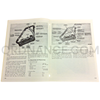
U.S. Army Technical Manual TM 9-1290-200-15 for M1 and M1A1 Gunner’s Fire Control Quadrants, May 1966
Item Overview
This U.S. Army technical manual covers the M1 and M1A1 Gunner’s Fire Control Quadrants. Issued as TM 9-1290-200-15 in May 1966, it provides operating and maintenance information for the M1, FSN 1290-674-0631, and M1A1, FSN 1290-891-9999. These portable precision instruments were used to measure, set, and check weapon elevation. This listing is for the technical manual only. It does not include a quadrant, carrying case, artillery piece, vehicle, weapon, or other equipment.
Publication Details
This manual was prepared for operators and maintenance personnel responsible for keeping the M1 and M1A1 quadrants accurate and serviceable.
- Manual number: TM 9-1290-200-15
- Publication date: May 1966
- Models covered: M1 and M1A1
- M1 Federal Stock Number: 1290-674-0631
- M1A1 Federal Stock Number: 1290-891-9999
- Equipment type: Portable artillery fire-control instrument
- Manual level: Operator, organizational, direct support, general support, and depot maintenance
- Issuing authority: Headquarters, Department of the Army
- Country of origin: United States
- Item included: Technical manual only
Manual Coverage
The “15” suffix identifies a manual covering maintenance from the operator level through depot support. Its subject matter includes operation, handling, inspection, cleaning, preventive maintenance, troubleshooting, adjustment, repair, calibration, and final testing. Procedures such as micrometer and end-for-end tests helped personnel find measurement errors and determine whether a quadrant was accurate enough for service.
About the M1 and M1A1 Quadrants
The M1 and M1A1 are portable precision leveling instruments used to lay artillery weapons in elevation, measure their elevation angles, and check mounted fire-control equipment. Each instrument uses a sector-shaped frame, adjustable radial arm, graduated scales, micrometer control, level vial, and two pairs of machined shoes. These shoes provide separate reference surfaces for low- and high-angle readings.
Differences Between the Models
The M1A1 retained the basic design and operating method of the M1. Its main changes included a micrometer mask and a matching mask key on the leveling radial arm. These features helped control and protect the micrometer setting while preserving the simple mechanical operation that made the original M1 dependable.
Role in Fire Control
Correct gun elevation is critical because a small angle error can move a projectile far from its intended target. A crew placed the quadrant on prepared seats or a leveling surface and moved the weapon until the level bubble was centered. The instrument could apply an ordered quadrant elevation, measure a gun tube’s angle, level a cannon, or check the adjustment of another sighting device.
Weapon-System History
The M1 and M1A1 quadrants were general-purpose instruments rather than parts of one weapon system. They supported towed artillery, self-propelled guns, howitzers, mortars, antiaircraft mounts, armored vehicles, and other weapons requiring accurate elevation settings. Army references document their use with systems including the M109 and M109A1 155mm self-propelled howitzers, M107 175mm self-propelled gun, M110 8-inch self-propelled howitzer, and M115 8-inch towed howitzer.
Historical Background
Gunner’s quadrants developed from much older tools used to measure cannon elevation. The U.S. M1 was standardized during the World War II period and represented a compact, durable version of this traditional instrument. The M1A1 carried the same design into the postwar era with minor improvements. This May 1966 manual dates from the Cold War and Vietnam War period, when the Army was placing greater emphasis on mobile artillery and mechanized forces.
History of Use
Artillery and armored-vehicle crews used these quadrants during firing missions, boresighting, tube leveling, sight adjustment, maintenance inspections, and training. Maintenance personnel also used them as independent standards when checking a weapon’s mounted elevation quadrant or telescope system. Because they required no batteries or external power, the M1 and M1A1 remained useful alongside newer mechanical and electronic fire-control equipment.
Collector and Research Value
TM 9-1290-200-15 is a useful reference for collectors, museums, restorers, and historians studying American artillery instruments. Its coverage of both models helps document the development from the World War II-era M1 to the Cold War M1A1. The manual can also assist with identifying components and understanding period testing, adjustment, and maintenance procedures.
Condition
This vintage military technical manual may show cover wear, edge wear, folds, yellowing, stains, writing, stamps, punched holes, loose pages, or other signs of age and storage. Printing details and condition may vary between available copies. Please check the pictures for the general condition of the item.
Ideal For
This manual is well suited for collections, restoration projects, research libraries, and displays focused on artillery and military fire-control equipment.
- U.S. Army technical-manual collections
- M1 and M1A1 Gunner’s Quadrant research
- Artillery fire-control displays
- Military instrument restoration
- World War II and Cold War exhibits
- Museum and archival collections
Approx length 8", Approx width 10", Approx height .2", Approx weight .2lbs.
Pictures are stock images of our inventory. Unless otherwise noted, you will not be receiving the exact item shown in the pictures. The pictures are representative of the item’s general condition. The item you receive might be slightly better, or worse, condition than was shown in the pictures.
Please visit our page about order lead times here: Order Lead Times.