


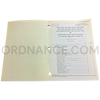

Description
U.S. Army Technical Manual TM 9-1270-201-34P for XM58 Antioscillation Sighting System, July 1972
Item Overview
This U.S. Army technical manual provides higher-level repair-parts and special-tools information for the XM58 Antioscillation Sighting System, part number 10527235. Issued as TM 9-1270-201-34P in July 1972, the manual supported the sight used with the M22 helicopter guided-missile armament subsystem. This listing is for the technical manual only. It does not include an XM58 sight, M22 launcher, helicopter, missile, mount, electronic equipment, or special tools.
Publication Details
The “34P” suffix identifies this publication as a direct-support and general-support repair-parts and special-tools list, including applicable depot-level items. It was intended for trained maintenance and supply personnel working with the XM58 sighting system.
- Manual number: TM 9-1270-201-34P
- Publication date: July 1972
- Primary subject: XM58 Antioscillation Sighting System
- Part number: 10527235
- Manual type: Repair parts and special tools list
- Maintenance level: Direct support and general support
- Associated subsystem: M22 Helicopter Guided Missile Launcher
- Aircraft application: UH-1B and UH-1C Iroquois helicopters
- Associated missile: AGM-22B, formerly designated SS-11B1
- Item included: Technical manual only
Manual Coverage
This publication helped maintenance personnel identify and order authorized XM58 repair parts, assemblies, subassemblies, and special tools. A parts manual of this type commonly organizes components through illustrated figure and item references, official nomenclature, part numbers, and supply data. It should not be confused with an operator’s manual or a complete repair-procedure manual.
About the XM58 Sighting System
The XM58 was an electrically powered, gyro-stabilized sight created for helicopter-launched guided missiles. It used a six-power telescope with a 12-degree field of view to help the operator acquire and follow a target. Its stabilized gimbals reduced the effect of helicopter vibration and attitude changes, helping keep the target and missile within view during flight. A line-of-sight indicator also showed the pilot when the helicopter was pointed along the sight’s viewing line.
Guidance and Operation
The XM58 did not guide the missile automatically. After launch, the operator watched a flare on the missile’s tail through the stabilized telescope and used a small control stick to correct its flight. Commands traveled to the missile through wires that unreeled behind it. The stabilized sight made this manual guidance more practical from a moving helicopter, although turbulence and combat movement still made the task difficult.
M22 Weapon-System History
The M22 was an early U.S. Army helicopter antitank missile system developed around the French Nord SS-11. The Army acquired the SS-11 system in 1961 and adapted it for the UH-1 Huey. A complete M22 installation carried six AGM-22B wire-guided missiles, with three mounted on each side of the helicopter. The XM58 sight was one of the system’s most important improvements because it gave the missile operator a steadier view from the vibrating aircraft.
History of Use
The Army first deployed M22 systems to Vietnam in 1966. On October 9 of that year, UH-1B crews used the missiles against bunkers during operations in Binh Dinh Province. Additional deployments followed in 1967 and 1972, and the system was also stationed in Europe. M22 crews attacked tanks, bunkers, and other fortified targets, but the missile required a skilled operator and steady visual tracking throughout its flight.
Historical Importance of the July 1972 Manual
This manual was published during the M22’s renewed Southeast Asia deployment in 1972. That period also saw the arrival of newer airborne TOW missile technology, which offered improved performance and gradually replaced the AGM-22 system. The M22 returned to the United States in 1973, but it remained part of the Army inventory for several more years. TM 9-1270-201-34P therefore records a key transition between early manual-guided helicopter missiles and later antitank systems.
Collector and Research Value
This manual is a specialized reference for studying the XM58 sight, M22 armament subsystem, AGM-22B missile, and armed UH-1 Huey. It also documents the repair-parts system used to support complex optical, gyroscopic, and electronic equipment during the Vietnam War.
Condition
This vintage military technical manual may show cover wear, edge wear, folds, yellowing, stains, writing, stamps, punched holes, loose pages, or other signs of age and storage. Printing details and condition may vary between available copies. Please check the pictures for the general condition of the item.
Ideal For
This manual is well suited for collections, research projects, restorations, and exhibits covering Vietnam War aviation and early helicopter missile systems.
- U.S. Army technical-manual collections
- XM58 sighting-system research
- M22 launcher and AGM-22B missile displays
- UH-1B and UH-1C Huey research
- Vietnam War aviation collections
- Military optics and gyroscopic-system research
- Museum and archival collections
Approx length 8", Approx width 11", Approx height .25", Approx weight .5lbs.
Pictures are stock images of our inventory. Unless otherwise noted, you will not be receiving the exact item shown in the pictures. The pictures are representative of the item’s general condition. The item you receive might be slightly better, or worse, condition than was shown in the pictures.
Please visit our page about order lead times here: Order Lead Times.