




Description
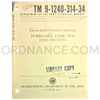
U.S. Army Technical Manual TM 9-1240-314-34 for M36 Tank Periscope, June 1964
This U.S. Army technical manual covers direct-support and general-support maintenance for the M36 Tank Periscope. Issued as TM 9-1240-314-34 in June 1964, it was prepared for trained personnel responsible for servicing this specialized day-and-night optical sight. This listing is for the technical manual only. It does not include an M36 periscope, periscope mount, infrared equipment, weapon, tank, or other optical components.
About the M36 Tank Periscope
The M36 was a tank commander’s sight designed for observation and fire control from inside the armored cupola. It combined a wide unity-power observation window with separate magnified daylight and active-infrared viewing bodies. Illuminated reticles and elevation and deflection controls allowed the sight to be aligned with the commander’s cupola-mounted .50-caliber machine gun.
Construction and Features
The M36 was a modular optical instrument built around a head assembly, daylight body, infrared body, elbow assembly, reticle equipment, electrical connections, and adjustment controls. The periscope was supported in the M119 Periscope Mount, which included an armored cover and headrest equipment. Its removable viewing bodies allowed the correct optical channel to be selected for daylight or infrared operation.
Vehicle Application
The M36 was used as a commander’s periscope on the U.S. Army M60 and M60A1 tanks. It was also used later on the M728 Combat Engineer Vehicle, which was based on the M60-series chassis. Vehicle manuals identify the M36 as an optical sight for observation and fire control of the cupola-mounted M85 .50-caliber machine gun.
Historical Background
Published during the early Cold War, TM 9-1240-314-34 documents the Army’s move toward improved night-fighting equipment. The M36 used an active-infrared channel that worked with an infrared light source, allowing the commander to observe and aim in darkness. This system was an important improvement over daylight-only sights, but it depended on projected infrared light. The later M36E1 introduced passive night-vision technology that could work with available light. Newer editions of TM 9-1240-380-34 eventually carried maintenance coverage for both the M36 and M36E1.
Publication Details
This original military publication provides a specialized maintenance reference for the M36 commander’s periscope and its optical, mechanical, and electrical assemblies.
- Manual number: TM 9-1240-314-34
- Publication date: June 1964
- Official subject: M36 Tank Periscope
- Federal Stock Number: 1240-980-9291
- Manual type: Direct-support and general-support maintenance manual
- Equipment role: Tank commander’s day-and-night observation and fire-control sight
- Night-vision type: Active infrared
- Associated periscope mount: M119
- Primary vehicle applications: M60 and M60A1 tanks
- Later documented application: M728 Combat Engineer Vehicle
- Later related model: M36E1 passive periscope
- Item included: Technical manual only
Collector and Research Value
This manual is a useful addition to a U.S. Army technical-publication, military-optics, or armored-vehicle collection. It supports M60-series restoration research, M36 parts identification, museum displays, and the study of early Cold War infrared fire-control systems.
Ideal For
This publication is well suited for collectors, restorers, museums, and researchers studying American tanks and military optical equipment.
- U.S. Army technical-manual collections
- M60 and M60A1 tank restoration research
- M728 Combat Engineer Vehicle research
- M36 periscope maintenance references
- Cold War infrared-optics displays
- Tank fire-control system research
- Museum and archival collections
Approx length 8", Approx width 10", Approx height .15", Approx weight .2lbs.
Pictures are stock images of our inventory. Unless otherwise noted, you will not be receiving the exact item shown in the pictures. The pictures are representative of the item’s general condition. The item you receive might be slightly better, or worse, condition than was shown in the pictures.
Please visit our page about order lead times here: Order Lead Times