



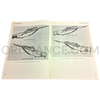

Description
Technical Manual (TM 9-1005-222-12P/2) for .30cal M1, M1C, and M1D Rifles August 1965
Add a strong piece of U.S. Army Garand rifle documentation to your collection with this Technical Manual TM 9-1005-222-12P/2, covering the .30 Cal M1, M1C, and M1D rifles. Dated August 1965, this manual is tied to the parts and organizational maintenance side of the legendary M1 Garand and its sniper rifle variants.
This manual is especially desirable because it covers the standard M1 rifle along with the M1C and M1D sniper rifles. A later 1969 Army manual for the same rifle family states that it superseded TM 9-1005-222-12P/2, dated August 11, 1965, confirming this manual’s place in the official publication timeline.
Historical Significance
The M1 Garand is one of the most important American service rifles ever issued. The National Park Service notes that American troops carried it from World War II through the Korean War, and that it served U.S. soldiers, Marines, and sailors from 1936 to 1957.
That gives this August 1965 parts manual strong collector appeal. It was issued after the M1 had already earned its reputation in World War II and Korea, but while the rifle family still remained important enough for formal Army maintenance and parts documentation.
The inclusion of the M1C and M1D sniper rifle variants makes this manual especially attractive for collectors. These rifles represent the scoped precision side of the Garand family and are among the most sought-after subjects in U.S. military rifle collecting.
The M1, M1C, and M1D Rifle Connection
This manual is tied to three major Garand rifle configurations:
- M1 Rifle
- M1C Sniper’s Rifle
- M1D Sniper’s Rifle
Army technical data describes the M1, M1C, and M1D as clip-fed, gas-operated, air-cooled, semiautomatic shoulder weapons. It also identifies the key sniper-rifle difference: the M1C has its telescope mounted to the receiver, while the M1D has its telescope mounted to the barrel. The same manual notes that the M1C and M1D require a flash hider and cheek pad.
For collectors, this gives the manual broad appeal. It is useful for standard Garand displays, sniper rifle reference collections, M84 telescope research, and .30 caliber U.S. rifle documentation.
What This Manual Covers
As TM 9-1005-222-12P/2, this publication served as an organizational maintenance repair-parts and special-tools reference for the M1, M1C, and M1D rifle family. A later direct-support manual specifically states that TM 9-1005-222-12P/2 contains a list of repair parts and special tools allocated to using organizations.
This manual is especially relevant for:
- M1 Garand parts research
- M1C sniper rifle documentation
- M1D sniper rifle documentation
- organizational maintenance reference
- repair parts and special tools identification
- U.S. Army small-arms technical manual collections
- Garand sniper rifle display research
- museum and archival reference libraries
The later 1969 manual for the same rifle family lists the related stock-numbered rifles as M1 W/E 1005-674-1425, M1C Sniper’s W/E 1005-674-1430, and M1D Sniper’s W/E 1005-674-1431.
Key Features
- Technical Manual TM 9-1005-222-12P/2
- Covers Rifle, Caliber .30, M1
- Covers Rifle, Caliber .30, M1C Sniper’s
- Covers Rifle, Caliber .30, M1D Sniper’s
- Dated August 1965
- Later publication reference identifies the date as August 11, 1965
- Organizational maintenance repair-parts subject
- Includes special tools list context
- Strong World War II, Korean War, Vietnam-era, and Cold War collector appeal
- Excellent reference for M1 Garand, M1C, and M1D rifle collectors
Why This Manual Matters
The M1 Garand already has a major place in American military history. The M1C and M1D sniper variants make this manual even more interesting because they connect the Garand platform to precision rifle use, telescope mounts, flash hiders, cheek pads, and sniper equipment.
This is not a commercial guide or general history booklet. It is part of the Army’s official maintenance and parts-documentation system for the M1 rifle family. That makes it a valuable companion piece for collectors who want the paperwork behind the rifles, not just the rifles themselves.
It pairs well with M1 Garand displays, M1C and M1D sniper rifle collections, M84 telescope accessories, .30-06 ammunition references, World War II and Korean War small-arms exhibits, and Vietnam-era technical manual libraries.
About This Manual
This listing is for Technical Manual TM 9-1005-222-12P/2, covering the .30 Cal M1, M1C, and M1D Rifles, dated August 1965.
This listing is for the manual only unless otherwise stated. No rifle, firearm, receiver, barrel, telescope, mount, flash hider, cheek pad, ammunition, sling, tools, repair parts, storage case, or additional accessories are included unless specifically shown or noted.
Ideal For
This manual is a strong fit for:
- M1 Garand collectors
- M1C sniper rifle collectors
- M1D sniper rifle collectors
- U.S. Army technical manual collections
- World War II and Korean War small-arms displays
- .30 caliber rifle reference libraries
- Garand sniper rifle research collections
- museum and archival reference displays
- serious U.S. military small-arms historians
Approx length 10", Approx width 8", Approx height .2", Approx weight .5lbs.
Pictures are stock images of our inventory. Unless otherwise noted, you will not be receiving the exact item shown in the pictures. The pictures are representative of the item's general condition. The item you receive might be slightly better, or worse, condition than was shown in the pictures.
Please visit our page about order lead times here: Order Lead Times