


Description
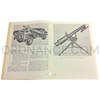
Technical Manual (TM 9-1000-209-35) for XM28 and XM29 "Davy Crockett" Battle Group Weapon Systems June 1962
Own a rare piece of Cold War tactical nuclear weapons documentation with this Technical Manual TM 9-1000-209-35 for the XM28 and XM29 “Davy Crockett” Battle Group Weapon Systems, dated June 1962. This manual is tied to one of the most unusual weapons ever fielded by the U.S. Army.
Unlike the operator-level manual, this -35 manual belongs to the field and depot maintenance side of the Davy Crockett publication family. Archival records identify TM 9-1000-209-35 as a field and depot maintenance manual for the Battle Group Lightweight Weapon System XM28 and Battle Group Heavy Weapon System XM29. The XM28 is listed as portable and vehicle-mounted, while the XM29 is listed as vehicle-mounted.
Historical Significance
The XM28 and XM29 Battle Group Weapon Systems are better known as the Davy Crockett. They came from the Army’s early Cold War effort to give small front-line units access to tactical nuclear firepower.
The Army Historical Foundation describes the M28/M29 Davy Crockett as one of the smallest weapons in the Army’s nuclear arsenal. It was a recoilless rifle system operated by a small crew and entered service in May 1961.
This manual’s June 1962 date gives it exceptional collector appeal. It was issued during the active early service period of the Davy Crockett and just before the famous Little Feller nuclear tests in July 1962. The Davy Crockett was deployed with U.S. Army forces from 1961 to 1971, with about 2,100 systems produced.
The XM28 and XM29 Davy Crockett Systems
The Davy Crockett came in two major versions. The XM28 / M28 was the lighter 120mm system. The XM29 / M29 was the heavier 155mm system.
Brookings describes the Davy Crockett as using an XM-388 projectile launched from either a 120mm XM-28 or 155mm XM-29 recoilless rifle. The same source lists maximum range at about 1.24 miles for the 120mm version and 2.49 miles for the 155mm version.
That is the “cool factor.” This manual is connected to a battlefield nuclear weapon system small enough for tactical Army use. It belongs to the same Cold War world as Pentomic divisions, Fulda Gap defense planning, armored breakthrough fears, and early nuclear battlefield doctrine.
What This Manual Covers
As TM 9-1000-209-35, this publication would have supported field and depot maintenance for the XM28 lightweight and XM29 heavy Battle Group Weapon Systems.
This manual is especially relevant for:
- XM28 Davy Crockett documentation
- XM29 Davy Crockett documentation
- Battle Group Weapon System maintenance research
- Cold War tactical nuclear weapons collections
- U.S. Army Ordnance Department publication libraries
- field and depot maintenance manual collections
- Pentomic Army and early 1960s battlefield doctrine displays
- museum and archival reference collections
- collectors building a complete TM 9-1000-209 manual set
Key Features
- Technical Manual TM 9-1000-209-35
- Covers the XM28 Battle Group Lightweight Weapon System
- Covers the XM29 Battle Group Heavy Weapon System
- Dated June 1962
- Field and depot maintenance-level technical manual
- Connected to the famous Davy Crockett tactical nuclear weapon system
- Strong Cold War / nuclear-era U.S. Army subject
- Excellent companion piece for Davy Crockett technical manual collections
- Highly desirable reference for ordnance, artillery, armor, and nuclear-era military history collectors
- Strong fit for museum, archive, and serious technical manual libraries
Why This Collectible Stands Out
Most Army technical manuals cover common vehicles, rifles, radios, or artillery pieces. This one is tied to the Davy Crockett, one of the strangest and most memorable weapons of the nuclear age.
The system had a short service life. That makes original documentation especially interesting. It captures a narrow moment in history when the Army believed tactical nuclear weapons could be pushed down to small front-line units.
This manual is even more appealing because it is a -35 field and depot maintenance manual. It represents the deeper support side of the system, not just operator-level use. For collectors of Davy Crockett material, atomic artillery references, Cold War ordnance manuals, or Pentomic Army documentation, this is a standout piece.
About This Manual
This listing is for Technical Manual TM 9-1000-209-35 for the XM28 and XM29 “Davy Crockett” Battle Group Weapon Systems, dated June 1962.
This listing is for the manual only unless otherwise stated. No weapon system, launcher, projectile, nuclear material, ammunition, warhead, spotting equipment, vehicle mount, tripod, tools, parts, storage case, or additional accessories are included unless specifically shown or noted.
Ideal For
This manual is a strong fit for:
- Cold War U.S. Army technical manual collections
- Davy Crockett weapon system displays
- tactical nuclear weapons history collections
- U.S. Army Ordnance Department publication libraries
- Pentomic Army doctrine research
- early 1960s battlefield nuclear collections
- museum and archival reference collections
- collectors completing a TM 9-1000-209 manual set
- serious ordnance, artillery, and nuclear-era military historians
Approx length 10", Approx width 8", Approx height .5", Approx weight 1lbs.
Pictures are stock images of our inventory. Unless otherwise noted, you will not be receiving the exact item shown in the pictures. The pictures are representative of the item's general condition. The item you receive might be slightly better, or worse, condition than was shown in the pictures.
Please visit our page about order lead times here: Order Lead Times