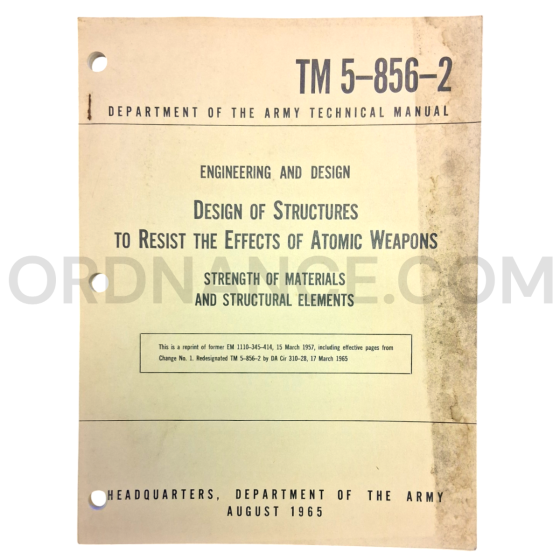
Technical Manual (TM 5-856-2) Effects of Atomic Weapons on Structures
$115.00
In stock
SKU
Technical Manual (TM 5-856-2) Structures Resist Atomic Weapons

This Technical Manual TM 5-856-2 covers the Design of Structures to Resist the Effects of Atomic Weapons and is dated August 1965. This manual is an official reprint of former EM 1110-345-414, originally issued on March 15, 1957, and it includes Change 1. For collectors of U.S. Army technical manuals, Cold War engineering publications, military construction references, and atomic-age civil defense material, this is a strong period document tied to one of the most specialized areas of mid-century military engineering.
Issued during the Cold War, this publication belongs to the era when the U.S. military was actively developing engineering standards for hardened facilities, protective construction, and survivable infrastructure. Manuals like this were not casual reading pieces. They were formal technical references intended for engineers, planners, and military construction personnel working within the Army’s design and protective-structure framework. That makes this manual especially useful for collectors, researchers, and institutions focused on military engineering history and Cold War preparedness.
Design of Structures to Resist the Effects of Atomic Weapons
The title places TM 5-856-2 squarely in one of the most historically important technical fields of the Cold War: protective structural design in the atomic era. Rather than focusing on weapons, vehicles, or field equipment, this manual documents the Army’s engineering side of nuclear-age planning.
This volume is especially significant because it covers the strength of materials and structural elements, making it directly relevant to the way engineers evaluated how construction materials and key structural components would perform under extreme loading conditions associated with atomic weapon effects. In practical terms, that means it belongs to the technical world of:
For collectors, this manual is important because it documents how military engineering adapted to a strategic environment shaped by atomic warfare planning and the need for structures that could better resist blast and related effects.
What This Manual Covers
As a technical manual devoted to the design of structures to resist the effects of atomic weapons, TM 5-856-2 would have served as an official Army engineering reference for structural design principles and related protective-construction concepts.
Because this manual specifically covers strength of materials and structural elements, it is especially relevant for:
The fact that this is an official reprint of former EM 1110-345-414 also adds value for collectors who appreciate the continuity between earlier engineer-manual formats and later technical-manual designations.
Historical Significance
The date August 1965 places this publication in the mature Cold War period, when atomic-age military construction remained a serious engineering concern. By this time, the Army had refined a large body of technical literature dealing with protective structures, hardened facilities, and survivability planning. Manuals like this reflect a period when military engineering extended far beyond conventional barracks and support buildings to include specialized design doctrine shaped by nuclear-era threat assumptions.
For collectors and historians, this manual is especially relevant to subjects such as:
Because it covers a broad engineering subject rather than a single piece of equipment, it also has wide appeal across military history, architecture, engineering, and civil defense collections.
About This Manual
This listing is for Technical Manual TM 5-856-2 Design of Structures to Resist the Effects of Atomic Weapons, dated August 1965.
This manual is an official reprint of former EM 1110-345-414, originally issued on March 15, 1957, and it includes Change 1.
It is especially well suited for:
Because manuals were working documents, surviving examples are valued not only for their content, but also for their connection to real military planning, design, and service practice.
Why This Manual Matters
Many military manuals focus on rifles, vehicles, artillery, or field equipment. This one documents a different but equally important subject: how the Army approached structural design in the atomic era. The added focus on strength of materials and structural elements makes it especially valuable for collectors and researchers who want more than general Cold War background and are interested in the actual engineering side of protective design.
For collectors, it is a strong stand-alone Cold War technical manual with clear historical value. For researchers, it offers a useful reference point for military structural design, material behavior, and survivability doctrine. For museums, it helps explain the engineering side of atomic-age preparedness that shaped military construction during the 1950s and 1960s.
Ideal For
This manual is a strong fit for:
Approx length 10", Approx width 8", Approx height .25", Approx weight .5lbs.
Pictures are stock images of our inventory. Unless otherwise noted, you will not be receiving the exact item shown in the pictures. The pictures are representative of the item's general condition. The item you receive might be slightly better, or worse, condition than was shown in the pictures.
Please visit our page about order lead times here: Order Lead Times