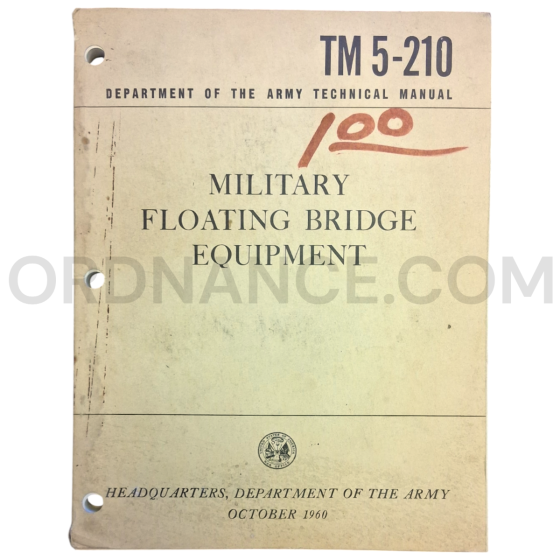
Technical Manual (TM 5-210) for Military Floating Bridge Equipment
$75.00
In stock
SKU
Technical Manual (TM 5-210) Military Floating Bridge Equipment

This Technical Manual TM 5-210 covers Military Floating Bridge Equipment and is dated October 1960. For collectors of U.S. Army technical manuals, combat engineer material, bridging equipment references, and Cold War military publications, this is a strong period document tied to one of the most important mobility subjects in military engineering: getting troops, vehicles, and supplies across water obstacles.
Issued in 1960, this manual belongs to the Cold War era, when the U.S. Army still relied heavily on specialized engineer bridging equipment for tactical river crossings, support operations, and mobile warfare planning. Manuals like this were working references, intended to support the identification, understanding, use, and maintenance of equipment in actual military service. That makes this publication especially useful for collectors, researchers, restorers, and museums focused on U.S. Army engineer history.
Military Floating Bridge Equipment
The subject of this manual places it squarely in the world of combat engineering and military bridging. Floating bridge equipment was essential wherever terrain, rivers, canals, or destroyed infrastructure threatened to slow or stop the movement of forces. In practical terms, these systems allowed military engineers to assemble temporary waterborne bridges, rafts, and ferry arrangements capable of supporting vehicles, artillery, and personnel in the field.
By October 1960, floating bridge equipment remained an important part of Army mobility doctrine. It reflected the continuing need for rapid obstacle crossing in an era shaped by mechanized warfare, armored formations, and the expectation of large-scale maneuver operations. That makes TM 5-210 especially useful for collectors interested not just in weapons and vehicles, but in the engineer equipment that allowed those systems to move and fight.
For collectors, this manual is significant because it documents the technical side of military bridging rather than the better-known combat hardware itself. It belongs to the broader story of U.S. Army engineers, field construction, tactical mobility, and the logistical systems that supported military operations in wartime and training.
What This Manual Covers
As a technical manual devoted to Military Floating Bridge Equipment, TM 5-210 would have served as an official Army reference for floating bridge and related engineer support equipment.
In practical terms, a manual like this is especially relevant for:
That makes it useful not only as a collectible, but also as a practical reference for anyone studying U.S. Army bridging doctrine and engineer equipment in the Cold War period.
Historical Significance
The date October 1960 places this publication in an important period of Army engineering history. It reflects the continuing importance of floating bridge systems in the years after World War II and before later generations of bridging equipment fully reshaped the field. Manuals like this show how the Army organized its technical knowledge around mobility, obstacle crossing, and field engineer support during the early Cold War.
For collectors and historians, this manual is especially relevant to subjects such as:
Because it covers military floating bridge equipment rather than a single vehicle or weapon, it also has broad appeal. It can complement collections focused on engineer equipment, bridging operations, tactical mobility, military transport, and Cold War field engineering.
About This Manual
This listing is for Technical Manual TM 5-210 for Military Floating Bridge Equipment, dated October 1960.
It is especially well suited for:
Because manuals were working documents, surviving examples are valued not only for their content, but also for their connection to real military training, planning, and service practice.
Why This Manual Matters
Many military manuals focus on rifles, vehicles, tanks, or artillery. This one documents a different but equally important subject: the equipment that allowed military forces to cross rivers and sustain movement in the field. That makes it especially useful for collectors who want to preserve the broader technical and logistical picture of U.S. Army operations rather than only front-line combat hardware.
For collectors, it is a strong stand-alone Cold War technical manual with clear historical value. For researchers, it offers a useful reference point for military bridging terminology and service context. For museums, it helps explain the engineering side of mobility and river-crossing operations that were essential to Army planning and execution.
Ideal For
This manual is a strong fit for:
Approx length 10", Approx width 8", Approx height .5", Approx weight 1lbs.
Pictures are stock images of our inventory. Unless otherwise noted, you will not be receiving the exact item shown in the pictures. The pictures are representative of the item's general condition. The item you receive might be slightly better, or worse, condition than was shown in the pictures.
Please visit our page about order lead times here: Order Lead Times