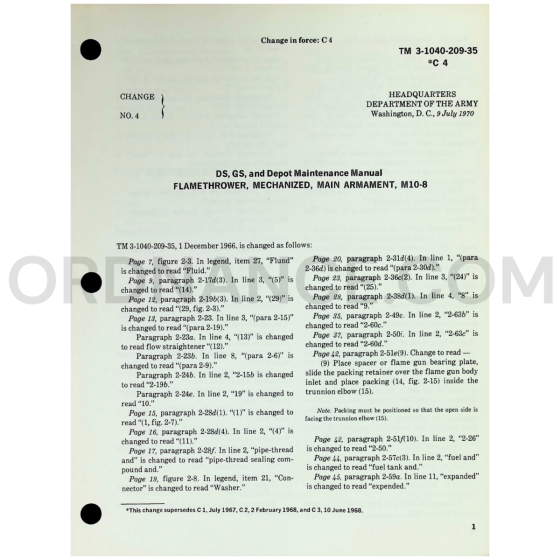
Technical Manual Change 4 (TM 3-1040-209-35) for M10-8 Flame Thrower
$30.00
In stock
SKU
Technical Manual C4 (TM 3-1040-209-35) for M10-8 Flame Thrower

This TM 3-1040-209-35 Change 4, dated 1970, is a Cold War-era U.S. Army technical manual update for the M10-8 Mechanized Flame Thrower. This change was issued specifically for the TM 3-1040-209-35 technical manual printed on December 1, 1966, making it an important companion document for collectors, researchers, restorers, and anyone building a serious reference library around U.S. military flamethrower equipment and Army technical literature.
Unlike a full base manual, this item is an official Change 4 publication. That means it was issued to revise and update the original manual rather than replace it outright. For collectors, that matters. Army manuals were commonly kept current through numbered changes, and surviving change issues help document how technical guidance, maintenance information, and service procedures evolved while the equipment remained in use. In that sense, this is not just an update sheet. It is part of the actual service history of the manual.
The M10-8 Mechanized Flame Thrower
The M10-8 Mechanized Flame Thrower belongs to the family of U.S. mechanized flamethrower systems developed for installation in armored or specialized vehicles. Unlike portable backpack flamethrowers, mechanized systems were intended to provide a mounted flame capability for attacking bunkers, trenches, fortified positions, and other close-range hard targets.
That places the M10-8 within the broader history of armored support weapons, combat engineering systems, and specialized flame warfare equipment. For collectors, it is an especially interesting subject because it sits at the intersection of flamethrower history and armored vehicle history, giving manuals like this a broader appeal than a standard infantry-equipment publication.
What This Manual Change Covers
As a technical manual change, TM 3-1040-209-35 Change 4 would have been issued to revise and update the information contained in the original December 1, 1966 printing of the manual.
In practical terms, publications like this are especially relevant for:
Because it is a Change 4 issue, it is especially useful for collectors who want to pair it with the original base manual and preserve the manual as it was actually updated and used in service.
Historical Significance
The date 1970 places this publication in the Cold War and Vietnam-era Army, when the U.S. military was still maintaining specialized flame weapon systems and updating the technical literature that supported them. That gives this change added historical value because it reflects the continued service life of the M10-8 Mechanized Flame Thrower and the Army’s effort to keep its documentation current.
For collectors and historians, this manual change is especially relevant to subjects such as:
Because it is a change issue, it also appeals to collectors who appreciate the way military manuals were actually maintained in service rather than preserved only as first-print base editions.
About This Item
This listing is for TM 3-1040-209-35 for M10-8 Mechanized Flame Thrower Technical Manual – Change 4, dated 1970. It was issued for the December 1, 1966 print of the original TM 3-1040-209-35 manual.
It is especially well suited for:
Why This Manual Matters
Many military manuals focus only on base editions, but change sheets are a major part of how Army documentation was actually used in service. This item adds a layer of authenticity and completeness that a base manual alone does not always provide.
For collectors, it is a useful companion piece to the original 1966 TM 3-1040-209-35. For restorers and researchers, it helps document the continued maintenance and support history of the M10-8 Mechanized Flame Thrower. For museums, it adds context to the administrative and technical side of a weapon system that is far less commonly documented than standard armored vehicle armament.
Ideal For
This manual is a strong fit for:
Approx length 10", Approx width 8", Approx height .2", Approx weight .2lbs.
Pictures are stock images of our inventory. Unless otherwise noted, you will not be receiving the exact item shown in the pictures. The pictures are representative of the item's general condition. The item you receive might be slightly better, or worse, condition than was shown in the pictures.
Please visit our page about order lead times here: Order Lead Times