




Description
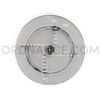
U.S. Army M2A2 Aiming Circle P-2 Polaris II Optical Reticle, P/N 11785525
Item Overview
This U.S. Army P-2, also known as the Polaris 2 or Polaris II, is an optical reticle made for the four-power elbow telescope of the M2A2 aiming circle. It combines standard graduated crosshairs with three circular rings for finding direction through star observation. This is a legacy military-surplus optical component for collecting, study, and display. It is not a rifle-scope reticle or current calibrated survey equipment.
Identification and Features
Army repair-parts data identifies this reticle by part number 11785525 and places it within the M2A2 elbow-telescope assembly. The older package stock number and later federal number share NIIN 01-152-8516, confirming that they identify the same item.
- Official item: Reticle, Optical Instrument
- Pattern: P-2 / Polaris 2 / Polaris II
- Army part number: 11785525
- Earlier package NSN: 1240-01-152-8516
- Later/current NSN: 6650-01-152-8516
- Shared NIIN: 01-152-8516
- Application: M2A2 aiming-circle elbow telescope
- Telescope type: Four-power, fixed-focus optical instrument
- Design-authority CAGE: 19200, U.S. Army
- Pouch FSCM: 34870, FJW Optical Systems, Inc.
- Package contract: DAAA09-84-C-0072
- Package date: May 1984
How the Reticle Worked
The crosshairs have 5-mil graduations reading from 0 through 85 mils for normal azimuth and elevation work. The three circular rings supported the Polaris 2 method of hasty survey. An operator located Polaris, Delta Ursae Minoris, and 43H Cephei, then placed the stars on their assigned rings. This allowed an artillery unit to establish accurate direction without radio or wire communications.
M2A2 Aiming Circle Application
The M2A2 aiming circle was used to measure horizontal and vertical angles, establish an azimuth of fire, and place several indirect-fire weapons on the same direction. Its tripod-mounted telescope could be sighted on distant survey points or the panoramic sights of individual howitzers. The P-2 reticle added a nighttime astronomical method for establishing direction when other survey control was limited.
Historical Background
Aiming circles developed from traditional surveying instruments and became important tools for modern indirect artillery fire. The M2 and improved M2A2 served U.S. Army and Marine Corps artillery units during the Cold War and afterward. Crews used these instruments for battery orientation, field survey, weapon laying, and training. Later electronic and satellite-based systems reduced their role, but the M2A2 remained useful as a dependable optical instrument and training aid.
Stock Number and Calibration Note
The change from FSC 1240 to FSC 6650 did not create a different reticle because both numbers retain NIIN 01-152-8516. The original astronomical calibration for the base 11785525 reticle exceeded its stated service life in January 1996, and later revisions include part numbers 11785525-2, 11785525-3, and 11785525-4. This original version should be treated as a collectible component and should not be trusted for current precision survey work.
Condition
This is an original military-surplus optical reticle. It may show dust, scratches, edge wear, discoloration, storage marks, or wear to its protective pouch and packaging. The exact expiration marking on the loose glass may not be legible. This listing is for the reticle only; the M2A2 aiming circle, elbow telescope, tripod, and other accessories are not included unless specifically stated. Please check the pictures for the general condition of the item.
Ideal For
This reticle is well suited for collections and exhibits covering artillery surveying, optical fire-control equipment, military astronomy, and the history of indirect-fire weapon laying.
- U.S. artillery-equipment collections
- M2 and M2A2 aiming-circle displays
- Military optical-instrument research
- Field-artillery and surveying exhibits
- Cold War military collections
- Museums and educational displays
Approx length .25", Approx width .25", Approx height .1", Approx weight 0.1lbs.
Pictures are stock images of our inventory. Unless otherwise noted, you will not be receiving the exact item shown in the pictures. The pictures are representative of the item’s general condition. The item you receive might be slightly better, or worse, condition than was shown in the pictures.
Please visit our page about order lead times here: Order Lead Times.