








Description
8 cm Wgr. Mortar-Bomb Fiberboard Transport Container
Item Overview
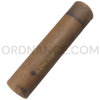
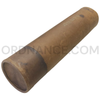
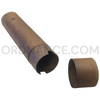
This single-round fiberboard transport container is marked 8 cm Wgr., identifying its intended contents as an 8 cm mortar bomb. The offering includes the heavy fiberboard body, removable slip-on lid, and inner sleeve with opposing cutouts. Together, these parts preserve the packing arrangement of an individual ammunition tube. Dated 1944, this original transport/storage tube is extremely rare to find today, given how few survived the war, especially in this condition. Only one available, so you will be receiving the one shown in the photos. Only example we've ever had.
Identification and Features
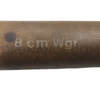
Wgr. abbreviates the German term Werfergranate, meaning mortar bomb. The white contents marking is the key identification feature and connects the tube with German-language mortar-ammunition terminology.
- White marking: 8 cm Wgr.
- Individual container for one mortar bomb
- Heavy fiberboard body
- Removable slip-on lid
- Inner sleeve with opposing cutouts
Function
The container enclosed a mortar bomb during storage and transport, separating it from surrounding equipment and reducing direct contact with other items. The lid covered the opening, while the sleeve formed an additional inner layer. The exterior marking identified the intended ammunition while the package remained closed.
Documented End-Item Application
The U.S. War Department's German Infantry Weapons, published May 25, 1943, identifies the 8 cm Wgr. 34 as ammunition for the German 81 mm schwerer Granatwerfer 34 mortar, abbreviated s.Gr.W. 34. This is a documented example of the ammunition family named by the tube's broader 8 cm Wgr. stencil.
Product History
Wartime German mortar ammunition used protective packing and carrying equipment as part of its supply system. The 1943 U.S. guide discusses ammunition containers and also records steel carrying cases holding four complete 81 mm rounds. This fiberboard tube preserves an individual packing format, with its contents marking, separate closure, and inner packing retained.
Parent-Equipment History
The related German Granatwerfer 34 mortar entered production in 1934, according to the U.S. Army's Catalog of Enemy Ordnance. It used a smoothbore barrel supported by a bipod and baseplate. Although described as an 8 cm weapon, its actual caliber was 81.4 mm. Its conventional layout made it a standard infantry support weapon before and during World War II.
Weapon-System Background
Germany began World War II with 50 mm mortars at company level and 81 mm mortars at battalion level. The larger mortar gave infantry units their own high-angle fire support. Its ammunition included high-explosive and smoke rounds for different battlefield tasks. The later short 8 cm Granatwerfer 42 also used standard German 81 mm ammunition, extending the ammunition family's role within the infantry mortar system.
History of Use
A February 1944 U.S. Intelligence Bulletin discussed German 81 mm mortar use based on American combat experience in Tunisia and Italy. Contemporary manuals also describe the Model 34 mortar being carried in three main loads or moved on a horse-drawn cart. These records show the practical demands of moving the weapon and maintaining its ammunition supply during field operations.
Condition
The fiberboard body, removable lid, and inner sleeve described above are present, along with the white contents marking. Please check the pictures for the general condition of the item.
Ideal For
This marked tube adds ammunition packaging to a mortar display and gives collectors a physical example of individual round protection. Its lid and inner sleeve are useful details for exhibits explaining military storage and transport.
- Mortar-ammunition packaging collections
- German 8 cm Wgr. reference displays
- 81 mm mortar history exhibits
- Military supply and transport collections
- Museums and educational displays
Approx length 15", Approx width 3.5", Approx height 3.5", Approx weight 0.8lbs.
Please visit our page about order lead times here: Order Lead Times.