






Description
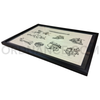
Original 1898 Whitehead 5-Metre U.S. Mark I Torpedo and Obry Gear Print in Modern Frame, 20 x 13 Inches
Item Overview
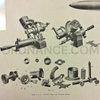
This original engineering print depicts the Whitehead torpedo and its associated Obry gyroscope equipment. The complete weapon appears alongside detailed studies of the steering mechanism, capturing an important stage in the development of automatic torpedo guidance. Its modern frame makes the period illustration an appealing display piece for a naval history or engineering collection. This 128-year-old print has been professionally linen-backed and framed.
Identification and Features
The publication heading and subject caption identify both the print’s source and the specific torpedo variant illustrated. Numbered figures connect the assembled equipment with separate views of its mechanical parts.
- Publication: Engineering.
- Printed issue date: July 15, 1898.
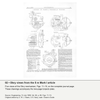
- Subject caption: “5-Metres (U.S. Mark I.), Whitehead Torpedo.”
- Original period print presented in a modern frame.
- Framed size: approximately 20 x 13 inches.
Print Contents
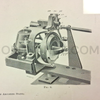
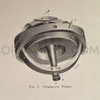
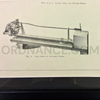
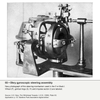
Figure 1 shows the torpedo. Figures 2 through 4 cover the locking dial and rudder index. Figures 5, 6, and 8 show the Obry gear on its adjusting stand, while Figure 9 depicts the gyroscope wheel. Figures 7 and 10 show dismounted equipment, including the wheel, rings, impulse sector, springs, and rolling valve. Together, these views let the reader compare the assembled mechanism with its separate parts.
Documented End-Item Application
The print specifically concerns the 5-metre U.S. Mark I Whitehead torpedo. A contemporary Navy description published in January 1898 identifies this model as a 5-metre, 45-centimetre torpedo fitted with Obry course-control equipment. The gyro assembly was carried inside the torpedo’s rear body. The illustrated adjusting stand supported work on the mechanism outside the weapon.
Publication History
Engineering began publication in London in 1866 and became an established journal for the engineering profession. This dated print belongs to its late nineteenth-century coverage of machinery and technical development. Detailed illustrations helped readers study equipment that was normally hidden inside a larger machine. The period sheet preserves that published record, while the modern frame gives it a present-day display format.
Parent-Equipment History
Robert Whitehead developed an experimental self-propelled torpedo at Fiume, now Rijeka, Croatia, in 1866. Continued development improved its propulsion, depth control, and reliability. Export sales and manufacturing licenses brought Whitehead designs into service with many navies. The United States adopted the Whitehead in 1892 after the E. W. Bliss Company secured manufacturing rights, placing the illustrated subject within a wider period of naval modernization.
Obry Gyroscope History
The steering gear takes its name from inventor Ludwig Obry. His U.S. Patent No. 562,235, titled Steering Mechanism for Torpedoes, was issued on June 16, 1896. Navy accounts described the device in 1897 and 1898, placing this print close to its early adoption. The Obry gear was an important practical application of gyroscopes to automatic weapon guidance.
Weapon-System Background
The Whitehead torpedo carried its own propulsion system and traveled underwater toward a surface ship. Compressed air powered its engine, while separate mechanisms controlled depth and heading. A spring started the Obry gyroscope, which maintained a steady directional reference. If the torpedo veered, the gyro controlled an air-powered steering unit that moved the vertical rudders to correct its course. The drawings document the compact mechanical equipment behind that function.
History of Use
An American naval commission observed Obry gear demonstrations at Fiume in November 1896. Further trials followed in the United States, and a naval account published in 1900 reported the gear’s adoption by the U.S. Navy. Whitehead torpedoes armed battleships and torpedo boats during this period. The July 1898 print records the technology as gyroscopic steering was becoming an important part of torpedo development.
Condition
Please check the pictures for the general condition of the item.
Ideal For
This framed print makes a strong companion display for an early torpedo or gyroscope collection. Its view of the complete weapon and numbered component studies give viewers several levels of detail to explore, from the torpedo’s overall form to the machinery inside it.
- Collectors of original nineteenth-century engineering prints.
- Whitehead torpedo and Obry gyroscope exhibits.
- Naval ordnance and maritime history collections.
- Museum galleries, studies, offices, and engineering displays.
Approx length 20", Approx width 13", Approx height 1", Approx weight 3lbs.
Pictures are stock images of our inventory. Unless otherwise noted, you will not be receiving the exact item shown in the pictures. The pictures are representative of the item’s general condition. The item you receive might be slightly better, or worse, condition than was shown in the pictures.
Please visit our page about order lead times here: Order Lead Times.