









Description
WWI-Era Whitehead Royal Navy Torpedo Gyroscope with Original Wooden Carrying Case
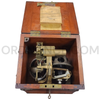
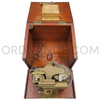
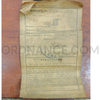
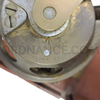
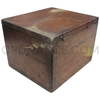
This WWI-era Whitehead torpedo gyroscope was made for Royal Navy service and comes in its original wooden carrying case. The instrument is stamped "2974 W&C Co". Two period leaflets remain inside the box: a naval test record and Whitehead's directions for gyroscopes fitted with relay valves. The paperwork preserves manufacturer, inspection, depot, and test information, adding a written record to this example of early British torpedo steering equipment.
Identification and Features
The instrument and its enclosed paperwork carry different identifying numbers. The following markings and entries are retained as transcribed.
- Manufacturer: Whitehead; the directions sheet is signed "WHITEHEAD & Co., WEYMOUTH."
- Service: Royal Navy torpedo equipment.
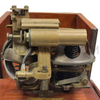
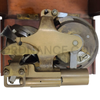
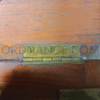
- Instrument stamp: "2974 W&C Co".
- Test-sheet identification: "GYROSCOPE No. 2944"; maker entry "W I Co".
- Test form: "0.-406."; revised July 1916.
- Recorded test date: "10 4-19".
- Depot entry: R.N. Torpedo Depot "Longhope".
- Engineer Commander entry: "H.O .Bleave".
- Vessel entry: "H.M.S Sokoto".
- Admiralty inspector entry: "P.D. Malilry".
- Manufacturer's directions sheet: "D.-534e."; "Established Oct., 1902."; additional number "1055."
- Reference codes: "Sta. 2570/08."; "Sta. 59/14."; "Sta 140/16".
- Printing line: "Nm/ 16-[028] 0526/D864 15m 5/17sv 1283 G&S 110".
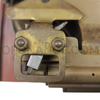
- Case lock: Wording transcribed as "secure improved letter", with a bomb-shaped emblem.
- Included grouping: Gyroscope, original wooden carrying case, and two interior leaflets.
Function and Contents
In service, a torpedo gyroscope supplied a stable direction reference after launch. Its spinning wheel resisted changes in direction, allowing the steering system to detect when the torpedo moved away from its intended course. The relay valve passed steering corrections to the air-powered steering mechanism, which controlled the rudder. The enclosed directions focus on the care of this sensitive valve and its casing. They discuss protective wash-leather storage, cleanliness, lubrication, and the orientation marks on the valve assembly.
Original Leaflets and Test Record
The first leaflet combines identification and test fields with printed care directions. Its headings cover diagram behaviour, wheel spinning time without air, and wheel fall over four minutes. Reported entries include "SD", "26mins", and "NIL inches". The second leaflet is titled "DIRECTIONS FOR GYROSCOPES FITTED WITH RELAY VALVES" and carries Whitehead's Weymouth name. The October 1902 date belongs to the established instructions, while July 1916 identifies the revised test form. The handwritten test date reads as 10 April 1919 in British date order.
Documented Applications
The manufacturer's leaflet expressly describes gyroscopes installed in torpedoes. The naval test sheet includes Royal Navy depot and Admiralty inspection entries, placing the paperwork within a service testing and maintenance system. The 1909 Torpedo Manual for His Majesty's Fleet also devoted a chapter to gyroscopes, with plates covering the gyro, reducer and strainer, balancing equipment, and adjustment. These documents establish the role of this equipment type in Royal Navy torpedo steering and its support by trained technical personnel.
Product History
Gyroscopic steering became a major improvement to the Whitehead torpedo in the late 1800s. Ludwig Obry patented a practical torpedo steering gyro in 1894, and Whitehead adopted his system in 1897. Earlier torpedoes could control their depth, but holding a reliable direction remained a challenge. The gyro helped solve that problem by giving the steering mechanism a stable reference. The relay-valve instructions established in 1902 and the form revised in 1916 place this boxed equipment within the period when gyro care and testing had become a formal part of naval service.
Manufacturer History
Whitehead's British torpedo factory was built in 1891 at Ferrybridge, in the Wyke Regis area of Weymouth, Dorset. The works formed part of the wider business that grew from Robert Whitehead's original torpedo development at Fiume, now Rijeka, Croatia. A British manufacturing base supported the firm's place in naval weapons production and technical support. The printed "WHITEHEAD & Co., WEYMOUTH" heading on the enclosed leaflet gives this grouping a direct factory-name reference, separate from the abbreviated mark stamped on the instrument.
Equipment History
The parent equipment was the self-propelled Whitehead torpedo, first developed in 1866. Early versions used compressed air to drive an engine and propeller, carrying the weapon beneath the water toward its target. The Royal Navy purchased Whitehead torpedoes in 1870 and began manufacturing a British version in 1871. Over the following decades, improvements to engines, propellers, depth control, and steering increased the torpedo's usefulness. Gyroscopes became important components within these larger assemblies, supported by dedicated manuals, inspection records, and specialist repair facilities.
Weapon-System Background
A naval torpedo combined a warhead, propulsion machinery, depth control, and course steering. Each system had a separate task: the engine moved the weapon, the depth mechanism controlled its position below the surface, and the gyro guided its direction. During the First World War, torpedo attacks formed part of destroyer and submarine operations and influenced the movements of larger fleets. Admiral Jellicoe's account of the Grand Fleet describes both torpedo-attack practice and exercises in avoiding attacks. This made reliable steering equipment important to training as well as combat readiness.
History of Use
Torpedo gyroscopes were checked and maintained by naval technical staff before use and during depot servicing. The enclosed test record captures that work in the early postwar period through its April 1919 date. At the Grand Fleet base of Scapa Flow, torpedo support included ships and shore facilities that stored and repaired weapons. C.W. Burrows's period account identifies Sokoto as a torpedo depot ship at Longhope. That documented setting gives useful context for the depot and vessel entries on the leaflet, while the supplied spellings remain recorded above.
Condition
The gyroscope remains with its original wooden carrying case and two interior leaflets. The instrument bears the reported manufacturer mark and number, and the case lock carries the described wording and emblem. The retained paperwork is part of the collectible grouping. Please check the pictures for the general condition of the item.
Ideal For
Suited to collections of Royal Navy equipment, First World War naval artifacts, and historic mechanical instruments. The manufacturer directions and test sheet make it useful for displays about the technical work behind torpedo readiness. Researchers can compare the instrument stamp, form numbers, and inspection entries with period manuals and naval records.
- Royal Navy and Whitehead collections.
- WWI naval history displays.
- Torpedo technology exhibits.
- Historic instrument and document research.
Approx length 9.5", Approx width 9", Approx height 7", Approx weight 15lbs.
Pictures are stock images of our inventory. Unless otherwise noted, you will not be receiving the exact item shown in the pictures. The pictures are representative of the item’s general condition. The item you receive might be slightly better, or worse, condition than was shown in the pictures.
Please visit our page about order lead times here: Order Lead Times.