






Description
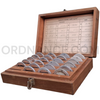
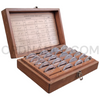
Add a piece of early Atomic Age laboratory history to your collection with this Nuclear-Chicago Model C-101 Calibrated Absorber Set.
This laboratory radiation-measurement accessory was used to study how radiation passed through known layers of metal. It is not an ordnance component.
What This Set Was Used For
The absorber disks were placed between a radioactive sample and a detector. A scientist could measure the sample, add an absorber disk, measure it again, and compare the results.
Common applications included:
- Photon-energy studies
- Beta-particle energy studies
- Isotope identification
- Isotope purity checks
- Decay studies
- Reducing counting rates
- Creating absorption curves
The set could also be used with the Nuclear-Chicago C-100 Actigraph to create absorption curves.
Set Details
The 1954 Nuclear-Chicago catalog described the C-101 set as containing:
- 17 calibrated aluminum absorbers
- 6 calibrated lead absorbers
- 1 empty zero-absorption ring
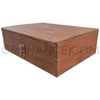
- Walnut carrying case
This version dates to 1954 or later. Earlier C-101 sets contained fewer absorbers.
Important Condition Note
Position No. 1 appears to be empty. The calibration card lists this position as 1.5 mg/cm², indicating that the set is missing its thinnest aluminum absorber.
Position No. 17 is marked 0. This is the correct empty zero-absorption ring.
The handwritten measurements in mg/cm² indicate each absorber’s mass thickness, meaning the amount of material distributed over a specific area. They are not radiation-dose measurements.
No Radioactive Source Included
No radioactive source is included with this set. The components are passive aluminum and lead absorbers. A separate radioactive sample would have been required during laboratory use.
Atomic Age History
Nuclear-Chicago was founded in 1946 by individuals who had worked with radiation instruments at the University of Chicago Metallurgical Laboratory during World War II.
This set is not a Manhattan Project artifact, but the company originated from the scientific community connected to that work. It represents the period when wartime nuclear technology began moving into universities, laboratories, medicine, and civilian research.
Founder James Schoke later stated that he had trained George Koval to maintain Manhattan Project alpha-detection instruments. Koval was later identified as a Soviet intelligence agent.
Nuclear-Chicago also became an important name in medical imaging. The company later produced the Pho/Gamma 1, an early commercial gamma camera that contributed to the development of modern nuclear-medicine imaging.
Approximate Dimensions
- Length: 10 inches
- Width: 7 inches
- Height: 3 inches
- Weight: 4.5 pounds
What Is Included
This listing includes one Nuclear-Chicago Model C-101 Calibrated Absorber Set with walnut case. No radioactive source, detector, Actigraph, counter, tools, manual, or additional laboratory equipment is included unless specifically shown or noted.
Ideal For
- Atomic Age collections
- Nuclear-Chicago equipment collections
- Radiation-measurement displays
- Early laboratory equipment collections
- University science-history displays
- Medical-imaging history collections
- Museum and archive exhibits
- Cold War science collections
Product Images
Pictures are stock images of our inventory. Unless otherwise noted, you will not receive the exact item shown. The pictures represent the general condition of the available inventory. The item you receive may be in slightly better or worse condition than the example shown.
Please visit our page about order lead times here: Order Lead Times