










Description
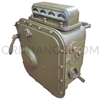
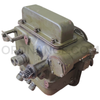
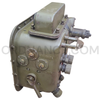
WWII U.S. Army General Electric Model 1942 60-Inch Searchlight Elevation Control Box
Item Overview
This WWII-era elevation control box was used on the U.S. Army’s General Electric Model 1942 60-inch carbon-arc antiaircraft searchlight. The assembly controlled the vertical movement of the searchlight drum and placed important lamp and electrical controls within reach of the operating crew. Its panel layout and mechanical housing match the elevation control box illustrated in Army manual TM 5-7045, Figure 8, printed page 10. This listing is for the elevation control-box assembly rather than a complete searchlight system.
Identification and Features
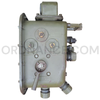
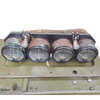
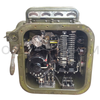
The assembly is identified by its distinctive four-instrument panel, ARC SWITCH lever, RECARBONING LAMP SWITCH, three rotary controls, bulged side cover, and heavy mechanical housing. The instruments allowed the crew to monitor electrical operation and check directional alignment.
- Component: Elevation control box
- Parent equipment: General Electric Model 1942 60-inch searchlight
- Service: U.S. Army antiaircraft searchlight equipment
- Manual identification: TM 5-7045, Figure 8
- Panel instruments: Arc voltage, arc current, and directional indicators
- Visible controls: Arc switch, recarboning-lamp switch, rotary switches, clutch, and brake controls
- Visible reference: WW-8009163, not confirmed as an official part number
Historical Background
The elevation control box was designed as an integrated part of the General Electric Model 1942 searchlight and control station. Army manual TM 5-7045, dated June 4, 1943, documented its construction and operation during World War II. The box combined elevation-drive machinery, control circuits, protective limit devices, lamp controls, and monitoring instruments in one enclosed assembly. This arrangement supported both local operation at the searchlight and distant electrical control from other equipment in the antiaircraft position.
Function and Operation
An electric motor inside the box moved the searchlight drum in elevation, directing the beam upward or downward. The elevation clutch allowed the mechanism to be transferred between hand control and distant electrical control, while the brake held the drum at the selected angle. Upper and lower electrical limit switches stopped powered movement before the drum reached its mechanical limits. The panel instruments displayed arc voltage and current and helped the crew compare elevation and azimuth alignment signals. The arc switch controlled the lamp circuit, and the recarboning-lamp switch operated the light used while servicing or replacing the carbon rods.
End-Item Application
This control box was mounted on the General Electric Model 1942 60-inch antiaircraft searchlight. The complete equipment included the wheeled searchlight, a separate control station, a generator power plant, power and control cable reels, an extended hand controller, protective covers, and accessory boxes. A cable could connect the control station to a sound locator or other detector so that target-direction information could be passed to the searchlight crew. The elevation control box formed the powered vertical-control portion of this larger searchlight installation.
Searchlight System Background
The Model 1942 used a high-intensity carbon arc positioned at the focal point of a 60-inch parabolic reflector. The bright arc formed at the positive carbon’s crater, while the control mechanism maintained the correct gap as the carbons were consumed. Army instructions specify a nominal operating level of approximately 150 amperes and 78 volts. The large reflector concentrated the light into a narrow beam with an approximate divergence of 1 degree and 10 minutes. Periodic recarboning was a normal part of operating this type of searchlight.
Antiaircraft Defense System
Searchlights worked as part of a coordinated nighttime air-defense system rather than as independent lights. A sound locator or other detector supplied an aircraft’s direction, and distant electrical control equipment could move the searchlight toward the predicted target position. The Model 1942 could operate through automatic distant electrical control, manual distant electrical control from the control station, or an extended hand controller at the light. Once an aircraft was caught in the beam, the crew could continue tracking it for antiaircraft gun units, observers, or friendly fighter aircraft.
History of Use
The 60-inch searchlight became the standard large U.S. Army antiaircraft light during World War II. Army historical records describe the standard light as producing about 800 million candlepower and illuminating aircraft at long distances under favorable conditions. Searchlight battalions served overseas and supported fixed and mobile defenses around ports, cities, military installations, and field forces. A December 1944 U.S. Army Signal Corps photograph shows members of the 360th Antiaircraft Artillery Searchlight Battalion servicing a 60-inch light at Monghidoro, Italy. Searchlight crews also trained with aircraft so that operators could practice target pickup, beam control, and continuous tracking.
Condition
The assembly is offered in the configuration shown, with its four-instrument panel, switches, operating levers, side cover, and mechanical housing.
Ideal For
This original elevation control box is well suited to a General Electric Model 1942 searchlight restoration or a detailed exhibit about World War II antiaircraft defense. Its instruments, control hardware, and documented manual appearance also make it a useful reference for studying period military electrical and mechanical systems.
- Model 1942 searchlight restorations
- World War II antiaircraft displays
- Military electrical-equipment collections
- Museum and educational exhibits
- Historic searchlight research
Approx length 18", Approx width 22", Approx height 24", Approx weight 175lblbs.
Pictures are stock images of our inventory. Unless otherwise noted, you will not be receiving the exact item shown in the pictures. The pictures are representative of the item’s general condition. The item you receive might be slightly better, or worse, condition than was shown in the pictures.
Please visit our page about order lead times here: Order Lead Times.