





Description
U.S. Navy Aircraft Rangefinder Mark XLIV Mod. I, Fairchild Aviation Corporation, Bureau of Ordnance, Contract 83668
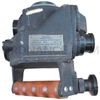
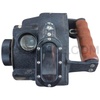
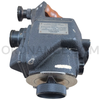
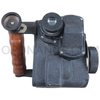
The U.S. Navy Aircraft Rangefinder Mark XLIV, Model I is a pre-World War II to early World War II-era handheld optical instrument manufactured by Fairchild Aviation Corporation of New York for the U.S. Navy Bureau of Ordnance.
Unlike a long-base naval coincidence rangefinder, this compact aircraft instrument was designed to determine the viewing angle from an aircraft to a surface target. When that angle was combined with the aircraft's known altitude, the crew could estimate the distance to the target for bombing, reconnaissance, and other naval aviation ordnance work.
The original identification plate is marked AIRCRAFT RANGEFINDER, U.S. NAVY BUREAU OF ORDNANCE, MARK XLIV – MOD. I, and FAIRCHILD AVIATION CORPORATION.
Historical Significance
During the years before and during World War II, accurate aerial navigation and target measurement depended on mechanical and optical instruments rather than radar, lasers, or digital computers.
Naval aircraft crews needed a way to estimate the distance to ships, shore positions, and other surface targets from the air. Instruments such as the Mark XLIV helped turn the aircraft's altitude and measured viewing angle into usable ranging information.
Fairchild was well suited to this type of work. The company was already a major developer of precision aerial cameras and photographic equipment. By the early 1940s, Fairchild was also manufacturing military fire-control equipment, octants, rangefinders, and other precision instruments for the U.S. war effort.
The Mark XLIV represents this early period of airborne optical fire-control and ranging technology, before electronic ranging systems became practical.
What This Item Is and Does
The operator held the rangefinder by its wooden grips and looked through the optical eyepiece toward a surface target.
The instrument provided an internal optical reference and an adjustable artificial-horizon bubble. By aligning the sight with the target and reference system, the operator could determine the angle between the aircraft and the point being observed.
With the aircraft's altitude already known, that angular measurement could be used to estimate the horizontal or slant range to the target.
The control marked BUBBLE ADJUSTMENT changes the size or appearance of the artificial-horizon bubble used as part of the sighting reference.
The fitting marked GAS OUTLET is associated with the instrument's internal bubble or pneumatic system.
This is an aircraft optical ranging instrument. It is not a conventional shipboard coincidence rangefinder, binocular telescope, bombsight, or modern laser rangefinder.
Key Features
- Official nomenclature: Aircraft Rangefinder
- Service: U.S. Navy
- Responsible agency: Bureau of Ordnance
- Model: Mark XLIV, Mod. I
- Manufacturer: Fairchild Aviation Corporation
- Manufacturer location: New York, New York, U.S.A.
- Instrument number: Appears to read 411-119
- Contract number: 83668
- Type: Handheld optical aircraft rangefinder
- Operating principle: Angular measurement combined with known aircraft altitude
- Internal artificial-horizon bubble
- Bubble Adjustment control
- Gas Outlet fitting
- Optical eyepiece
- Original wooden handgrips
- Original wooden face/head support
- Period: Pre-World War II / early World War II
- Intended application: U.S. Navy aircraft
- Included: One Aircraft Rangefinder Mark XLIV Mod. I
Why This Item Matters
Early aircraft fire-control instruments are much less common than the cameras, gunsights, and navigation equipment normally associated with World War II aircraft.
The Mark XLIV is especially interesting because it shows how aircrews solved a basic targeting problem before electronic rangefinding was available. It turned simple geometry, aircraft altitude, and a precision optical angle measurement into useful target-range information.
The original Fairchild and Bureau of Ordnance markings also connect the instrument to two important parts of American wartime history: the rapid growth of naval aviation and the expansion of precision optical manufacturing.
Its wooden grips, optical housing, bubble controls, and mechanical construction also make it an excellent display piece for showing the technology available to naval aircrews before modern avionics.
About This Item
The identification markings read:
- AIRCRAFT RANGEFINDER
- U.S. NAVY BUREAU OF ORDNANCE
- MARK XLIV – MOD. I
- NO. appears to be 411-119
- CONTRACT NOS. 83668
- FAIRCHILD AVIATION CORPORATION
- NEW YORK, N.Y., U.S.A.
The original wooden handgrips and face/head support remain with the instrument.
The rangefinder may show scratches, chipped or worn finish, oxidation, patina, wood wear, dirt, and other signs of age, military use, and long-term storage.
Optical clarity, bubble operation, internal seals, gas system, adjustment accuracy, calibration, and overall functionality have not been tested or verified.
This listing is for the Aircraft Rangefinder Mark XLIV Mod. I only. Aircraft mounting equipment, manuals, cases, charts, and other ranging or bombing equipment are not included unless shown or specifically stated.
Ideal For
- U.S. Navy aviation collections
- World War II aircraft displays
- Naval aviation museums
- Early fire-control collections
- Military optical-instrument collections
- Fairchild Aviation Corporation collections
- Bombing and reconnaissance displays
- Mechanical computing and ranging exhibits
- Historic aircraft equipment collections
- Educational and technical displays
- Prewar and World War II technology collections
Approx length 7", Approx width 6", Approx height 5", Approx weight 5 lbs.
Pictures are stock images of our inventory. Unless otherwise noted, you will not be receiving the exact item shown in the pictures. The pictures are representative of the item's general condition. The item you receive might be slightly better, or worse, condition than was shown in the pictures.
Please visit our page about order lead times here: Order Lead Times