






Description
U.S. Mk 57/B57 Nuclear Bomb Removable Nose Protective Cover
Item Overview
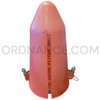
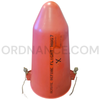
This Cold War-era military component is identified as a removable protective nose cover for the U.S. Mk 57/B57 nuclear bomb family. Its rounded shell follows the forward shape of the weapon, while two opposed clamps held it in position during storage, transport, loading, and ground servicing. The cover was removed before an aircraft departed and was not carried as part of the weapon in flight. Only the protective cover is included; no bomb or nuclear component is included. All ordnance is inert.
Identification and Features
The red-painted shell retains numerous exterior and interior markings, mounting brackets, adjustable clamps, short retaining chains, and one hairpin-style retaining clip. Codes are recorded as they appear and are not represented as model or serial numbers unless identified as such.
- Warning stencil: “REMOVE BEFORE FLIGHT H8067”
- Exterior markings: “320253-02” and “BBN-7135-G5”
- Interior markings: “N889BX65BX” and “166382-01”
- Yellow outlined diamond containing “96,” crossed out with a black X
- Faint circular inspection or acceptance stamp that is no longer readable
- Two opposed mounting brackets with adjustable screw clamps and retaining chains
Function
This cover protected the B57’s forward nose area while the weapon was handled on the ground. Its rigid shell guarded against routine contact and handling damage, while the side clamps secured it to the weapon. Retaining chains helped keep the removable clamp hardware with the cover. The large “REMOVE BEFORE FLIGHT” stencil warned ground crews that the cover had to be taken off before the aircraft departed.
Documented End-Item Application
The parent end item was the lightweight Mk 57/B57 multipurpose nuclear bomb. The U.S. Air Force employed B57 variants as tactical aircraft bombs. U.S. Navy depth-bomb configurations were documented for the land-based P-3 Orion, carrier-based S-3A Viking, and SH-3 Sea King helicopter. This listing is for the removable nose cover only and does not claim compatibility with every B57 modification.
Protective-Cover History
Removable covers formed part of the support equipment used to protect military weapons between operational steps. Covers could be installed during storage, movement, servicing, and aircraft loading, then removed during final preflight preparation. This example’s prominent warning stencil, paired clamps, and captive hardware reflect that ground-handling role.
Parent Equipment History
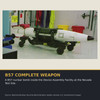
The Mk 57/B57 entered the United States nuclear arsenal in 1963. It was a compact, single-stage nuclear weapon designed for both tactical strike and antisubmarine missions. Museum records describe six models with several yield options. A complete weapon was nearly ten feet long and weighed about 500 pounds when armed, making it much lighter than many earlier nuclear bombs.
Larger Weapon-System Background
The B57 was developed during the Cold War, when the United States sought smaller nuclear weapons that could be carried by tactical aircraft and naval antisubmarine platforms. Its multipurpose design allowed related configurations to serve in land-attack and nuclear depth-bomb roles. The weapon became part of the wider air-delivered nuclear deterrent maintained by the U.S. Air Force and U.S. Navy.
History of Use
B57 weapons remained in the American stockpile for about three decades. Throughout that period, military units trained for secure storage, inspection, aircraft loading, preflight preparation, and possible delivery. Accessories such as this cover supported those ground procedures. No B57 is documented as having been used in combat, and the remaining strike and depth-bomb versions were retired in 1993.
Condition
The photographs show scratches, scuffs, abrasions, isolated paint loss, and edge wear across the red finish. The metal clamp hardware has visible tarnish, oxidation, and handling wear. Both bracket and clamp assemblies are present. One retaining chain has a hairpin-style clip, while the opposite chain’s free end appears shortened or incomplete. The interior has stains and handling marks. Fit and operation have not been tested.
Ideal For
This uncommon support component offers a direct link to Cold War nuclear-weapons handling and American military aviation history.
- Cold War and nuclear-history collections
- U.S. military aviation and ordnance displays
- Museum, educational, or interpretive exhibits
- Collectors of remove-before-flight equipment
- B57 and Mk 57 research displays
Approx length 19", Approx width 14", Approx height 14", Approx weight 4.1lbs.
Pictures are stock images of our inventory. Unless otherwise noted, you will not be receiving the exact item shown in the pictures. The pictures are representative of the item’s general condition. The item you receive might be slightly better, or worse, condition than was shown in the pictures.
Please visit our page about order lead times here: Order Lead Times.