





Description
U.S. Army Telescope M71K for M24 Chaffee 75mm Gun M6
Item Overview
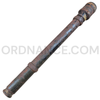
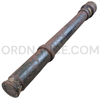
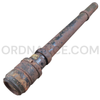
This U.S. Army Telescope M71K is a fixed-power direct-fire gunner’s sight made for the M24 Chaffee light tank. In its original installation, the telescope was secured in Telescope Mount M65 beside the 75mm Gun M6 in the M64 combination gun mount. The gunner looked through the telescope to aim the main gun at visible ground targets. This example is the optical telescope only and is detached from its separate M65 mounting assembly.
Identification and Features
The identification plate is marked “TELESCOPE M71K,” providing a firm model identification. Army technical material documents the M71K as part of the M24’s fire-control equipment and illustrates it installed in the M65 telescope mount. The telescope has fixed 5× magnification and an approximately 13-degree field of view, giving the gunner a magnified target image while retaining a practical field for tracking and aiming.
- Official designation: Telescope M71K
- Type: Direct-fire gunner’s telescope
- Magnification: Fixed 5×
- Field of view: Approximately 13 degrees
- End item: M24 Chaffee light tank
- Main armament: 75mm Gun M6
- Gun installation: Combination Gun Mount M64
- Telescope installation: Telescope Mount M65
Historical Background
The M71K belongs to the M71 family of straight optical telescopes developed for U.S. armored-vehicle fire-control systems during World War II. Individual model suffixes identified configurations intended for particular weapons and mounting arrangements. A 1945 Ordnance catalog lists the M71K among the fire-control equipment for the M24, while TM 9-729 shows the telescope installed in its M65 mount. The M71K therefore belongs to the final generation of American World War II tank sights and continued in service with the M24 after the war.
Function and Operation
The M65 mount held the M71K in alignment with the 75mm gun so the telescope followed the gun as it was elevated or lowered. The gunner viewed the target through the five-power optical system and used the graduated reticle as an aiming reference. Once the turret and gun were placed on the required line, the telescope allowed the gunner to make precise corrections before firing. It was a direct-fire sight for engaging visible targets and was not a rangefinder or a general-purpose observation telescope.
End-Item Application
The documented end-item application is the M24 Chaffee light tank. The M71K worked as part of the M24’s complete sighting installation with Telescope Mount M65, the 75mm Gun M6, and Combination Gun Mount M64. The M65 supported the telescope and maintained its relationship to the gun during aiming. This listing is for the detached M71K telescope; the M65 mount and other tank fire-control components are not included.
M24 Chaffee Weapon-System Background
The U.S. Army developed the M24 during 1943 as a replacement for the M3 and M5 Stuart light tanks. Originally designated T24, it combined a low-profile hull, torsion-bar suspension, a three-man turret, and improved firepower. Its 75mm Gun M6 was derived from the lightweight 75mm weapon developed for the B-25H Mitchell bomber. The M6 used the same general ammunition and ballistics as the Sherman tank’s 75mm Gun M3 but employed a compact recoil system suited to the smaller M24 turret. Production began in 1944, and 4,731 M24 tanks were completed before production ended in August 1945.
History of Use
M24 tanks began reaching American forces in Europe late in 1944 and entered combat during the closing months of World War II. They served with tank and cavalry reconnaissance units during the Ardennes-Alsace, Rhineland, and Central Europe campaigns. After the war, M24s performed occupation and security duties in Europe and Japan. They were among the first American tanks sent into combat during the Korean War, where heavier tanks later replaced them in front-line armored fighting. M24s then continued in their intended reconnaissance role. The M71K supported this service by giving the gunner a dedicated optical sight for the tank’s 75mm main gun.
Condition
This is a military-surplus M71K telescope with visible age, surface wear, and corrosion around the identification plate. Glare and corrosion prevent a certain reading of the serial number; it appears to fall within approximately 30117–30317. The model marking remains readable. The telescope has been removed from its M65 mounting assembly, and that mount is not included. Review the inventory photographs for the exterior condition and components supplied.
Ideal For
This original M71K is a specialized example of American armored-vehicle optical equipment from the late World War II and Korean War periods. Its documented connection to the M24 Chaffee, 75mm Gun M6, M64 gun mount, and M65 telescope mount gives it strong display and restoration value.
- M24 Chaffee restoration projects
- World War II or Korean War armor displays
- Tank fire-control collections
- Historic military-optics collections
- Ordnance and armored-vehicle exhibits
Approx length 27", Approx width 3", Approx height 3", Approx weight 12.6lbs.
Pictures are stock images of our inventory. Unless otherwise noted, you will not be receiving the exact item shown in the pictures. The pictures are representative of the item’s general condition. The item you receive might be slightly better, or worse, condition than was shown in the pictures.
Please visit our page about order lead times here: Order Lead Times.