





Description
U.S. Army M71E5C Gunner’s Telescope for M46 and M46A1 Patton Tanks
Item Overview
This U.S. Army Telescope M71E5C is a fixed-power gunner’s direct-fire sight made for the M46 and M46A1 Patton medium tanks. Installed in the T173 telescope mount, it provided the gunner with a clear aiming view aligned with the tank’s 90mm Gun M3A1. The sight uses 5× magnification and has an approximately 13-degree field of view. Its compact optical system allowed the gunner to identify and track targets while aiming the main gun during direct-fire engagements.
Identification and Features
The M71E5C was a specialized development of the earlier Telescope M71C. Army documentation identifies it as authorized gunner’s equipment for the M46 and M46A1 rather than a general observation telescope. Its fixed optical arrangement, graduated aiming reticle, locating pin, and cylindrical housing were designed for installation beside the main gun in the tank turret.
- Official designation: Telescope M71E5C
- Type: Gunner’s direct-fire telescope
- Magnification: Fixed 5×
- Field of view: Approximately 13°
- Weapon: 90mm Gun M3A1
- Telescope mount: T173
- End items: M46 and M46A1 Patton tanks
- Base design: Modified Telescope M71C
Historical Background
The M71 series began as a direct-fire sight for American 90mm tank and tank-destroyer guns during the closing period of World War II. The M71C served with systems such as the M26 Pershing and M36 tank destroyer. When the Army introduced the M46 after the war, it retained the proven 90mm gun concept but adopted an updated mounting and fire-control arrangement. The M71E5C adapted the established M71C optical design to the T173 mount used in the new Patton tank. Army publications from the early 1950s list the M71E5C as M46 and M46A1 gunner’s equipment and document procedures for correcting deflection errors when using this telescope.
M71E5C Design and Modification
The main difference between the M71C and M71E5C was the orientation of the reticle. In earlier M72 and T131 telescope mounts, the locating slot was positioned at the bottom of the installation. The T173 mount placed the locating slot in the upper portion of its adapter assembly. To keep the aiming pattern correctly oriented when the telescope was installed, the M71C reticle was rotated 180 degrees, creating the M71E5C configuration. This was an installation-specific change that allowed the proven optical system to work correctly in the M46 turret layout.
Function and Operation
The M71E5C gave the gunner a magnified sight picture and a graduated reticle for aiming the 90mm Gun M3A1. Using range information supplied through the tank’s fire-control process, the gunner selected the appropriate aiming reference and operated the turret traverse and gun-elevation controls until the reticle was placed on the target. Its fixed 5× magnification balanced target detail with a field of view wide enough for tracking during direct fire. The M71E5C was an aiming telescope; target distance was obtained separately and then applied by the crew.
T173 Mount and Fire-Control Installation
The T173 mount held the telescope in alignment with the main gun and connected it to the M46 turret’s aiming system. The mount incorporated an electronic cant corrector that could compensate for tank cant of up to 15 degrees to either side. After the telescope was leveled, the system could adjust its orientation to reduce aiming errors caused by the vehicle standing on sloped ground. Army maintenance documentation also treated the T173 as a separate serviceable component, allowing the telescope and mount to be inspected, adjusted, and maintained as parts of the complete fire-control installation.
M46 and M46A1 Patton Weapon-System Background
The M46 was developed from the M26 Pershing and accepted by the Army in 1949. It combined the Pershing’s general hull and turret design with a more powerful Continental engine, a cross-drive transmission, and the 90mm Gun M3A1. The gun was installed in the M73 combination mount and featured a bore evacuator and single-baffle muzzle brake. The M46A1 entered production in 1951 with improvements to the engine, transmission, braking, cooling, electrical, and fire-extinguishing systems. Both versions used a five-man crew, with the gunner seated in the right-front portion of the turret near the telescope and powered traverse controls.
History of Use
The M46 Patton saw major operational use during the Korean War, where its mobility and 90mm gun supported armored advances, tank engagements, and attacks on bunkers and prepared positions. As fighting became more fixed, M46 crews also conducted firing missions against enemy positions. The M71E5C was one of the authorized telescopes available to M46 and M46A1 gunners for direct-fire work. The Army’s July 1952 publication covering the elimination of deflection errors with the M71E5C shows that the sight remained part of the active M46 fire-control program during Korean War service.
Condition
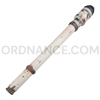
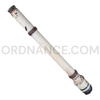
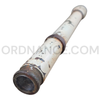
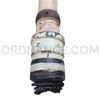
This military-surplus M71E5C telescope is offered in the condition represented by the stock images. Review the photographs for the representative condition of the exterior finish, identification markings, optical surfaces, adjustment features, and mounting areas. Internal optical condition and reticle visibility are not specified. The listing is for the telescope and does not include an M46 tank or complete T173 fire-control installation unless additional components are specifically shown or described.
Ideal For
This original-pattern tank optical sight is well suited to collections and displays focused on early Cold War armor, Korean War equipment, American military optics, and the development of armored-vehicle fire-control systems. Its documented connection to the M46 and M46A1 gives it a clearly defined place in the history of the Patton tank family.
- M46 or M46A1 restoration projects
- Korean War armored-vehicle displays
- U.S. Army optical-instrument collections
- 90mm tank-gun and fire-control exhibits
- Military museum and educational displays
Approx length 28", Approx width 3", Approx height 3", Approx weight 12.8lbs.
Pictures are stock images of our inventory. Unless otherwise noted, you will not be receiving the exact item shown in the pictures. The pictures are representative of the item’s general condition. The item you receive might be slightly better, or worse, condition than was shown in the pictures.
Please visit our page about order lead times here: Order Lead Times.