


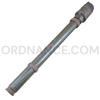


Description
U.S. Army M71D Gunner’s Telescope for 76mm M4 Sherman Tank
Item Overview
This U.S. Army Telescope M71D, stock number 7578296, is a World War II gunner’s direct-fire sight made for 76mm-armed M4-series Sherman tanks. It was installed beside the 76mm Gun M1 in the M57 telescope mount and moved with the main gun during elevation and traverse. The fixed 5× optical system gave the gunner a magnified aiming view while its graduated reticle supplied range and deflection references for engaging targets.
Identification and Features
The identification plate appears to read “TELESCOPE, M71D” and “STOCK NO. 7578296,” with an individual serial number beneath those lines. The M71D is a straight, lens-erecting optical telescope with an adjustable sunshade and a mounting collar designed for the M57 mount. The original Army configuration also used a soft rubber eyeshield and could be illuminated by the M33 instrument light carried on the telescope mount.
- Official designation: Telescope M71D
- Stock number: 7578296
- Type: Gunner’s direct-fire telescope
- Magnification: Fixed 5×
- Field of view: 13°
- Exit pupil: Approximately 6.7mm
- Telescope mount: M57
- Weapon: 76mm Gun M1 series
- End item: 76mm-armed M4 Sherman tank
Historical Background
The M71D was developed as part of the Army’s wartime effort to provide improved direct-fire optics for tanks carrying the higher-velocity 76mm gun. The 1944 Standard Ordnance Items catalog lists the M71D with the M57 telescope mount and M33 instrument light for 76mm M4-series medium tanks. Its optical arrangement followed the established American practice of mounting a straight telescope beside the gun so the sight remained aligned as the weapon moved. The M71D was tailored to the 76mm Sherman installation and its original armor-piercing ammunition rather than the earlier 75mm Sherman fire-control system.
M71D Optical Design and Reticle
The M71D provided 5× magnification with a 13-degree field of view. Its original reticle was marked “76-M62” and graduated for the 76mm M62 armor-piercing capped projectile at a listed muzzle velocity of 2,600 feet per second with a one-mil jump correction. A cross at the top served as the boresighting reference. Range numbers below it were expressed in hundreds of yards, while the horizontal lines and spaces provided five-mil deflection intervals. These markings allowed the gunner to apply range and lateral corrections without looking away from the target.
Function and Operation
The M71D served as the gunner’s direct optical sight. After receiving an estimated or measured range, the gunner selected the proper range mark in the reticle and used the turret traverse and gun-elevation controls to bring that mark onto the target. Because the telescope was mechanically aligned with the 76mm gun and moved with it, the sight remained connected to the gun’s line of aim throughout the engagement. The M71D did not measure range by itself; it displayed the aiming references needed to apply range and deflection information supplied to the gunner.
M57 Telescope Mount Installation
The M57 mount was bolted to the right side of the gun cradle in the 76mm Sherman turret. It held the telescope at the gunner’s station and included lateral and vertical adjustments for boresighting the optic to the main gun. Locating pads and a spring-loaded retaining arrangement positioned the telescope securely, while a separate bracket supported the M33 instrument light used to illuminate the reticle in low-light conditions. This listing is for the M71D telescope itself; the separate M57 mounting bracket is not shown or included.
76mm M4 Sherman Weapon-System Background
The original M4 Sherman entered service with the 75mm Gun M3, but the Army developed the longer 76mm Gun M1 to improve armor penetration and extend effective antiarmor performance. The 76mm gun was installed in a larger turret based on the experimental T23 tank turret, giving the crew more room for the gun and its controls. Production 76mm Shermans began appearing in 1944 in M4A1, M4A2, and M4A3 configurations, many with wet ammunition stowage identified by the “W” suffix. Army manuals specifically illustrate the M71D and M57 installation in the M4A1(76)W. The M71D should not be assigned to the 75mm Sherman sighting system or confused with the M76C and M55 combination documented for the M18 76mm Gun Motor Carriage.
History of Use
American 76mm Sherman tanks entered combat in Europe during 1944 and served through the campaigns in France, Belgium, the Rhineland, the Ardennes, and Germany. Their crews used the higher-velocity gun against armored vehicles, antitank positions, buildings, and other point targets. During these direct-fire engagements, the gunner depended on a properly boresighted telescope to place accurate fire while the tank was halted or operating with its stabilized gun system. The M71D and M57 mount formed one documented direct-sight arrangement for these 76mm Sherman tanks during the closing campaigns of World War II.
Condition
This original military-surplus telescope has a heavily weathered exterior finish with visible age and storage wear. The rubber eyeshield appears to be missing or substantially deteriorated. The identification plate remains present, although the serial number has not been confidently transcribed. The separate M57 mounting bracket is not included. Internal optical condition, reticle visibility, seals, and adjustment operation are unknown.
Ideal For
This M71D is suited to a 76mm M4 Sherman restoration, a World War II armored-vehicle display, or a collection centered on American tank optics and fire-control equipment. Its identifiable stock number, specialized M62 reticle, and documented M57 mounting arrangement connect it directly to the development and combat service of the 76mm Sherman.
- 76mm M4 Sherman restoration
- World War II armored-vehicle display
- Tank gunsight and optical-instrument collection
- 76mm Gun M1 fire-control exhibit
- Museum or educational display
Approx length 28", Approx width 3", Approx height 3", Approx weight 12.2lbs.
Pictures are stock images of our inventory. Unless otherwise noted, you will not be receiving the exact item shown in the pictures. The pictures are representative of the item’s general condition. The item you receive might be slightly better, or worse, condition than was shown in the pictures.
Please visit our page about order lead times here: Order Lead Times.