






Description
Factory Cutaway M577A1 Mechanical Time and Superquick Artillery Fuze – Inert Display
Item Overview
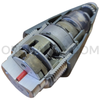
This is an inert factory cutaway of the U.S. M577A1 Mechanical Time and Superquick (MTSQ) artillery fuze. A longitudinal section through the body exposes the setting dials, clockwork gear train, springs, rotor, safety parts, and threaded projectile connection. It was prepared as a technical display for studying the fuze’s internal construction and operation.
Identification and Features
The three numbered setting dials, nose setting key, compact clockwork, safe-separation mechanism, and standard artillery-fuze body match documented M577A1 construction. The handwritten “577” label visible on the base is a later identification label rather than a factory marking.
- Model: M577A1
- Type: Mechanical Time and Superquick (MTSQ)
- Configuration: Inert factory longitudinal cutaway
- Time range: 2 to 200 seconds
- Setting method: M35 fuze setter or flat screwdriver
- Service assembly drawing: 9352381
- DODIC: N285
- Service-reference NSNs: 1390-01-158-8194 and 1390-01-247-4013
- Service-fuze reference size: 5.28 inches overall, 3.77 inches visible
- Service-fuze reference weight: approximately 1.41 pounds
- Configuration: Without booster
Mechanical Time and Impact Functions
The service M577A1 used a mechanical clockwork to function at a selected time during projectile flight. Three dials displayed hundreds, tens, seconds, and tenths of seconds against a reference line. In time mode, the fuze initiated an expulsion charge that released a projectile’s carried payload in flight. Unlike the earlier M577, the M577A1 did not use a separate point-detonating element in its nose. Its safe-separation assembly also acted as an inertial element to initiate the superquick impact function.
Safety and Arming System
The service design used setback and projectile spin to release internal safety locks after firing. A rotor kept the firing train out of alignment before arming, while the timing mechanism controlled when the remaining parts could move into operating position. This sequence helped prevent functioning during normal storage, handling, and initial travel from the weapon. The exposed mechanisms in this cutaway allow these normally hidden relationships to be studied.
Documented Ammunition Applications
Army technical manuals document the M577A1 and M577 series for 4.2-inch and 105mm cartridges and for 155mm and 8-inch projectiles carrying payloads released during flight. Specific documented examples include M314-series 105mm illumination and M916 105mm DPICM ammunition. M577-series combination tables also cover 155mm base-ejection ammunition such as the M483A1 DPICM, M485 illumination, M692 and M731 ADAM mine projectiles, M718 and M741 RAAMS mine projectiles, M825-series smoke, and M864 extended-range DPICM. Authorized use depended on the projectile, weapon, propelling charge, and applicable firing tables.
M577A1 Development History
The original M577 received Standard A classification in March 1973. The improved M577A1 received Standard A classification in June 1984. The A1 retained the basic 2-to-200-second setting system but revised the impact mechanism and wrench-slot arrangement. Military specification MIL-F-64042 covered the loading, assembly, packing, and metal parts of M577A1 fuzes before that specification was canceled in 1996.
Parent Artillery and Mortar Systems
The ammunition families associated with M577-series fuzes were fired from several U.S. indirect-fire weapons. These included the M30 4.2-inch mortar, M101 and M102 105mm howitzers, later M119-series 105mm howitzers, M114 and M198 155mm towed howitzers, M109-series 155mm self-propelled howitzers, and M110-series 8-inch self-propelled howitzers. Together, these systems supplied infantry, airborne, armored, and general-support units with timed airburst and payload-delivery capability.
Base-Ejection Weapon-System Background
Base-ejection projectiles carried illumination canisters, smoke material, grenades, or scatterable mines inside the projectile body. The gun crew set the fuze for the time calculated by fire direction. At the selected point in flight, the fuze initiated an expulsion charge, which moved a pusher plate and forced the payload through the projectile’s rear opening. Spin then spread the payload over the intended area.
History of Use
The M577 family supported U.S. artillery from the 1970s, with the M577A1 entering standardized service during the later Cold War. It served during the period when M109, M198, and M110 artillery systems equipped U.S. and allied forces, including the Gulf War era. Factory cutaways were useful for ordnance instruction because they allowed students and maintenance personnel to examine the fuze’s clockwork, setting system, and safety-and-arming parts without disassembling a service fuze.
Condition
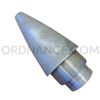
The photographs show a purpose-made longitudinal section with clean machined openings through the body and ogive. The timing dials, gears, springs, rotor, safety parts, and threaded base remain visible. The metal surfaces show scratches, handling marks, and areas of discoloration consistent with storage and instructional use. A paper label handwritten “577” is attached to the base. A separate conical threaded metal component is also pictured, but its exact designation is not established by the visible markings. All ordnance is inert.
Ideal For
This detailed mechanical cutaway is suited to collections and displays focused on American artillery ammunition, fuze development, and Cold War military technology.
- U.S. artillery and ordnance collections
- M109, M114, M198, or M110 weapon-system displays
- Military museums and educational exhibits
- Mechanical fuze and cutaway collections
- Artillery training-room or classroom displays
Approx length 5.5", Approx width 2.5", Approx height 2.5", Approx weight 3lbs.
Pictures are stock images of our inventory. Unless otherwise noted, you will not be receiving the exact item shown in the pictures. The pictures are representative of the item’s general condition. The item you receive might be slightly better, or worse, condition than was shown in the pictures.
Please visit our page about order lead times here: Order Lead Times.