


Description
U.S. Army Large Split Sleeve Bushing G104-04-00280 for M3/M4 Medium-Tank Family
Item Overview
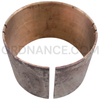
This large split sleeve bushing is identified by its military tag as “BUSHING,” stock number G104-04-00280, U.S.A. The historical G104 catalog prefix associates the part with the Army supply family covering the M3 and M4 medium tanks and related variants. It is a formed bearing component designed to provide a replaceable wear surface between larger mechanical parts. The stock number establishes its G104 vehicle-family association, but the surviving identification does not specify a particular tank model or mounting position.
Identification and Features
The bushing has a large split cylindrical body measuring approximately 4.5 inches in diameter and 3 inches high. It appears to have a steel outer backing with a bronze-colored inner bearing surface. Paired notches are present along its edges, and the metal is stamped “10” above an unidentified maker’s emblem. These features are consistent with a heavy-duty bearing liner intended to be pressed into a machined housing. The split permits controlled compression during installation and helps the bushing conform to its mounting bore.
- Nomenclature: Bushing
- Stock number: G104-04-00280
- Supply-catalog family: G104
- Associated equipment family: M3 and M4 medium tanks
- Country notation: U.S.A.
- Metal marking: “10” above maker’s emblem
- Form: Split cylindrical sleeve
- Apparent construction: Steel backing with bronze-colored bearing surface
Function and Operation
A sleeve bushing fits between a rotating or moving part and the larger housing that supports it. Its inner surface carries the movement while its outer surface remains seated in the housing. This arrangement reduces direct wear on major parts and allows the bushing to be replaced during maintenance instead of replacing an entire housing or mechanical assembly. The bronze-colored bearing surface would provide a durable, low-friction contact area, while the apparent steel backing would support the bushing under load. The split body allows the part to compress slightly as it is pressed into its bore, and the paired edge notches may have been used to help secure or align it after installation.
End-Item Application
The G104 prefix belongs to the U.S. Army supply-catalog family for the Medium Tank M3, Medium Tank M4, and their modifications. This establishes the bushing as a component associated with that broader tank family. It does not establish whether the part was common to every M3 or M4 model, and it does not identify one exact installation point. The bushing’s apparent steel-backed bronze construction and paired edge notches are similar to the differential compensating-case bushings described in TM 9-1750. That manual documents one bushing in the compensating case and one in each cover, but the exact G104-04-00280 stock number has not been matched to those positions.
Historical Background
The U.S. Army developed the Medium Tank M3 during the rapid expansion of American armored forces before World War II. Its design placed a 75mm gun in the hull and a 37mm gun in a rotating turret, giving the Army a tank that could be produced while a fully turreted 75mm design was being completed. The later M4 Sherman carried its main gun in a fully rotating turret while retaining important mechanical development from the M3, including elements of its lower hull, suspension, and power train. The M3 provided valuable early wartime service, especially in North Africa, before the M4 replaced it as the principal American medium tank. M4 variants served in North Africa, Europe, the Pacific, and with numerous Allied armies, making the Sherman family one of the most widely used armored-vehicle systems of World War II.
History of Use
M3 and M4 tanks required regular inspection and rebuilding of their engines, transmissions, differentials, final drives, suspension components, and other heavily loaded mechanical assemblies. Army ordnance shops used replaceable bushings to restore proper bearing surfaces without replacing large and costly housings. TM 9-1750 instructed maintenance personnel to remove steel-backed bronze compensating-case bushings when they were worn or damaged beyond use. Replacement bushings were pressed into their bores and secured by peening their edges into notches in the case. The size, apparent materials, split construction, and edge notches of this G104 bushing are consistent with that period method of tank maintenance, although its exact position has not been verified.
Condition
The bushing retains its large split-sleeve form, visible outer backing, bronze-colored inner surface, paired edge notches, and stamped “10” with maker’s emblem. Its accompanying military identification tag retains the BUSHING nomenclature, G104-04-00280 stock number, and U.S.A. notation. Surface finish, patina, scratches, staining, and storage wear may vary between inventory examples. This listing is for the bushing only and does not include a tank housing or related mechanical assembly.
Ideal For
This tagged G104 component is well suited for collectors of American armored-vehicle parts, M3 and M4 tank displays, restoration research, military maintenance exhibits, and the study of World War II tank construction. Its large size, layered bearing construction, surviving stock-number identification, and connection to the G104 supply family make it a useful example of the service parts maintained by Army ordnance personnel. It also provides a strong research piece for collectors working to document individual power-train and running-gear components from the M3 and M4 medium-tank families.
- M3 medium-tank collections
- M4 Sherman displays
- World War II armor exhibits
- Tank power-train research
- Military maintenance displays
- Historic vehicle restoration reference
Approx length 4.5", Approx width 4.5", Approx height 3", Approx weight 1 lb.
Pictures are stock images of our inventory. Unless otherwise noted, you will not be receiving the exact item shown in the pictures. The pictures are representative of the item’s general condition. The item you receive might be slightly better, or worse, condition than was shown in the pictures.
Please visit our page about order lead times here: Order Lead Times.