






Description
U.S. M19 New-Configuration (M19A1) Active-Infrared Driver’s Periscope for M113 Family, P/N 11747126, NSN 1240-01-005-6035 — Fraser-Volpe, 1983
Item Overview
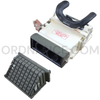
This original U.S. M19 new-configuration driver’s night periscope was manufactured by Fraser-Volpe Corporation in March 1983. Later Army vehicle manuals designated this same P/N 11747126 and NSN 1240-01-005-6035 as the M19A1. It provided a binocular view for driving compatible M113-family vehicles at night with infrared headlights. This Cold War optical instrument is an excellent display item for an armored-vehicle, night-vision, or military electronics collection.
Identification and Features
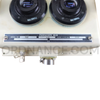
The identification plate is marked M19, P/N 11747126, NSN 1240-01-005-6035, 3/83, and serial number 002. FSCM 19200 identifies the U.S. Army design authority at ARRADCOM, Picatinny Arsenal, while FSCM 55096 identifies Fraser-Volpe Corporation as the manufacturer. The March 1983 date falls within the ARRADCOM period, making ARRADCOM the correct historical organization rather than the later ARDEC name.
- Model: M19, new configuration
- Later designation: M19A1
- Item type: Binocular driver’s night periscope
- Operating principle: Active infrared
- Part number: 11747126
- NSN: 1240-01-005-6035
- Magnification: 1×
- Field of view: 26.8 degrees
- Date marking: 3/83, March 1983
- Design authority: FSCM 19200, U.S. Army ARRADCOM at Picatinny Arsenal
- Manufacturer: FSCM 55096, Fraser-Volpe Corporation
- Serial number: 002
- Original operating voltage: Approximately 16,000 VDC
M19 and M19A1 Designations
The M19 marking on this 1983 unit is historically correct. The Army’s 1980 support manual identifies NSN 1240-01-005-6035 as the “M19—New Configuration” and assigns P/N 11747126 to that version. Later M113-family manuals use the M19A1 designation for the same NSN and part number. The different names reflect a change in Army terminology, not evidence that the identification plate is incorrect.
New-Configuration Features
The earlier M19 used separate left and right focus controls beneath the body. Army maintenance instructions state that these controls were removed from the new configuration. The newer body retained the binocular eyepieces, adjustable headrest, locking assembly, trunnion, electrical connection, image-converter system, and removable upper head. These details help separate P/N 11747126 from the older M19 body, P/N 7652971.
How the Periscope Worked
The M19 was an active-infrared viewing system rather than a thermal imager or passive starlight scope. Infrared headlights projected light that could not normally be seen by the unaided eye. Objects ahead of the vehicle reflected those infrared rays back to the periscope. A prism in the upper head directed the returning light into two image-converter tubes, which changed it into a visible binocular image for the driver. The system offered a natural 1× view with a wide 26.8-degree field of view.
Viewing Range and Focus
Army maintenance data states that the periscope was focused at approximately 18 meters in front of the vehicle. Army field doctrine gave active-infrared night-driving equipment a planning range of about 40 meters under suitable conditions. Actual visibility depended on the infrared headlights, weather, dust, terrain, target reflectivity, electrical condition, and condition of the optical and converter components.
Head Assembly
The upper head contains the prism that receives infrared light from outside the vehicle and directs it down into the body assembly. Army records list Head Assembly, Tank Periscope P/N 7688707, NSN 1240-00-768-8707, as the replacement head used with M19 and M19A1 periscopes.
- Documented head description: Head Assembly, Tank Periscope
- Documented head part number: 7688707
- Documented head NSN: 1240-00-768-8707
- Verification status: Correct Army replacement assembly; marking not physically verified on this example
Documented Vehicle Applications
Army records directly document P/N 11747126 in numerous M113-family tracked vehicles. These applications include personnel carriers, command vehicles, mortar carriers, smoke-generator vehicles, and specialized fire-support vehicles. The common periscope design allowed the Army to support several related vehicles with one driver’s night-viewing unit.
- A2-series applications: M113A2, M577A2, M106A2, and M125A2
- Other documented applications: M1059, M1064, and M1068
- A3-series applications: M113A3, M577A3, M901A3, M981A3, M1064A3, M1068A3, and M1059A3
- Documented exclusion: The M113A3-family hand receipt specifically excludes the M58 from this application listing
Important Application Distinctions
This P/N 11747126 M19/M19A1 should not be listed as the complete periscope for the M60 tank or M728 Combat Engineer Vehicle. Those vehicles used the taller M24/M24A1 new-configuration unit, P/N 11747127. The M47 tank used an earlier member of the M19 family, but the later 11747126 body has not been directly documented for that vehicle. The M163 Vulcan Air Defense System also used an M19-family driver’s periscope, but available Army documentation does not directly confirm P/N 11747126 for that application. The shared P/N 7688707 head assembly may explain why M19 and M24 applications are sometimes combined in surplus descriptions.
M113 Family History
The M113 entered U.S. Army service during the early 1960s as a lightweight aluminum armored personnel carrier. Its simple tracked chassis became the base for command, mortar, recovery, antitank, air-defense, smoke-generator, and support vehicles. The family saw major use during the Vietnam War and continued through the Cold War and later military operations. A2 and A3 upgrades improved the vehicle family while retaining many common components, including driver observation equipment.
History of Use
Active-infrared periscopes helped vehicle drivers move at night without using normal visible headlights. M19-family equipment supported night marches, tactical movement, training, and operation under blackout conditions. This March 1983 example was manufactured after most U.S. combat operations in Vietnam and represents the later Cold War support of M113-family vehicles. Active-infrared systems were important steps in military night driving before passive image intensifiers and thermal viewers became more common.
High-Voltage and Optical Safety
This periscope was designed to operate with a high-voltage vehicle power supply of approximately 16,000 volts DC. Do not connect or casually bench-test it with improvised equipment. Army instructions require power to be switched off for at least two minutes, and the viewed image to disappear, before disconnecting the high-voltage cable. Direct sunlight entering the optical system can also damage the image-converter components. This item should be treated as untested vintage electrical equipment unless professional testing is specifically documented.
Condition
This is an original military optical and electrical instrument dated March 1983. It may show scratches, paint wear, oxidation, discoloration, worn rubber, dust, cloudy optics, aged seals, missing finish, or other signs of military service and storage. No claim of present electrical or optical operation is made unless specifically stated. This listing is for the periscope assembly only; vehicle mounting parts, high-voltage power supply, electrical cables, infrared headlights, manuals, and other accessories are not included unless specifically shown or described. Please check the pictures for the general condition of the item.
Ideal For
This M19 new-configuration periscope is well suited for collections and exhibits covering armored vehicles, the M113 family, Cold War electronics, and the development of military night-vision equipment. Its early serial number, dated Fraser-Volpe identification plate, and documented vehicle applications make it an interesting technical display.
- M113-family vehicle restorations
- Cold War armored-vehicle collections
- Military night-vision exhibits
- U.S. Army optics and electronics collections
- Museums and educational displays
- Tracked-vehicle parts collections
Approx length 6", Approx width 8.25", Approx height 15.25", Approx weight 15.625 lbs.
Pictures are stock images of our inventory. Unless otherwise noted, you will not be receiving the exact item shown in the pictures. The pictures are representative of the item’s general condition. The item you receive might be slightly better, or worse, condition than was shown in the pictures.
Please visit our page about order lead times here: Order Lead Times.