







Description
U.S. M11 Red Star Parachute Aircraft Signal, August 1940
Item Overview
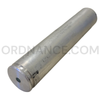
This inert U.S. M11 aircraft signal example preserves a dated piece of WWII aviation survival equipment. It includes the marked aluminum outer barrel and a separate shorter tube. The August 1940 date places its production before the United States entered World War II, adding interest for collectors of early military aviation equipment.
Identification and Features
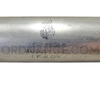
The markings record the signal's model, color, parachute type, production date, lot, and manufacturer initials. For reference, the Army's 1944 ordnance catalog lists the complete service signal as 7.69 inches long and 1.56 inches in diameter, weighing 9.6 ounces. Those figures describe the assembled service item.
- Model marking: M11 SIGNAL
- Full identification: SIGNAL AIRCRAFT / RED STAR PARACHUTE M11
- Date markings: AUG '40 / AUGUST 1940
- Production lot: LOT 2751-5
- Manufacturer markings: I.F.S. / I.F.S. DIV.
- Aluminum outer barrel with primer retained in its base
- Two separate tubular components
Function
The service M11 produced a bright red light suspended beneath a parachute. Its documented burn time was about 30 seconds, with a rated intensity of 20,000 candlepower. The parachute slowed the light's descent, giving observers more time to see the signal. Its purpose was to draw attention to an aircraft crew needing assistance.
Documented End-Item Application
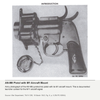
The 1944 Army ordnance catalog identifies the M2 and M8 pyrotechnic pistols as launchers for the M11. The Army's December 1943 Military Pyrotechnics manual also lists the M9 hand projector for the rimless aircraft-signal family that included this model. These references place the M11 within the military's established aircraft signaling equipment.
Product History
The August 1940 markings document manufacture during the early years of World War II. I.F.S. identifies International Flare-Signal, listed in the 1941 Aircraft Year Book as the International Flare-Signal Division of the Kilgore Manufacturing Company in Tipp City, Ohio. The yearbook records the division supplying parachute flares and signals to commercial aviation, the U.S. Government, and foreign governments. This example connects that industry history with a specific dated production lot.
Parent-Equipment History
The M2 and M8 were portable pyrotechnic pistols listed in wartime Army references. The AN-M8 was developed during World War II and used an aluminum frame with a hinged steel barrel. Army manuals recognized it for use with or without an aircraft mount, giving the signaling system both installed and portable roles.
Weapon-System Background
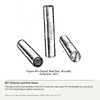
Military aviation used pyrotechnic signals to pass information between aircraft and between aircrews and ground personnel. Different colors and effects identified single-star, double-star, cluster, and parachute signals. Standard names, markings, and identification tops helped crews distinguish these types. The M11 belonged to the rimless aircraft-signal group, whose long cylindrical barrel contained a separate internal signal case.
History of Use
The M11 was authorized as a distress signal from a grounded aircraft to a rescuing aircraft or ground party. By 1944, the Army catalog retained it as standard for issue and manufacture, while the M14 red-star cluster, M15 white-star blinker, and M16 green-star blinker signals were classified as limited standard. This record connects an early-production example with a signal model that remained part of the wartime rescue system.
Condition
This is an inert, two-piece example presented with the longer marked barrel and separate shorter tube. The primer remains in the base of the longer barrel. Please check the pictures for the general condition of the item.
Ideal For
This piece fits displays about the equipment that helped aircrews signal for rescue. Its dated markings also support reference collections organized by manufacturer, model, and production lot.
- WWII U.S. aviation and aircrew-survival collections
- M11 aircraft-signal and military pyrotechnics displays
- M2 and M8 signal-pistol reference collections
- International Flare-Signal and Kilgore manufacturing history
- Military museums and aviation rescue exhibits
Approx length 7.5", Approx width 1.5", Approx height 1.5", Approx weight lbs.
Please visit our page about order lead times here: Order Lead Times.