





Description
Kaman H-43 / HH-43 Huskie Left-Hand Rotor Shaft and Housing Assembly
Item Overview
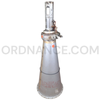
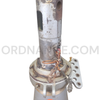
This U.S. military rotor shaft and housing assembly was made for the Kaman H-43 and HH-43 Huskie helicopter family. A surviving warning label identifies the complete unit as a rotor shaft and housing assembly, while the marked upper structure identifies it as the left-hand assembly. This substantial piece of flight hardware supported one side of the Huskie’s unusual twin intermeshing-rotor system. It includes several marked flanges, mounting brackets, and related structural components.
Identification and Features
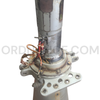
The assembly carries several Kaman drawing or component numbers that document its construction. The left-hand identification is marked directly on the mounting structure. Serial number B8-4B7 belongs to the marked subassembly and should not be treated as the serial number of the complete rotor tower.
- Item: Rotor Shaft and Housing Assembly
- Aircraft family: Kaman H-43 / HH-43 Huskie
- Configuration: Left-hand assembly
- Lower flange: K774532
- Upper flange: K774535-11
- Mounting bracket: K774677-MB
- Left-hand assembly marking: K774676-1A L.H. ASSY.
- Inside gear-shaft bracket: K774593-11
- Wire-mount bracket: A MARMAN 19412
- Marked subassembly serial number: B8-4B7
- Technical-order family: Kaman K-600
- Overhaul reference: T.O. 3R12-2-3, Rotor Shaft and Housing Assembly Overhaul
Historical Background
The rotor shaft and housing was an overhaulable part of the military maintenance system for the Kaman K-600 helicopter family. Air Force Technical Order 3R12-2-3 was devoted to the overhaul of K-600 rotor shaft and housing assemblies. The separate numbers on the flanges, mounting brackets, and internal gear-shaft bracket reflect the unit’s multi-part construction and helped maintenance personnel identify its components. Assemblies of this type could be removed from the aircraft and serviced as complete units during scheduled maintenance or repair.
End-Item Application
This assembly is associated with the Kaman H-43 and HH-43 Huskie helicopter family. The left-hand marking identifies its position within the helicopter’s paired rotor-mast installation. The K-600 designation connects the assembly with the broader Kaman military helicopter family that included Air Force rescue and firefighting versions of the Huskie. The marked component numbers and specialized construction distinguish it from a general-purpose helicopter transmission or bearing housing.
How It Worked
The Huskie used two angled rotor shafts positioned beside one another. Each shaft drove a rotor in the opposite direction, and the rotor blades passed through the same area without striking because the transmission kept them precisely synchronized. The rotor shaft carried power to the rotor head, while the surrounding housing supported and aligned the shaft and its bearings. The housing also transferred flight loads from the turning rotor into the helicopter’s supporting structure. This intermeshing arrangement balanced rotor torque without requiring a tail rotor.
Aircraft-System Background
The H-43 belonged to Kaman’s K-600 family of intermeshing-rotor helicopters. The U.S. Air Force received its first H-43A aircraft in November 1958, followed by the turbine-powered H-43B beginning in June 1959. In 1962, the Air Force changed the designation from H-43 to HH-43 to show its primary rescue mission. Later HH-43F aircraft continued the basic Huskie design with changes intended for improved rescue performance. The aircraft’s wide rotor system, compact fuselage, and lack of a tail rotor made it well suited to working near runways, damaged aircraft, and confined rescue areas.
History of Use
The Air Force first used the H-43 and HH-43 for local base rescue and aircraft-fire response. Crews remained on alert near active runways and could quickly carry firefighters, rescue personnel, or a sling-loaded fire-suppression kit to an accident. During the Southeast Asia War, HH-43 crews operated under the radio call sign “Pedro” and expanded their work to combat search and rescue. These helicopters carried pararescuemen, used rescue hoists to recover injured or downed personnel, and supported rescue operations near air bases. The Huskie’s rotor-shaft assemblies were central to every mission because they supported the synchronized rotor system that gave the aircraft lift and control.
Condition
This is a surplus rotor shaft and housing assembly with its left-hand ring structure, flanges, mounting brackets, and marked hardware present as shown in the inventory photographs. The listed identification and component markings remain visible. Surface finish and signs of storage or handling may vary between examples. Internal condition, overhaul status, and serviceability are unknown.
Ideal For
This original assembly is well suited to a Kaman Huskie restoration, museum display, technical exhibit, or study of early intermeshing-rotor aircraft. Its size, mechanical construction, and numerous component markings make it a strong display piece for collections centered on Air Force rescue aviation, helicopter engineering, or the Southeast Asia War.
- Kaman H-43 and HH-43 restoration projects
- Military aviation museums
- Cold War and rescue-aircraft collections
- Rotorcraft engineering displays
- Technical training and historical study
Approx length 18", Approx width 18", Approx height 52", Approx weight 95.7lbs.
Pictures are stock images of our inventory. Unless otherwise noted, you will not be receiving the exact item shown in the pictures. The pictures are representative of the item’s general condition. The item you receive might be slightly better, or worse, condition than was shown in the pictures.
Please visit our page about order lead times here: Order Lead Times.