








Description
WWII Japanese Provisional Type 2 Torpedo Steering Gyroscope with Original Wooden Case
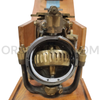
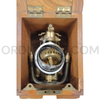
This WWII Japanese torpedo gyroscope is identified to Yokosuka Naval Arsenal and comes in its original wooden storage case. The case names a provisionally designated Type 2 vertical-rudder steering mechanism, while the nameplate and component markings repeat Yokosuka No. 18. The set brings together a precision steering instrument, its marked case, and a blue spare-parts quantity label. These surviving details make it a useful reference for collectors studying Imperial Japanese Navy equipment and mechanical torpedo guidance.
Identification and Features
The instrument and original case preserve several important identifying features:
- WWII Japanese torpedo course-steering gyroscope.
- Yokosuka Naval Arsenal nameplate.
- Provisionally designated Type 2 vertical-rudder steering mechanism.
- Yokosuka No. 18 identification and repeated component numbers.
- Original wooden storage case with black brush-style lettering.
- Blue spare-parts quantity label with coded entries.
- Left/right direction scale with arrows, divisions, and a central zero index.
Function and Contents
The gyroscope supplied a stable reference for the torpedo's left/right course. Its spinning wheel operated within pivoting rings, allowing the steering mechanism to respond to changes in direction and control the vertical rudders. Separate depth controls managed up/down movement. The wooden case stored and protected the instrument, while its parts label recorded service components associated with the mechanism. The included set consists of the gyroscope and original marked case with its identification plate and parts-list label.
Documented Applications
The documented equipment category is a Japanese naval torpedo's course-steering system. The case inscription specifically names a vertical-rudder steering mechanism and its storage case. In this terminology, vertical rudders control left/right direction; the term does not mean vertical depth control. The Yokosuka nameplate and matching number markings connect the instrument with the arsenal and case. The Type 2 designation is preserved as the steering mechanism's provisional name, keeping the component identity distinct from the names of complete torpedoes.
Product History
The original case preserves a working equipment designation alongside a formal arsenal nameplate and identifying number. “Provisionally designated” is part of the historic name and is important to retain when describing this item. The repeated 18 markings add a link between the case and instrument components. Surviving Japanese defense archive catalogs list separate Yokosuka recordbooks for torpedoes and vertical-rudder steering mechanisms. That documented practice gives context to this set's numbered instrument, storage markings, and maintenance-parts record.
Nameplate and Wooden Case Translations
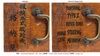
The nameplate reads 横須賀海軍工廠, meaning “Yokosuka Naval Arsenal,” and 横第18號, meaning “Yokosuka No. 18.” The character 横 abbreviates Yokosuka, while 第18號 identifies number 18. No separate logo or inspection emblem is visible on this plate. The black brush-style case lettering reads 假稱二式縱舵機, translated as “Provisionally designated Type 2 vertical-rudder steering mechanism.” The additional wording 格納筐 means “Storage case.” Together, these inscriptions identify the naval establishment, equipment designation, and purpose of the wooden box.
Direction Scale and Matching Numbers
The direction scale is labeled 左 for “Left” and 右 for “Right,” with two outlined arrows accompanying the words. Short engraved ticks divide the numbered scale, which extends outward on both sides. The central index line aligns with zero. These markings belong to the instrument's course-control indication. The lower marking reads 18, and the upper-ring markings also read 18 when viewed upright. They appear to be matching part identifiers, separate from the numbered direction scale.
Spare-Parts Quantity Label
The blue label is headed 補用品員數表, meaning “Spare Parts Quantity List.” Its columns are “Code,” “Name,” and “Quantity.” The entries below transcribe the written list. Red strokes cross out rows b, e, and i, but the reason is not stated. The specific fitting term in row i is partly obscured and has not been reconstructed. The label documents the service parts recorded for the mechanism; it is not a verified inventory of loose spares included with the item.
- a: Inner-ring pivot screws — 4.
- b: Air-adjusting screw nuts — 2.
- c: Cup centers for inner-ring pivot screws — 2.
- d: One can containing 14 balls.
- e: Air-adjusting screws — 2.
- f: Slide-valve fixing screws — 2.
- g: Inner/outer-ring clamping screws — 8.
- h: Upper outer-ring pivot — 1.
- i: Upper outer-ring pivot fitting — 1.
Bracket Stamp and Unidentified Impression
The bracket is stamped 横18, meaning “Yokosuka 18,” consistent with the case nameplate. Above and partly overlapping 横 is a circular, rosette-like impression. Closely spaced radial cuts surround a largely plain center. Its maker and purpose remain unconfirmed. The supplied photograph does not establish whether it is a factory emblem, an inspection mark, or another kind of impression, so it is described by its visible form.
Yokosuka Naval Arsenal History
Yokosuka's naval industry began with an ironworks project established in 1865 under Japan's Tokugawa government. French naval engineer François Léonce Verny helped develop the facilities, which continued to expand under the Meiji government. The site became a major center for shipbuilding, machinery production, and naval engineering. During World War II, Yokosuka was one of the Imperial Japanese Navy's largest shipbuilding and repair centers. Its work also included torpedoes and separately identified steering equipment, as shown by surviving wartime records. After Japan's defeat, the shipyard facilities became part of the American naval presence at Yokosuka.
Equipment History
Gyroscopic course control was established in naval torpedoes well before World War II. Earlier Whitehead torpedo descriptions explain a gyroscope working through steering valves to control vertical rudders. Japanese naval archives preserve records for several generations of steering mechanisms, including Fourth Year and Type 98 equipment made at Yokosuka. As torpedo designs changed, their control units also carried separate model names and identification numbers. Accurate course keeping became especially important over long underwater runs, where a small directional error could cause a large miss.
Weapon-System Background
The Imperial Japanese Navy used several torpedo families for different launch platforms. The 610mm Type 93 armed surface warships, the 533mm Type 95 served submarines, and the 450mm Type 91 was a major aircraft-carried torpedo. These are examples of the wider wartime torpedo program, rather than confirmed parent models for this provisional Type 2 steering unit. A complete torpedo combined propulsion, a warhead, depth control, and course steering. The gyroscope supported the last of these tasks, helping the weapon follow the course established for its underwater run.
History of Use
The wider combat history of Japanese torpedoes includes surface battles, submarine attacks, and naval air operations across the Pacific. During the Battle of Tassafaronga on the night of November 30–December 1, 1942, Japanese destroyer torpedoes sank USS Northampton and heavily damaged Minneapolis, New Orleans, and Pensacola. That action shows the importance of torpedoes in Japanese naval warfare. Steering equipment also required inspection, careful storage, and maintenance away from combat. The original case and coded parts label preserve evidence of the equipment-management practices that supported these precision instruments.
Postwar Technical Study
The U.S. Naval Technical Mission to Japan was established in August 1945 to study Japanese naval technology. Its investigators examined equipment and prepared reports during 1945–1946, including separate studies of ship and aircraft torpedoes. Those records became important references for understanding Japanese propulsion and control systems. Surviving instruments, marked cases, and parts labels can be compared with period reports to study construction, identification, and maintenance. This boxed gyroscope retains the physical and written details useful for that kind of historical research.
Condition
The gyroscope is supplied in its original wooden case with the described nameplate, painted markings, and blue parts label. The last parts-list entry is partly obscured, and three rows have red cross-out strokes. Please check the pictures for the general condition of the item.
Ideal For
This boxed Yokosuka torpedo gyroscope suits collections and exhibits focused on Japanese naval engineering, mechanical course control, and the identification of wartime equipment.
- WWII Japanese naval collections.
- Torpedo guidance history displays.
- Yokosuka Naval Arsenal research.
- Mechanical instrument collections.
- Japanese military markings studies.
Approx length ", Approx width ", Approx height ", Approx weight lbs.
Pictures are stock images of our inventory. Unless otherwise noted, you will not be receiving the exact item shown in the pictures. The pictures are representative of the item’s general condition. The item you receive might be slightly better, or worse, condition than was shown in the pictures.
Please visit our page about order lead times here: Order Lead Times.