



Description
U.S. Army M76-Series Direct-Fire Gun Telescope – M76C, M76F, or M76G
Item Overview
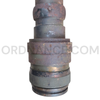
This original U.S. Army M76-series direct-fire gun telescope was built for installation beside the main gun of an armored combat vehicle. It was secured in a telescope mount and moved with the gun during elevation and traverse. This was a vehicle-mounted gunner’s sight, not a handheld observation or spotting scope. The documented tube number identifies the body as part of the M76C, M76F, and M76G family, with the M76F remaining the most plausible version based on its construction and related component markings.
Identification and Features
The telescope has the long armored optical tube, two spherical mounting collars, locating pin, adjustable diopter ring, and enlarged forward optical housing associated with the M76 family. The spherical collars allowed the tube to be held and aligned in its vehicle-mounted bracket, while the locating pin maintained its installed position. The missing identification plate prevents the exact suffix from being read directly.
- Tube marking: 7638325, officially documented as the tube used on the M76C, M76F, and M76G.
- Main-body marking: 7638289.
- Larger forward flange marking: 7638290.
- Smaller forward flange marking: 7580558.
- Eyepiece-area marking: B271322, similar in format to the documented B271321 eyepiece-cap assembly but not the same drawing number.
- M76F optical specification: Fixed 3× magnification with a 21°30′ field of view.
- M76F reticle identification: Part number 7669503 etched along the lower edge of the reticle.
- Known missing components: Identification plate and apparent rubber eyeshield.
Development and Parts History
The M76 series belonged to a family of U.S. Army direct-fire telescopes developed during World War II for armored-vehicle cannon. The M76C, M76F, and M76G shared major structural and optical components, which simplified production and repair while allowing each version to use a reticle matched to a particular weapon and ammunition type. The Army continued cataloging service parts for the M76C, M76F, M76G, and experimental T106 after World War II. The 1950 ORD 9 SNL F-235, Volume 11 parts catalog identifies tube 7638325 as common to the M76C, M76F, and M76G.
Function and Operation
The telescope gave the gunner a direct optical view of a target while aiming the vehicle’s main gun. Because the telescope was mounted beside the cannon and moved with it, the line of sight followed changes in gun elevation and traverse. The internal reticle supplied the aiming pattern and ammunition-related graduations assigned to the telescope version. The diopter adjustment allowed the gunner to focus the reticle for a clear sight picture. Army instructions noted that the 3× M76F resembled the externally similar 5× M71C, making the data plate and reticle important identification features.
End-Item Application
The Telescope M76F is documented with Telescope Mount T92 as part of the on-carriage fire-control equipment for the 90mm Gun M3 in the M36 Gun Motor Carriage. The M76F is also illustrated in the wartime technical manual for the M36B1 90mm Gun Motor Carriage. The M76C and M76G used related construction but were calibrated for other weapon applications. Since tube 7638325 was shared across all three versions, the tube number alone does not prove that this specific telescope was installed on an M36 or M36B1. A readable reticle is needed to establish that application.
M36 Motor Carriage and 90mm Gun M3
The M36 Gun Motor Carriage was developed to give American tank-destroyer units a weapon capable of defeating heavier German armor at longer ranges. The standard M36 combined a modified M10A1 chassis with a new open-topped turret and the 90mm Gun M3. The M36B1 installed the M36 turret and armament on an M4A3 Sherman tank hull, while the later M36B2 used converted M10-series hulls. The vehicle retained the mobility of the earlier tank-destroyer family while adding the greater range and armor penetration of the 90mm gun.
The 90mm Gun M3 was developed from the American 90mm antiaircraft-gun family and adapted for armored-vehicle use. Its high-velocity ammunition gave the M36 a major increase in anti-armor performance over the earlier 3-inch gun used by the M10 tank destroyer. The 90mm M3 was also used in the M26 Pershing, although the fire-control equipment and direct-fire telescopes varied by vehicle.
History of Use
The M36 entered combat in Europe during late 1944 and served through the final campaigns against Germany, including winter fighting during the Battle of the Bulge. Its 90mm gun allowed American crews to engage heavily armored vehicles, fortified positions, and other battlefield targets. M36-series vehicles returned to combat during the Korean War, where their firepower was used against enemy armor and fortified positions. When installed on an M36-series vehicle, the M76F formed part of the gunner’s direct-fire sighting system throughout these operations.
Ideal For
This M76-series telescope is suited to collections and displays focused on American armored-vehicle optics, direct-fire sighting equipment, and World War II or Korean War armored warfare. Its documented shared tube number also makes it useful for comparing the M76C, M76F, and M76G configurations.
- U.S. Army armored-vehicle optics collections
- M36 and M36B1 Gun Motor Carriage research
- 90mm Gun M3 fire-control displays
- World War II and Korean War museum exhibits
- M76-series parts and drawing-number research
- Restoration reference after the exact suffix is confirmed
Approx length 21", Approx width 3.5", Approx height 3.5", Approx weight 13lbs.
Pictures are stock images of our inventory. Unless otherwise noted, you will not be receiving the exact item shown in the pictures. The pictures are representative of the item’s general condition. The item you receive might be slightly better, or worse, condition than was shown in the pictures.
Please visit our page about order lead times here: Order Lead Times.