



Description
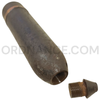
Imperial Russian 3-Inch (76.2 mm) High-Explosive Projectile with Slotted Transport Plug
Product Overview
This Imperial Russian 3-inch high-explosive artillery projectile represents a First World War ammunition pattern. Its long body and conical, slotted transport plug closely match period drawings. The measured dimensions also support this identification. This example offers a physical link to the ammunition supplied for Russia’s 76.2 mm field artillery during one of the largest conflicts of the early 20th century.
Identification and Features
The identification rests on the projectile’s shape, nose fitting, and measurements compared with the historical drawing. The 76.2 mm designation is the nominal gun caliber; the measurements below were taken from the projectile body.
- Pattern: Imperial Russian 3-inch high-explosive projectile associated with the First World War.
- Overall length with plug: Approximately 12⅜ inches, compared with 12.34 inches in the period drawing.
- Forward body diameter: 75.59 mm, compared with 75.69 mm in the drawing.
- Rear body diameter: 74.57 mm, compared with 74.93 mm in the drawing.
- Nose fitting: Conical transport plug with a broad slot.
Function
In service, this type of high-explosive projectile produced blast and fragments from its metal body. Such ammunition gave field artillery a way to attack battlefield positions and other targets. The fitted transport plug closed and protected the nose opening during storage and shipment. It is a protective fitting rather than a fuze, which was the separate component responsible for initiating the shell’s explosive action.
Product History
Russian 3-inch high-explosive shell construction appears in wartime technical literature, including Douglas T. Hamilton’s 1916 book, High-Explosive Shell Manufacture. Figure 48 on page 80 records a Russian HE shell and its component details. This period reference helps place the design within First World War ammunition production. The pattern identification does not establish this particular projectile’s factory, exact year of manufacture, or military service record.
Documented Applications
The associated weapon family was Russia’s 3-inch field artillery, including the Model 1902 field gun. Its corresponding historical cartridge case is the rimmed Russian 76.2×385R case, approximately 385 mm or 15.16 inches long. Hamilton’s Shrapnel Shell Manufacture, published in 1915, illustrates the Russian 3-inch case on page 232 and includes specifications for cases used with both shrapnel and high-explosive shells. That measurement describes the separate cartridge case.
Equipment History
The Model 1902 field gun was developed at the Putilov works in Saint Petersburg during the Imperial Russian period. It became a mainstay of Russian Army field artillery. Its design combined a quick-opening screw breech with recoil equipment and aiming controls. These features reflected the move toward faster-firing field guns that could deliver repeated fire while supporting troops in the field.
Weapon-System Background
The 3-inch field gun belonged to an artillery system that depended on guns, sights, ammunition, transport, and trained crews. Its recoil mechanism absorbed rearward movement during firing, helping crews maintain their aim between shots. The sights supported direct fire at visible targets and indirect fire from concealed positions. Different ammunition types gave the gun several battlefield roles, with high-explosive shells providing blast and fragmentation effects.
History of Use
The Model 1902 gun saw extensive service in the Russo-Japanese War and the First World War. During World War I, Russian field artillery supported troops across the Eastern Front, where ammunition supply became a major wartime demand. The gun family continued in use through the Russian Civil War after the 1917 revolutions, extending its service beyond the fall of the Russian Empire.
Condition
All ordnance is inert. Please check the pictures for the general condition of the item.
Ideal For
This Russian artillery projectile suits collections and exhibits focused on Imperial military history, First World War ammunition, and the equipment that supported field-gun batteries. Its period form and fitted transport plug offer useful details for close study and display.
- Imperial Russian and First World War militaria collections.
- Museum exhibits on field artillery and ammunition supply.
- Historical displays about the Eastern Front.
- Reference collections comparing early 20th-century artillery projectiles.
Approx length 12⅜" including plug, Approx width 3", Approx height 3", Approx weight 11.4lbs.
Pictures are stock images of our inventory. Unless otherwise noted, you will not be receiving the exact item shown in the pictures. The pictures are representative of the item’s general condition. The item you receive might be slightly better, or worse, condition than was shown in the pictures.
Please visit our page about order lead times here: Order Lead Times.