





Description
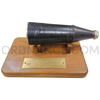
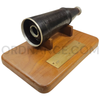
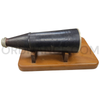
Hercules Incorporated Sprint Production S/S Rocket Motor Display with Wooden Stand
This Hercules Incorporated Sprint rocket motor display is marked for the production S/S motor's first delivery and static test at ABL on June 8, 1972. Supplied with a wooden display stand, this inert collector item connects rocket propulsion with the early production history of the U.S. Army's Sprint interceptor. Its dated identification makes it a useful centerpiece for a Cold War missile collection or an exhibit on American missile defense development.
Identification and Features
The item's identification records the manufacturer, program, test location, and production milestone:
- Manufacturer: Hercules Incorporated.
- Program identification: Sprint Production S/S Motor.
- Recorded event: First delivery and static test.
- Location marking: ABL, Allegany Ballistics Laboratory.
- Marked date: 6/8/72, or June 8, 1972.
- Wooden display stand included.
- Inert rocket motor display for collecting and exhibition.
Function and Contents
In the operational Sprint missile, rocket motors supplied the thrust needed to close rapidly on an incoming warhead. The first stage provided initial acceleration, while the second stage powered the smaller upper section as it continued toward interception. The displayed motor connects that propulsion role to the Hercules production milestone named in its identification. The wooden stand supports the item for a shelf, desk, or exhibit display, keeping the motor and its historical information together.
Documented Applications
The identified parent equipment is the Sprint anti-ballistic missile, the short-range interceptor used in the Army's Safeguard defense system. Martin Marietta developed the missile subsystem, while Hercules supplied its rocket propulsion. Contemporary industry records document Hercules work on both first- and second-stage Sprint motors before the display's 1972 milestone. The production and static-test identification ties the item to that propulsion program. Its S/S wording is retained as marked.
Product History
The June 8, 1972 marking records a production first-delivery and static-test milestone at ABL. A static test is a ground firing in which a motor remains secured to a test stand while engineers record its performance. Such tests helped confirm that production hardware met program requirements before use in complete missiles. The wording on this display marks that manufacturing and testing milestone after years of Sprint development.
Manufacturer History
The modern Hercules Powder Company was established in 1912 and adopted the name Hercules Incorporated in 1966. Its work in explosives and propellants expanded into military rocket propulsion during the twentieth century. By the Cold War, solid rocket propulsion was a major part of its aerospace business, including work on Poseidon and Sprint. Hercules also developed advanced composite materials for aerospace structures. The company name on this display reflects its post-1966 identity and the industrial supplier behind Sprint's rocket motors.
Allegany Ballistics Laboratory History
ABL stands for Allegany Ballistics Laboratory, located in Mineral County, West Virginia, near Cumberland, Maryland. Its rocket research roots reach back to World War II, when a major government rocket laboratory began operating there in February 1944. During the Hercules era, the complex included a Navy-owned research facility operated by the company. Work at ABL covered solid propellants, rocket motors, and ground testing. The location marking connects this display to the laboratory work behind the Army's Sprint program.
Equipment History
Sprint grew from the Army's Nike-X missile defense effort, with missile development assigned to Martin Marietta in May 1963. Its first flight test took place at White Sands Missile Range on November 17, 1965. The design continued through the Sentinel and Safeguard programs as national defense plans changed. The complete Sprint was a conical, two-stage, solid-propellant missile about 27 feet long. It was designed for extreme acceleration, with loads approaching 100 times gravity. Its structure, protective heat shield, and electronics had to withstand conditions far beyond those faced by ordinary aircraft.
Weapon-System Background
Safeguard was built to protect part of the U.S. Minuteman intercontinental ballistic missile force in North Dakota. It combined long-range Spartan interceptors with short-range Sprint missiles. Spartan engaged incoming threats outside the atmosphere, while Sprint formed the close defensive layer against warheads that continued inward. Ground radars and computers tracked targets and guided the interceptors by radio commands. Operational Sprint missiles carried nuclear warheads. The system's success depended on the radars, computers, launch equipment, and missiles working together within a very short warning period.
Arms Control and Deployment History
The display's 1972 milestone falls in the same year as the Anti-Ballistic Missile Treaty signed by the United States and Soviet Union in May. The treaty initially allowed each country two ABM deployment areas. A 1974 agreement reduced that allowance to one area with up to 100 ABM launchers. The United States retained the North Dakota Safeguard site. This policy change limited the scale of deployment after years of investment in Sprint, Spartan, and their supporting equipment.
History of Use
Sprint flight testing took place at White Sands from 1965 to 1970, then moved to Kwajalein in the Pacific for integrated system trials. In December 1970, Sprint completed a successful radar-guided test against a fixed point within the atmosphere about 10 seconds after launch. Deployment in North Dakota began in June 1974. The Stanley R. Mickelsen Safeguard Complex entered operational service in 1975 with 70 Sprint missiles and 30 Spartans. Sprint launchers were located at the main missile site and four remote sites. Congress directed deactivation, and the Safeguard ABM mission ended on February 10, 1976. Sprint's service history includes development flights, interception trials, readiness exercises, and a brief period of Cold War defensive deployment.
Condition
This is an inert collector display supplied with its wooden stand. The Hercules, Sprint, ABL, and dated production information are central to the item's identification. Please check the pictures for the general condition of the item.
Ideal For
This Sprint rocket motor display suits collections that connect missile hardware with the manufacturers, test facilities, and production milestones behind Cold War defense programs.
- Cold War missile collections.
- Sprint and Safeguard exhibits.
- Hercules Incorporated memorabilia.
- Rocket propulsion history displays.
- ABL research and industrial history collections.
Approx length 10", Approx width 7", Approx height 5", Approx weight 1.5lbs.
Pictures are stock images of our inventory. Unless otherwise noted, you will not be receiving the exact item shown in the pictures. The pictures are representative of the item’s general condition. The item you receive might be slightly better, or worse, condition than was shown in the pictures.
Please visit our page about order lead times here: Order Lead Times.