





Description
German WWII Glasmine 43 Glass Antipersonnel Mine with Schuko / Hebelzünder Igniter and Sprengkorper 28 Charge
Item Overview
This inert German Glasmine 43 is a World War II glass-bodied antipersonnel mine fitted with a mechanical Schuko lever igniter and the correct thin sheet-metal igniter plate. The set is reported to retain its remaining components but does not include the removable safety fork. Its molded-glass construction, mechanical igniter, and surviving internal parts make it an important example of Germany’s late-war effort to produce mines with a reduced metal signature.
Identification and Included Components
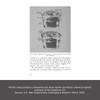
The component arrangement matches the Schuko version illustrated in the 1945 U.S. Office of the Chief of Ordnance Catalog of Enemy Ordnance Materiel. Wartime Allied publications called the mechanical igniter both the Schuko and the Hebelzünder, meaning lever igniter. Unlike the heavier corrugated plate used with the Buck chemical igniter, the Schuko configuration used a thin, flat sheet-metal igniter plate with a central opening.
- Molded glass outer mine casing
- Thick molded-glass pressure plate
- Thin glass shear plate
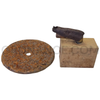
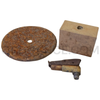
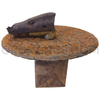
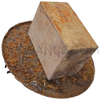
- Thin sheet-metal Schuko igniter plate
- Inert Schuko mechanical lever igniter
- Inert Charge block
- Remaining internal components included as reported
- Removable safety fork is not included
Design and Construction
The Glasmine 43 used a deep, bowl-shaped glass casing divided into upper and lower areas. Molded ribs in the bottom located the original explosive charge, while an internal shoulder supported the igniter plate above it. A thin glass shear plate rested near the top of the casing, and the much thicker molded pressure plate sat above the shear plate. The clear glass body reduced the need for steel and gave the mine a much smaller metal signature than conventional steel-cased mines.
Original Function
In its original service configuration, pressure on the thick glass top broke the thin shear plate and transferred force to the igniter below it. On the Schuko version, this movement operated a compact mechanical lever mechanism. The igniter then initiated the original explosive train. This description is included only to explain the historical purpose of the components. The example offered here is an inert collectible and contains no live explosive material.
Documented End-Item Application
The Schuko igniter and thin metal igniter plate were documented specifically for the German Glasmine 43. The 1945 U.S. ordnance catalog illustrates this exact arrangement with the thin plate resting on the internal shoulder and the Schuko igniter projecting through its center. The same catalog shows the Buck chemical igniter as an alternative configuration, but that version used a stronger corrugated metal plate and a different igniter assembly.
Schuko Igniter History
The Schuko was a German mechanical pressure igniter based on the lever principle. Allied technical references also called it the Hebelzünder, while later publications commonly identify the type as the Hebelzünder 44. Its horizontal housing contained a spring-driven striker and percussion components, while the raised lever received pressure from the mine’s glass plate assembly. Although designed for the Glasmine 43, wartime intelligence reports noted that the same lever principle could be adapted to other mines and booby traps.
Safety Fork
The glass pressure plate has two grooves associated with a removable metal safety fork. The fork bridged the outer rim of the casing and supported the pressure plate while the original mine was being handled. A notable detail in the 1945 U.S. ordnance catalog states that this fork was not supplied as a standard part of each mine and could be improvised by German units. This example does not include a safety fork.
Published Wartime Specifications
The 1945 U.S. ordnance catalog lists an external diameter of approximately 6 inches at the top, 4.5 inches at the base, and a height of approximately 4.2 inches to the lip of the container. The upper glass casing was listed as approximately 1/4 inch thick, while the lower casing was approximately 2/5 inch thick. The molded pressure plate measured about 4.5 inches in diameter, and the thin glass shear plate was approximately 1/32 inch thick. These are published specifications for the original mine design rather than measurements of this individual example.
Original Sprengkörper 28 Charge Arrangement
The lower cavity was designed around the German Sprengkörper 28, a standard 200-gram demolition charge used with several German demolition and mine systems. Molded glass ribs kept the charge in the proper position beneath the igniter plate. Some wartime descriptions also mention a Bakelite charge container filled with loose explosive as an alternative. Any charge or charge component included with this collectible has been rendered completely inert.
Glasmine 43 Development History
Germany developed the Glasmine 43 during the later part of World War II as conventional steel and other strategic materials became harder to obtain. Glass factories could produce the molded body without using the large amount of metal required for a traditional mine casing. The reduced metal content also made the mine more difficult to locate with the electromagnetic detectors used by Allied mine-clearing teams. The first versions still contained detectable metal in the igniter and internal plate, while later chemical and glass igniters reduced the metal content even further.
German Minimum-Metal Mine Program
The Glasmine 43 belonged to a wider German program that produced wooden, concrete, ceramic, and glass mine bodies. Other well-known examples included the wooden Schützenmine 42 and the nonmetallic Topfmine antitank series. These weapons were intended to delay advancing troops, restrict movement, protect defensive positions, and make mine-clearing work slower. The Glasmine was especially unusual because its glass casing also produced dangerous fragments when the original mine functioned.
Production History
The Glasmine entered German field issue during 1944. Production was spread among several glassworks across Germany and occupied territory, making use of factories that already had the equipment and workers needed to mold heavy glass containers. Historical production records indicate that more than 11 million Glasmine mines were manufactured during 1944 and 1945. Almost 9.7 million reportedly remained in German stocks at the end of the war, showing that production greatly exceeded the number actually placed in the field.
History of Use
German engineer troops used the Glasmine 43 in late-war defensive minefields and obstacle systems. A March 1945 U.S. War Department Intelligence Bulletin reported that the mine could be sealed against moisture and used on land, near riverbanks, around fords, and in beach defenses. Allied forces also discovered large quantities in German engineer dumps. The cover of that wartime bulletin illustrated German troops placing Glasmine mines in a prepared field position.
Allied Identification and Mine-Clearing History
The Glasmine received detailed attention from Allied intelligence because its glass construction made normal metal-detection methods less effective. U.S. technical publications supplied recognition photographs, sectional drawings, dimensions, and comparisons of the Schuko and Buck igniter versions. These reports helped engineers recognize captured examples and understand why different Glasmine mines could contain different igniter plates and firing devices. Surviving mines and components are now valuable references for studying wartime engineering and mine-detection development.
Condition
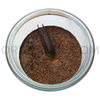
The glass casing and glass components are in good overall condition. The thin sheet-metal igniter plate is heavily rusted, and the Schuko igniter also has heavy corrosion. The Sprengkorper 28 Charge is in good condition. The safety fork is missing. The remaining components show age, oxidation, storage wear, and handling marks consistent with an original World War II artifact. All ordnance is inert.
Ideal For
This Glasmine 43 is well suited to advanced World War II collections, combat-engineer displays, military museums, educational exhibits, and reference collections focused on German ordnance or minimum-metal mine development.
- World War II German ordnance collections
- Combat-engineer and mine-warfare displays
- Military museum exhibits
- Minimum-metal mine collections
- Inert ordnance study and reference displays
Approx length 6", Approx width 6", Approx height 4", Approx weight 3.6lbs.
Please visit our page about order lead times here: Order Lead Times.