




Description
Flanick–Scranton HI-SPEED Hand-Held Aircraft Bombsight, Mod. I, with Display Stand
Item Overview
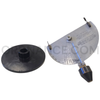
Flanick–Scranton HI-SPEED hand-held aircraft bombsight, engraved “MOD. I B.C.-2.2.” and supplied with a display stand. Its semicircular plate, engraved chart, and pivoted speed arm make this an interesting aviation instrument for collectors of mechanical bombing and sighting equipment.
Identification and Features
“HI-SPEED” is the sight’s identifying name. “MOD. I” denotes Model 1, using the Roman numeral I. The additional “B.C.-2.2.” engraving is preserved as marked; its exact meaning remains unverified. The instrument’s visible features show how its designer combined flight settings, sight lines, and an apparent gravity reference.
- Identification: Flanick–Scranton HI-SPEED
- Model engraving: MOD. I B.C.-2.2.
- Two upright sight fittings at opposite ends of the straight upper edge
- Semicircular plate with an engraved altitude chart and graduated angular scale
- Pivoted arm carrying a speed scale
- Attached black conical weight, apparently serving as a pendulum gravity reference
- Separate display stand included
Function
This mechanical bombsight relates aircraft ground speed and altitude to a sighting angle. Its chart, scales, and moving arm express flight information through their physical positions. The purpose was to help an aircrew member judge the release point for a falling bomb while sighting a target.
Documented End-Item Application
The supported application is hand-held aircraft bombsighting. The instrument served as an aiming aid within an aircraft’s broader bomb-delivery system. A particular aircraft model, military service, or installation has not been established for this exact Flanick–Scranton design.
Product History
The production and development history of the Flanick–Scranton HI-SPEED Mod. I remains unresolved. Its engraved name and model marking identify the instrument, but no period manual or official catalog has been located that establishes a manufacture date or military adoption history. Those details remain subjects for further research. We believe this hand-held device most likely dates from the period of 1915-1925, from the very early years of military bomber aircraft.
Parent-Equipment History
Aircraft bombing equipment developed into a combination of bomb carriers, release mechanisms, and aiming instruments during World War I. The U.S. Army’s August 1918 Handbook of Aircraft Armament described both internal and underwing bomb carriers alongside mechanical bombsights. These components addressed separate tasks: carrying the bomb, releasing it, and helping the crew judge the release point. This is the broader equipment setting for a portable aircraft bombing sight.
Weapon-System Background
Bombsight development focused on accounting for flight conditions while reducing errors caused by aircraft movement. The Army’s McCook Field engineers developed the Estoppey D-1 with pendulum stabilization, and the Army adopted the improved D-4 in 1926. Sperry’s C-1, completed in 1924, used a gyroscope. The Inglis L-1 of 1928 combined stabilized aiming with an automatic bomb release. These developments explain the wider importance of scales, moving arms, and stabilizing references in mechanical sight design.
History of Use
During World War I, the U.S. Army Air Service used British Wimperis and French Michelin bombsights, with wind and aircraft movement limiting accuracy. In 1921, Billy Mitchell borrowed Navy Mark III-A sights for the trials that sank the former German battleship Ostfriesland. Continued improvements helped shape the Army Air Corps’ high-altitude daylight bombing doctrine during the 1930s. These are documented examples of bombsight use generally, rather than a service record for this particular instrument.
Condition
Please check the pictures for the general condition of the item, including the engraved surfaces, sight fittings, moving arm, attached weight, and display stand.
Ideal For
The visible mechanical layout makes this sight well suited to collections and exhibits about aviation instruments and the history of aircraft bomb aiming.
- Aviation instrument collectors
- Mechanical calculator and sighting-device collections
- Museum and educational displays
- Research into aircraft bombsight design
- Display alongside aviation manuals and related equipment
Approx length 9", Approx width 8", Approx height 6", Approx weight lbs.
Please visit our page about order lead times here: Order Lead Times.