








Description
North American F-86L Sabre Left Cockpit Control Console Display — Military-Surplus F-86D/F-86L Components, Circa Late 1950s
Item Overview
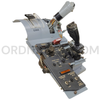
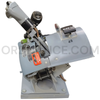
This post-service display brings together military-surplus controls from the left cockpit console of the North American F-86L Sabre interceptor. The components are arranged close to their documented positions in the aircraft and include engine, flight-control, radar, and armament controls. The supporting frame is later display construction rather than an intact section of the aircraft.
Identification and Features
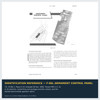
The strongest F-86L identifier is the armament-panel marking “IDENTIFICATION APPROACH — CSTI OFF / COMBAT APPROACH — CSTI ON.” The identification and combat approach switch appears on the F-86L armament control panel illustrated in T.O. 1F-86L-1, Figure 4-14. The same handbook’s left-console illustration matches the type and placement of the other controls in this display.
- Throttle and afterburner control with outboard movement for completing the engine-ignition circuit
- Wing-flap control lever
- Flight-control hydraulic, rudder-trim, and alternate-trim panel
- Hughes E-4 armament panel with FIRE 0, FIRE 6, FIRE 12, and FIRE 24 selections
- Identification and combat approach selector with CSTI markings
- Radar antenna and range hand controller; the black grip is not a flight-control stick
- Hand-controller plate marked P/N 435-19-2001-1 and FSN 1270-090-0474
- Control cross-referenced as “Control, Antenna” under NSN 5985-00-090-0474
Control Functions
The throttle controlled engine power and afterburner operation, while moving it outboard completed the ignition circuit during the handbook’s ignition procedure. The flap lever selected UP, HOLD, or DOWN. The nearby flight-control panel managed normal and alternate hydraulic operation, rudder trim, and alternate pitch and roll trim. The E-4 armament panel selected the number of rockets fired, and the separate hand controller operated radar antenna and range functions during target search and tracking.
Documented F-86L Application
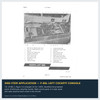
T.O. 1F-86L-1 documents the armament panel, throttle grip, flap handle, flight-control panel, E-4 radar panel, and radar antenna hand control on the F-86L’s left cockpit console. Figure 4-14 shows the identification and combat approach selector, while Figure 1-6 records the larger console arrangement. Because every F-86L began as an F-86D conversion, individual controls may retain F-86D descriptions, markings, or part-number history.
Display Assembly History
The military-surplus controls were assembled into this display after their aircraft service. They are positioned approximately as they appeared in the cockpit, but the gray framework, plywood bottom, rubber feet, return cord, and some fasteners are later additions. No provenance has been provided that connects the display to a specific aircraft or identifies it as an official military trainer.
F-86D and F-86L Aircraft History
The F-86D “Sabre Dog” was a one-seat, all-weather interceptor developed from the Sabre family. It used nose-mounted radar, an afterburning General Electric J47 engine, and a retractable rocket tray instead of fixed guns. Beginning in 1956, 981 low-time F-86Ds were converted into F-86Ls with SAGE-compatible electronics, revised cockpit equipment, extended wingtips, and leading-edge slats for improved high-altitude handling.
Hughes E-4 Armament System
The Hughes E-4 system combined radar tracking, cockpit displays, fire-control computing, and the aircraft’s rocket armament. The F-86D and F-86L carried 24 2.75-inch folding-fin aerial rockets in a retractable belly tray. The pilot could select salvos of 6, 12, or all 24 rockets. During an automatic intercept, the system could lower the tray and release the selected rockets at the computed firing point.
SAGE Air-Defense System Background
The Semi-Automatic Ground Environment, or SAGE, linked ground radar stations, large command-center computers, and equipped interceptor aircraft. Interception instructions were transmitted to the F-86L through its data-link equipment. CSTI meant Control-Surface Tie-In and allowed the automatic attack equipment to influence the aircraft’s controls during a combat approach. The panel’s CSTI OFF identification setting supported close visual identification, while CSTI ON prepared the system for a coupled combat approach.
History of Use
The first completed F-86L conversions entered Air Defense Command service in 1956. These aircraft stood alert against possible bomber attacks and flew interception training and readiness missions within the SAGE network. Newer F-102 and F-106 interceptors replaced most F-86Ls in active Air Defense Command units by 1960. Many aircraft then served with Air National Guard interceptor squadrons until the type was withdrawn from U.S. service by 1965.
Condition
The controls are genuine military-surplus F-86D/F-86L components mounted in a later display structure. The wiring has been cut, and the framework, plywood bottom, rubber feet, return cord, and some fasteners are post-service additions. This assembly is offered as a non-operational static display. It is not represented as an intact aircraft console or an official factory or military trainer.
Ideal For
This assembled console offers a strong display of late-1950s interceptor technology and the transition from pilot-directed interception to computer-assisted continental air defense.
- Cold War aviation and USAF collectors
- F-86D and F-86L restoration research
- SAGE and military-electronics exhibits
- Aircraft cockpit and control collectors
- Museums, educational displays, and aviation-themed collections
Approx length 20", Approx width 13", Approx height 12", Approx weight 14lbs.
Pictures are stock images of our inventory. Unless otherwise noted, you will not be receiving the exact item shown in the pictures. The pictures are representative of the item’s general condition. The item you receive might be slightly better, or worse, condition than was shown in the pictures.
Please visit our page about order lead times here: Order Lead Times.