











Description
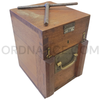
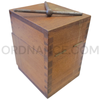
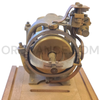
Early Whitehead Obry Gear Torpedo Gyroscopic Steering Assembly with Case and Tools
Item Overview
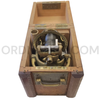
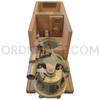
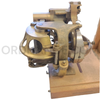
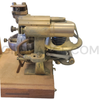
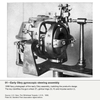
This early Whitehead Obry gear is a gyroscopic steering assembly for the Whitehead torpedo, supplied with its fitted wooden case and associated tools. Its exposed mechanism offers a close look at an important early practical use of gyroscopes in automatic weapon guidance. This is one of the world's first weapon guidance systems.
Identification and Features
The maker’s plate reads “WHITEHEAD & Co., FIUME,” identifying the Whitehead firm at Fiume, now Rijeka, Croatia. The assembly’s distinctive layout closely matches the Obry mechanism illustrated in the U.S. Navy’s 1898 documentation.
- Large exposed coil spring used to start the gyroscope.
- Toothed, bell-shaped impulse sector associated with the starting mechanism.
- Gyroscope wheel mounted within pivoting gimbal rings.
Function
At launch, a spring brought the gyroscope into motion. The spinning gyro provided a steady directional reference as the torpedo traveled through the water. When the torpedo turned away from its preset heading, the mechanism controlled an air-powered steering unit. That unit moved the vertical rudders to correct the course.
Fitted Case and Tools
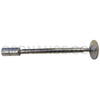
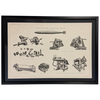
The fitted wooden case accompanies the mechanism and associated tools, including a large T-handled combination winding key and socket wrench named in the Navy’s 1898 tool list. The case and accessories add useful context for displaying and studying the assembly.
Documented End-Item Application
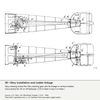
Obry gear was fitted to Whitehead torpedoes equipped for gyroscopic course control. A detailed U.S. Navy account from 1898 describes the system in a 5-meter, 45-centimeter Mark I Whitehead torpedo. In that documented arrangement, the removable assembly sat inside the rear body, just behind the bulkhead supporting the main engine.
Product History
The Obry gear takes its name from inventor Ludwig Obry. His U.S. Patent No. 562,235, titled Steering Mechanism for Torpedoes, was issued on June 16, 1896. Naval technical accounts published in 1897 and 1898 describe the mechanism and its purpose. This spring-start form reflects torpedo engineering of the late 1890s and early 1900s, and we believe this instrument dates from the late 1890s, probably 1898-1899.
Parent-Equipment History
Robert Whitehead developed his self-propelled torpedo at Fiume in 1866. In 1875, Whitehead and his son-in-law acquired the Fiume works and established the Whitehead torpedo factory. Export sales and licensed production spread the design to navies around the world. Continued improvements to propulsion, depth control, and steering made the Whitehead family a major part of early underwater warfare.
Weapon-System Background
The Whitehead torpedo was an underwater weapon designed to strike ships below the waterline. In the period design, compressed air powered the engine and propellers, while separate mechanisms controlled depth and direction. Horizontal rudders controlled depth, and vertical rudders corrected heading. Gyroscopic steering addressed a major problem with early torpedoes: keeping them on their planned course.
History of Use
An American naval commission observed Obry gear demonstrations at Fiume in November 1896. Later trials in the United States helped establish the device’s practical value, and a naval account published in 1900 reported its adoption by the U.S. Navy. The wider Whitehead torpedo family saw service aboard battleships and torpedo boats, making course control an important part of naval weapons development.
Condition
Please check the pictures for the general condition of the item. Pictures not included.
Ideal For
This assembly offers collectors and curators a detailed example of early mechanical guidance. The visible gyro and starting mechanism make it useful for exhibits that explain how precision instruments became part of naval weapon systems.
- Whitehead torpedo and naval ordnance collections.
- Gyroscope and automatic-control history displays.
- Maritime museums and engineering teaching collections.
- Fiume and Rijeka industrial history exhibits.
Approx length 11", Approx width 9", Approx height 7", Approx weight 17.6lbs.
Please visit our page about order lead times here: Order Lead Times.