





Description
Cold War Mk57 / B57 Themonuclear Bomb Nose Cone
Item Overview
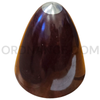
This original Cold War component is the bakelite nose cone made for the American Mk57, later designated B57, thermonuclear bomb family. Its molded body and silver-colored metal tip formed the extreme forward point of an N57 nose assembly. The cover measures approximately 7 inches long by 6.5 inches wide and displays the compact shape associated with the B57’s modular nose system. Own a genuine piece of America's Cold War nuclear stockpile! An extremely rare item!!
Identification and Features
The shape, materials, dimensions, and markings support identification as a Mk57/B57 forward protective cover. Notable features include:
- Weapon family: United States Mk57/B57 nuclear bomb
- Component: Forward protective nose cover
- Material: Molded Bakelite or similar phenolic material
- Tip: Pointed silver-colored metal terminal piece
- Marking: Orange production or inspection stamp reading “1596 / M / L”
- Documented location: Extreme forward end of the N57 nose assembly
- Reference wording: “PROTECTIVE COVER (BOTH NOSES)”
Original Marking
The orange “1596 / M / L” stamp appears to be an original manufacturing, inspection, or production-control marking. Its exact factory meaning has not been documented, but it adds visible period character and helps preserve the component’s original military origin.
Purpose and Function
This protective cover fitted over the forward end of the bomb’s nose assembly. Its pointed shape completed the aerodynamic profile while shielding the front of the installed nose equipment. The molded Bakelite body created a rigid outer shell, while the metal tip reinforced the narrow leading point.
NAVAIR Documentation
A NAVAIR hard-point drawing reproduced in Chuck Hansen’s Swords of Armageddon, Volume V labels the small terminal part as “PROTECTIVE COVER (BOTH NOSES).” The drawing shows the cover at the front of both the N57-1 and N57-2 nose profiles. A separately cataloged example also matches this cover’s shape, Bakelite construction, metal tip, and approximate 7-by-6.5-inch size.
N57 Nose-System History
The Mk57 used a modular design in which B57-1 and B57-2 basic assemblies could be fitted with N57-0, N57-1, or N57-2 nose sections. The N57-1 included dual-channel fuzing radar equipment for airburst delivery. The N57-0 and N57-2 supported laydown and depth-bomb missions, with the N57-2 designed to improve laydown performance. This interchangeable system allowed the same basic weapon family to support several missions.
Mk57 / B57 Development History
Development began after the U.S. Navy requested a lightweight, air-dropped nuclear depth charge in 1957. The U.S. Air Force soon requested a low-yield tactical bomb that could be delivered against targets on water or land. These needs were combined into a lightweight multipurpose weapon program. The designation TX-57 was assigned in December 1959, and engineering work began in January 1960. The Navy was listed as the primary user organization.
Production History
The Mk57 Mod 0 design was released in December 1961, and early production began in January 1963. Later versions added radar fuzing, coded safety controls, improved nose equipment, and compatibility with additional aircraft. About 3,100 Mk57 bombs were produced between January 1963 and May 1967. The weapon was later redesignated B57 under the standardized American bomb-naming system.
Weapons-System Specifications
The complete Mk57 measured approximately 9 feet 10 inches long, had a body diameter of 14.75 inches, and weighed about 500 pounds. Reported selectable yields ranged from 5 to 20 kilotons. Interchangeable suspension lugs allowed carriage by different aircraft, while a rear parachute system supported retarded delivery methods.
Military Roles
The Mk57/B57 could be carried by helicopters and fixed-wing aircraft. Its missions included nuclear depth-bomb delivery against submarines, free-fall airburst delivery, and parachute-retarded laydown delivery. The underwater application was associated with the name “Little Lulu.” Its compact size and several delivery options made it useful to both naval and tactical aviation forces.
History of Use
The Mk57/B57 served with the United States Navy and Air Force during much of the Cold War. About 825 remained active with U.S. forces in 1989. Retirement followed as newer weapons were planned to replace its strike and depth-bomb roles. The remaining Mod 1 weapons were retired by 1992, and the last Mod 2 weapons left service in 1993.
Condition
This inert historical component retains its molded Bakelite body, pointed metal tip, and orange “1596 / M / L” marking. Please check the pictures for the general condition of the item.
Ideal For
This original B57-family component is well suited to:
- Cold War militaria collections
- Historic ordnance displays
- American nuclear-weapons research collections
- Military aviation exhibits
- Restoration and reference displays
- Collectors of Bakelite military components
Approx length 7", Approx width 6.5", Approx height 6.5", Approx weight 1 pound.
Pictures are stock images of our inventory. Unless otherwise noted, you will not be receiving the exact item shown in the pictures. The pictures are representative of the item’s general condition. The item you receive might be slightly better, or worse, condition than was shown in the pictures.
Please visit our page about order lead times here: Order Lead Times.