




Description
British 81mm XL31E2 Experimental HES Inert Mortar Bomb
Product Overview
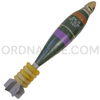
This British 81mm XL31E2 experimental mortar bomb is marked HES and INERT and is fitted with an extremely rare XM734 proximity nose fuze. A Voilet stripe and separate body, tail, and charge-component markings record its experimental configuration. The design has a connection to the British L16A2 mortar and the American program that produced the M252 mortar and M821 high-explosive ammunition. The mortar bomb still retains 95%+ of its original paint & markings. Round comes complete with five inert XL38E1 increment charges attached to the tail fin. This is the only example that we have, so you will be receiving the exact specimen shown in the photos.
Identification and Features
The body, fuze, tail, charge increments, and increment cover carry separate markings. Each inscription with its location distinguishes the model designations, component references, and dates.
- 81MM HES XL31E2 INERT: Main body marking identifying the caliber, British experimental model, High Explosive Substitute filling, and inert configuration.
- XM734: Hand-marked identification on the fitted proximity nose fuze.
- LOT 001: Lot reference.
- GD/0208/E BN 7/78: Body stamp above the obturating ring; the date is consistent with July 1978.
- TV 149 PAT 78 P 1160: Body stamp below the obturating ring, reproduced as marked.
- TV180 RG 5/78: Tail-fin assembly stamp; the date is consistent with May 1978.
- GD 172 XL38E1: Marking on the charge-increment components.
- GD/P 516: Marking on the charge-increment cover.
- GD WL: Two ink stamps below the purple stripe.
- Purple stripe: Consistent with British violet color coding for experimental ammunition.
Production and Establishment Markings
British Ministry of Defence monogram references associate GD with Glascoed, RG with Radway Green, and PAT with Patricroft. GD appears on the body and charge-related components, RG appears in the tail marking, and PAT appears in the lower body stamp. These separate inscriptions preserve the establishment references carried by the different parts.
Function
HES means High Explosive Substitute: inert material used in place of a projectile's explosive filling. Such fillings allowed representative ammunition to be used for evaluation, instruction, or display. The XL31E2 designation identifies an experimental bomb design, while the HES and INERT markings describe this example's filling configuration. In the original mortar-bomb design, the tail fins provided flight stability and the obturating ring helped seal the space between the bomb and barrel.
Product History
The XL31E2 belonged to British work on improved ammunition for the L16A2 mortar. Its influence extended into American development. An October 1984 U.S. General Accounting Office report records the adaptation of the British L16A2 mortar and XL31E2 cartridges for the XM252 improved 81mm system. The work incorporated American 81mm and 60mm components and was intended to replace the M29A1 mortar and its older ammunition.
Documented End-Item Applications
The original documented weapon application is the British L16A2 81mm mortar. The associated American development program included the XM252 mortar and XM821 high-explosive cartridge, leading to the later M252 and M821 combination. Printed page 1-29 of the 1984 GAO report records the British design connection and the American ammunition program together.
XM734 Fuze History
XM734 was the earlier designation of the M734 multi-option mortar proximity fuze. The official MIL-HDBK-145 fuze catalog, dated October 1, 1980, records that earlier name and lists an application to the related British XL31E3 cartridge and L16A2 mortar. The M734 family combined airburst and impact functions within one fuze design. The catalog's British cartridge entry concerns XL31E3, providing context for the fuze family while preserving the separate XL31E2 identity marked on this bomb.
Equipment History
The L16 mortar family grew from British-Canadian development and entered British service in 1965, replacing the wartime 3-inch mortar. Its barrel, bipod, and baseplate could be carried as separate loads, helping infantry units move the weapon. The L16A2 formed part of the family's continued improvement, supported by work on better ammunition.
Weapon-System Background
The American XM252 program developed into the M252, a medium 81mm mortar used for infantry indirect-fire support. Its role included supporting light infantry, airborne, and air-assault forces. Alongside the XM821 high-explosive cartridge, the improved ammunition program included the XM879 practice, XM853 illuminating, and XM819 smoke cartridges. The modernization effort therefore covered several ammunition roles as well as the mortar itself.
History of Use
The parent L16 family has a documented operational history. A National Army Museum photograph records an 81mm mortar crew from 42 Commando Royal Marines on Mount Kent during the 1982 Falklands War. The American branch of the design continued to develop over subsequent decades: the Army delivered the first lighter M252A1 systems to troops at Fort Bragg in 2014.
Condition
All ordnance is inert. Please check the pictures for the general condition of the item.
Ideal For
This XL31E2 suits a collection focused on experimental ammunition and the exchange of military technology between Britain and the United States. Its separate body, tail, increment, and cover markings make it useful for comparing component identification across an assembled specimen. The HES designation and hand-marked fuze add further details for study alongside period technical records.
- British experimental mortar-ammunition collections.
- Cold War ordnance and development-history displays.
- L16A2 and M252 mortar-system studies.
- XM734 and M734 fuze-history exhibits.
- Educational displays about inert substitute-filled ammunition.
Approx length 18", Approx width 3", Approx height 3", Approx weight 9lbs.
Please visit our page about order lead times here: Order Lead Times.