





Description
U.S. Navy Torpedo Mechanism Marked MK VIII MOD 2 with Original Wooden Carrying Case
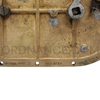
This U.S. Navy torpedo mechanism comes in its original wooden carrying case with an interior inventory sheet. The sheet identifies the stored item as a warhead attachment, while the component carries MK VIII MOD 2, WARHEAD and NO.2231 markings on its bottom side. The mechanism, original case, and inventory record bring together the physical equipment and its documented storage description.
Identification and Features
The markings below are recorded as supplied. The case inventory number and the number marked on the component are separate records.
- Service identification: U.S. Navy torpedo equipment.
- Included case: Original wooden carrying case with interior inventory sheet.
- Inventory sheet wording: "WARHEAD ATTATCHMENT, COMPLETE Bu.NO. 46293."
- Bottom-side marking: "MK VIII MOD 2 WARHEAD NO.2231."
- Additional stamp: "JA-2-1."
- Symbol stamp: A circle enclosing a triangle, with the letter "C" and a second letter read as either "T" or "I" inside the triangle.
Function and Contents
The listing includes the marked torpedo mechanism, its wooden carrying case, and the interior inventory sheet. In period torpedoes, a steering gyroscope used a spinning wheel to maintain a direction reference. A linked steering mechanism used that reference to correct the torpedo's course through its rudder. Warhead attachments served a different task: they formed part of the equipment associated with firing the warhead. Both belonged to the torpedo's internal machinery, but they had separate functions and identification systems.
Documented Applications
Navy publication records list Warhead Attachments, Ordnance Pamphlet 377, dated September 1, 1915. Gyro gear appeared in separate publications, including Ordnance Pamphlet 375 of July 1912 for Bliss-Leavitt torpedo gyros. Later, Navy OP 627(A) listed Gyros Mk 12 and Mk 12 Mod 1 for certain Torpedoes Mk 8 Mods 3C and 3D. These records document the equipment families and show why a torpedo's Mark number must be distinguished from the numbers assigned to its internal components.
Product History
Gyroscopic torpedo steering grew from efforts to improve accuracy in the late 1800s. Ludwig Obry received a patent for his torpedo steering gyro in 1894. His gear was used in early Whitehead torpedoes, giving the steering system a stable reference after launch. Around 1910, the U.S. Navy adopted gyro-controlled turns onto a preset course. This advance appeared in U.S.-built Whitehead Mk 5 and Bliss-Leavitt Mk 2 torpedoes and became part of First World War torpedo guidance.
Equipment History
The Naval Torpedo Station was established on Goat Island at Newport, Rhode Island, in 1869. Its work included testing underwater weapons, propulsion systems, and explosive components. During the early 1900s, the station became an important center for torpedo manufacture and technical development. Torpedo machinery required close attention to bearings, balance, and the fit of small parts. The Navy's later gyro manual describes specialized shop work and directs major repairs to a torpedo station. This support network of factories, test facilities, tenders, and trained crews helped keep complex torpedo equipment in service.
Weapon-System Background
For period weapon context, the Bliss-Leavitt Mark 8 torpedo was developed in 1911 as a weapon for attacking surface ships. It was the U.S. Navy's first torpedo in the 21-inch-diameter, 21-foot-length class. A turbine supplied propulsion, while gyroscopic guidance controlled its course. Production involved Navy facilities at Newport, Alexandria, and Washington. The full weapon combined a warhead, stored propulsion energy, an engine, and steering equipment. Its long service life connected the prewar torpedo program with naval operations in the Second World War.
History of Use
During the First World War, Newport's production shifted toward mines, depth charges, and aerial bombs as the Navy focused on the submarine threat. Torpedo equipment remained part of the fleet's weapons and training needs. The Mark 8 family continued in service beyond that conflict. The Navy's Second World War Motor Torpedo Boat Manual covers Mark VIII Mods 3C and 3D torpedoes used aboard PT boats. Torpedomen inspected, maintained, and prepared these weapons, including their steering equipment, as part of boat operations.
Condition
The mechanism is accompanied by its original wooden carrying case and interior inventory sheet. The component retains the stamped markings described above. Keeping the case and paperwork with the mechanism preserves its inventory record for future study. Please check the pictures for the general condition of the item.
Ideal For
Suited to collections and displays about early U.S. Navy torpedo technology, naval ordnance, and military mechanical instruments. Researchers can compare the component markings and inventory wording with period manuals and drawings. Displayed alongside a torpedo diagram, the boxed mechanism can help explain how individual assemblies formed part of a larger naval weapon.
- U.S. Navy torpedo collections.
- First World War naval history displays.
- Historic mechanical instrument collections.
- Ordnance marking and inventory research.
Approx length 13", Approx width 9", Approx height 8", Approx weight 18.lbs.
Pictures are stock images of our inventory. Unless otherwise noted, you will not be receiving the exact item shown in the pictures. The pictures are representative of the item’s general condition. The item you receive might be slightly better, or worse, condition than was shown in the pictures.
Please visit our page about order lead times here: Order Lead Times.