



Description
U.S. Army Bailey M2 Bridge Chord Bolt – NSN 5306-00-355-6493
Item Overview
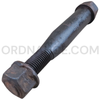
This U.S. military Bolt, Connector, Chord is a specialized structural fastener for the Bailey M2 panel bridge. Commonly called a chord bolt, it joined bridge panels stacked one above another in double- and triple-story trusses. Its heavy steel construction, long tapered body, and large fastener size distinguish it from an ordinary machine bolt and from the smaller Bailey bridge bracing bolt. The item is identified by legacy FSN 5420-355-6493 and modern NSN 5306-00-355-6493.
Identification and Features
The official supply nomenclature is Bolt, Connector, Chord. The earlier Federal Stock Number placed the part in the military bridging equipment class, while the modern National Stock Number classifies it under FSC 5306 for bolts. Army FM 5-277 identifies the chord bolt as 10 1/2 inches long, 1 3/4 inches in diameter, and approximately 7 1/2 pounds. Half of the bolt’s length is tapered to help align the holes in adjoining panel chords during bridge assembly. A 1 7/8-inch wrench was used to tighten the fastener.
- Official name: Bolt, Connector, Chord
- Legacy FSN: 5420-355-6493
- Modern NSN: 5306-00-355-6493
- Specification: MIL-B-11844
- Drawing reference: D2674, Item 12
- Parent equipment: Bailey M2 panel bridge
- Material: Structural steel
- Manual dimensions: 10 1/2 inches long by 1 3/4 inches in diameter
- Manual weight: 7 1/2 pounds
Function and Operation
The chord bolt connected the horizontal chords of vertically stacked Bailey bridge panels. Two bolts were used with each stacked panel. They passed upward through matching holes in the panel chords and were secured by nuts beneath the lower chord of the upper panel. The tapered section helped draw panels into alignment as the bolt was inserted and tightened. Chord bolts were also used to fasten overhead-bracing supports to the top chords of triple-story bridges. These supports carried the transoms and sway braces that stabilized the upper part of the bridge. Panels placed end to end were joined with panel pins, while chord bolts made the vertical connections between stories.
End-Item Application
The Bailey M2 was a portable, prefabricated, through-type truss bridge used by U.S. Army engineer units. Its main girders were assembled from standardized 10-foot steel panels connected end to end. One, two, or three trusses could be installed side by side, and additional panel stories could be stacked when a longer span or greater load capacity required a stronger structure. The M2 provided a clear roadway approximately 12 feet 6 inches wide and could be configured as a fixed bridge or adapted for specialized structures. FM 5-277 lists 29 types of bridge parts and 30 types of erection equipment in the M2 bridge set. The chord bolt was essential when the selected bridge design required a second or third panel story.
Historical Background
British civil engineer Donald Coleman Bailey developed the Bailey bridge during World War II and presented the design to the British War Office in 1941. The system used standardized parts that could be transported by truck and assembled largely by manpower. The U.S. Army adopted the original British design as the Bailey M1, then widened the roadway and designated the revised bridge as the Panel Bridge, Bailey M2. Its interchangeable panels allowed engineers to adjust a bridge’s length and strength without designing a new structure for every crossing. Chord bolts supported this modular design by allowing additional stories of panels to be securely added to the basic trusses.
History of Use
Allied engineer units used Bailey bridges extensively in Italy and northwestern Europe from 1943 through 1945. The bridges restored military routes where permanent spans had been demolished, damaged, or could not support wartime traffic. Engineers could assemble the bridge behind the near bank and launch it across a gap, reducing the need to work in the obstacle or on the enemy side. When the required span or vehicle load called for a multistory bridge, crews installed chord bolts as the upper panels were added. Bailey equipment remained part of U.S. military engineering doctrine after World War II, and later Army manuals continued to cover its assembly, transport, maintenance, and special applications.
Condition
This is a U.S. military surplus Bailey bridge component, sealed in cosmoline wax. The listing show the general condition of the finish, threads, tapered body, markings, and included hardware. Age and storage wear may include finish loss, patina, scratches, dents, thread wear, or surface corrosion as shown. Please check the pictures for the general condition of the item.
Ideal For
This chord bolt offers a substantial example of the specialized hardware behind the Bailey bridge’s modular construction. Its documented identification and recognizable tapered profile make it well suited to displays focused on military engineering, field bridging, Army transportation equipment, and Allied operations during World War II.
- Military engineering collections
- Bailey bridge component displays
- World War II Army exhibits
- Combat-engineer history collections
- Military vehicle and equipment museums
- Industrial hardware collections
Approx length 10.5", Approx width 1.75", Approx height ", Approx weight 7.5 lbs.
Pictures are stock images of our inventory. Unless otherwise noted, you will not be receiving the exact item shown in the pictures. The pictures are representative of the item’s general condition. The item you receive might be slightly better, or worse, condition than was shown in the pictures.
Please visit our page about order lead times here: Order Lead Times.