













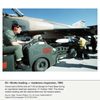


Description
AGM-45 Shrike Missile Radome with Forward Seeker Antenna/Detector Assembly
Item Overview
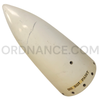
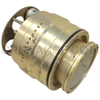
This radome and forward antenna/detector assembly is part of the AGM-45 Shrike missile hardware. The components are the protective nose cone and forward receiving assembly.
- Radome: White nose cone marked "DO NOT PAINT."
- Radome identifier: "10001-1570158, REV. B." The revision marking records revision B of the identified component or drawing.
- Serial marking: "S/N 541" appears near the radome identification; S/N means serial number.
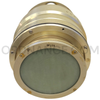
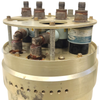
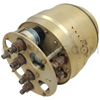
- Forward receiving hardware: Circular metal antenna/detector assembly.
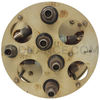
- Detector components: Four American Electronic Laboratories units labeled "CRYSTAL DETECTOR MOUNT."
- Directional connections: "UP," "DN," "LT," and "RT" indicate up, down, left, and right, consistent with vertical and horizontal directional sensing.
Function
The Shrike used passive radar homing to detect radio energy emitted by a radar installation. Its seeker supplied directional information to the missile's guidance system. The radome protected the forward receiving hardware while allowing radar signals to reach it. The antenna and detector components formed part of that receiving system. In this context, "anti-radiation" refers to the radar emissions that the weapon was designed to follow.
Documented End-Item Application
The attributed end item is the U.S. AGM-45 Shrike anti-radiation missile family, operated by both the Navy and Air Force. Documented aircraft applications included the Douglas A-4 Skyhawk, Republic F-105F and later F-105G Thunderchief Wild Weasels, and McDonnell Douglas F-4 Phantom II aircraft. These are historical applications of the parent missile family.
Product History
Shrike was the U.S. military's first dedicated anti-radiation missile. Its seeker and protected receiving hardware were central to that specialized role. Contemporary Navy research included a passive direction-finding antenna patent filed in 1963 and published in 1972. Its directional receiving channels provide a period comparison for the arrangement described here, but the patent does not identify this specimen. The surviving supplier labels and revision markings make this assembly useful for studying the physical components of Cold War electronic warfare equipment.
Parent-Equipment History
Shrike development began in 1958 at the Navy's Naval Ordnance Test Station at China Lake under the designation ASM-N-10. The program adapted AIM-7 Sparrow airframe technology to a new mission against ground-based radar. In June 1963, the missile received the AGM-45A designation. China Lake became part of the Naval Weapons Center in 1967. Production missiles were manufactured by Texas Instruments and Sperry Rand/Univac, combining established missile technology with a specialized passive seeker.
Weapon-System Background
The Soviet SA-2 Guideline missile system and its Fan Song guidance radar created a serious threat to aircraft over Vietnam. Early F-100F Wild Weasel crews relied on rockets and bombs against these defenses. Shrike added a guided anti-radar weapon, though its early reach remained within the SA-2's lethal range. Equipment and suppression methods continued to develop during the campaigns of 1966-67. The larger AGM-78 Standard ARM entered combat with Air Force Wild Weasels in March 1968, providing greater reach and a more flexible anti-radar capability.
History of Use
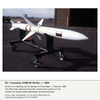
AGM-45 Shrike is an American anti-radiation missile designed to home in on hostile anti-aircraft radar. The Shrike was developed by the Naval Weapons Center at China Lake in 1963 by mating a seeker head to the rocket body of an AIM-7 Sparrow air-to-air missile. It was phased out by the U.S. in 1992 and, at an unknown time, by the Israeli Air Force, which was the only other major user, and has been superseded by the AGM-88 HARM missile. The Israel Defense Forces developed a version of the Shrike, called the Kilshon, that could be ground-launched with a booster rocket, and mounted it on an M4 Sherman tank chassis. The Navy first employed the Shrike during the Vietnam War in 1965, using the Douglas A-4 Skyhawk. The Air Force adopted the weapon the following year using F-105F and G Thunderchief Wild Weasel defense suppression aircraft, and later the F-4 Phantom II in the same role. The range was nominally shorter than the SA-2 Guideline missiles the system was used against, but it was a major improvement over the early method of attacking SAM sites with rockets and bombs from F-100F Super Sabers. A Shrike was typically lofted about 30 degrees above the horizon at a Fan Song radar some 15 miles (25 km) away for a flight time of 50 seconds. Tactics changed incrementally over the campaigns of 1966 and 1967 until the advent of the AGM-78 Standard ARM. That new weapon allowed launches from much longer ranges with a much easier attack profile, as the Standard could be launched up to 180 degrees off target and still expect a hit, and its speed let it travel faster than the SA-2. It became closely associated with Vietnam War operations against radar sites and remained in service through the Cold War.
Condition
Please check the pictures for the general condition of the item.
Ideal For
This assembly is suited to historical collections that document aviation electronics, military contractors, and guided-missile development.
- Cold War missile and aviation collections.
- U.S. Navy and Air Force historical exhibits.
- Wild Weasel and electronic warfare displays.
- American Electronic Laboratories component collections.
- Museum interpretation of passive radar-homing technology.
Approx length 16", Approx width 8", Approx height 8", Approx weight 11.5lbs.
Pictures are stock images of our inventory. Unless otherwise noted, you will not be receiving the exact item shown in the pictures. The pictures are representative of the item’s general condition. The item you receive might be slightly better, or worse, condition than was shown in the pictures.
Please visit our page about order lead times here: Order Lead Times.