




Description
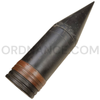
90mm T33E7 AP-T Projectile with Windscreen
Item Overview
The 90mm T33E7 AP-T projectile is an American armor-piercing tracer design from the Cold War era. This example includes its windscreen, giving it the pointed profile shown in military ammunition references. It suits collections focused on U.S. tank ammunition and the development of armored warfare.
Identification and Features
The original service design combined a hardened steel body with a lightweight aluminum windscreen attached over the nose. Beneath that cover, the steel body had a shorter, curved nose and a flat base. A rotating band engaged the gun’s rifling, while a threaded opening in the base held the tracer. The windscreen and steel body served separate purposes within the same projectile.
Original Function
AP-T stands for Armor-Piercing Tracer. The projectile used the energy of its impact to penetrate armor and carried no high-explosive bursting charge. Its tracer produced a visible light during flight, allowing crews to observe the shot’s path. The windscreen improved the projectile’s shape for flight by reducing air resistance around the steel nose.
Product History
The T33E7 belongs to the development history of the American T33 series of 90mm armor-piercing ammunition. A 1958 Army report on experimental tank armor cites a T33E7 test study dated June 19, 1956. Later Army manuals associate the designation with the M318/M318A1 AP-T family. These records place the design within early Cold War efforts to improve tank ammunition and evaluate stronger armor.
Documented Applications
Army ammunition data sheets list the M36, M41, and M54 90mm guns for this ammunition family. Their parent vehicles included the M47 Patton with the M36 gun, the original 90mm-armed M48 Patton series with the M41 gun, and the M56 Scorpion with the M54 gun. These applications covered both armored tanks and light airborne equipment.
Equipment History
The M47 entered American service in 1952 after the Korean War created an urgent need for improved tanks. It combined a modified T42 turret with an M46 hull. The M48 began replacing it in 1953 and introduced a new hull, turret, and suspension. The M56 followed a lighter approach, carrying a 90mm gun on a small tracked chassis built for airborne troops, with little protection for its crew.
Weapon-System Background
The M36 was a more powerful development of the M3A1 90mm gun used in the M46 tank. The M41 equipped the 90mm M48 series and incorporated a bore evacuator, blast deflector, and turret-mounted recoil system. The M54 brought this caliber to the compact M56. Together, these guns show how American forces adapted 90mm firepower to different vehicles and battlefield roles.
History of Use
The weapons associated with this ammunition served through major Cold War deployments. M47 tanks equipped American allies, including West Germany from 1955. M48 tanks served American and NATO forces in Europe, then supported Army and Marine Corps operations in Vietnam. The 1st Infantry Division used M48A3 tanks for road security and convoy protection. M56 Scorpions also served the 173rd Airborne Brigade in Vietnam, chiefly in infantry support.
Condition
This is an inert projectile supplied with its windscreen fitted, intended for collection, display, and historical study.
Ideal For
A suitable addition to American armor-piercing ammunition collections, Patton tank displays, and Cold War ordnance exhibits. Pair it with period technical illustrations or an example without its windscreen to explain how the outer cover relates to the steel penetrating body.
Approx length 14", Approx width 3.5", Approx height 3.5", Approx weight 24lbs.
Pictures are stock images of our inventory. Unless otherwise noted, you will not be receiving the exact item shown in the pictures. The pictures are representative of the item’s general condition. The item you receive might be slightly better, or worse, condition than was shown in the pictures.
Please visit our page about order lead times here: Order Lead Times.