




Description
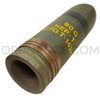
90mm T142E3 HEP-T Projectile
Product Overview
Add a piece of Cold War ammunition history to your collection with this inert 90mm T142E3 HEP-T Projectile. HEP-T stands for High-Explosive Plastic–Tracer. Developed for U.S. 90mm gun ammunition, this model reflects an era when the Army explored new ways to defeat tank armor. Its connections to Patton tanks and airborne antitank equipment make it a fitting subject for military history displays.
Original Function and Design
HEP ammunition used an explosive charge that spread against armor on impact. The blast could break metal fragments from the armor’s inner surface, an effect called spalling. This principle is also known as HESH, or High-Explosive Squash Head. The word “plastic” describes the moldable explosive used in the original live ammunition. Historical T142E3 configurations used Composition A3 and M91-series base-detonating fuzes. The tracer produced a visible trail that helped crews follow the projectile’s flight.
Product History
The T142E3 belonged to the T142 family of American 90mm HEP ammunition. Its development formed part of the Army’s early Cold War effort to expand the types of ammunition available for armored warfare. HEP offered a different approach from solid armor-piercing shot, which relied on impact energy to force its way through armor. Army publications continued to identify T142 and T142E3 ammunition during the 1960s.
Documented Applications
Army records list T142E3 ammunition for the 90mm M36, M41, and M54 guns. These armed the M47 Patton, 90mm-equipped M48 Patton tanks, and M56 Scorpion self-propelled antitank gun, respectively. The Army’s ammunition interchangeability chart also lists T142E3 cartridges assembled with the M19 case for M1- and M2-series 90mm guns. These applications describe complete ammunition configurations; the cartridge case and loading were part of the weapon compatibility.
Equipment History
The M47 entered American service in 1952, combining an existing tank hull with a newer turret and improved fire control. The M48 began replacing it in 1953 and introduced a redesigned hull, turret, and suspension. The M56 followed a lighter path. Built for airborne troops, it carried a powerful gun on a small tracked chassis with little protection for its crew. Together, these vehicles show how the Army adapted 90mm firepower to different needs.
Weapon-System Background
The M36, M41, and M54 were rifled guns. Their barrels spun projectiles to help steady them in flight. Each gun worked with a mount, recoil equipment, and aiming sights suited to its vehicle. Their ammunition choices included armor-piercing, high-explosive, HEAT, smoke, and canister rounds. HEP-T added an armor-defeating option based on blast effects, giving the 90mm gun family a wider range of roles.
History of Use
Aberdeen Proving Ground documented T142E3 armor trials in December 1953. Those tests examined spalling and the effect of projectile spin. A further government report published in 1959 studied its functioning and spall effects with the M91A1 fuze. The associated vehicles also have a broad service history: M47 tanks equipped many American allies, while M48 tanks served in Europe and Vietnam. The M56 saw use with the 173rd Airborne Brigade in Vietnam, chiefly supporting infantry. These vehicle histories do not establish a combat history for this individual projectile.
Collecting and Display
This projectile suits Cold War ordnance collections, Patton tank exhibits, and displays about ammunition development. It gives collectors a physical example of the HEP-T category to compare with other historic 90mm projectile types.
Approx length 14", Approx width 3.5", Approx height 3.5", Approx weight 8.9lbs.
Pictures are stock images of our inventory. Unless otherwise noted, you will not be receiving the exact item shown in the pictures. The pictures are representative of the item’s general condition. The item you receive might be slightly better, or worse, condition than was shown in the pictures.
Please visit our page about order lead times here: Order Lead Times.