






Description
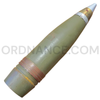
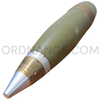
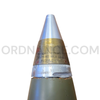
90mm M71 HE Projectile with M501A1 Nose Fuze
Item Overview
This 90mm M71 HE projectile is fitted with an M501A1 nose fuze. A collectible from the U.S. military’s gun ammunition family, it suits displays covering American artillery, anti-aircraft guns, and armored vehicles.
Identification and Features
The M71 designation identifies the high-explosive projectile, while M501A1 identifies its nose fuze. The projectile’s design uses a forged steel body, a streamlined nose, and a tapered base. Its rotating band engaged the gun’s rifling, which spun the projectile during flight. These features reflect the construction of American large-caliber ammunition from the mid-20th century.
Function
The original loaded M71 produced blast and steel fragments against personnel and equipment. HE stands for high explosive. The M501A1 is a mechanical time and superquick fuze, often shortened to MTSQ. In military service, this fuze type provided timed action or a prompt response to impact. These functions describe the original service ammunition.
Documented Applications
Wartime Army references list the M71 for the 90mm M1, M1A1, and M2 anti-aircraft guns. A January 1945 Ordnance publication also lists it for the M3 gun in M36 and M36B1 tank destroyers and the T26E3, which became the M26 Pershing. Later Army ammunition data sheets list the M71 family for the M36, M41, and M54 gun models. The Navy-prepared Iraq Ordnance Identification Guide identifies the M501A1 among the fuzes used with the M71.
Product History
The Army’s 1944 Catalog of Standard Ordnance Items listed the M71 as standard ammunition. It replaced the earlier M55 after problems showed that the older shell could not reliably withstand the stress of firing. The later M71A1 added a tracer, which made the projectile’s flight visible, and was standardized in 1960. Army ammunition data sheets continued to document the original M71 in 1994.
Equipment History
American 90mm guns developed from heavy anti-aircraft weapons into important vehicle-mounted guns. The M3 brought this caliber to tank destroyers and tanks during the closing years of World War II. Postwar development continued through the Patton tank family, including the M48. The Army began producing the M60 with a larger 105mm gun in 1960, marking the next step in American tank armament.
Weapon-System Background
The U.S. 90mm gun system used several ammunition types for different battlefield needs. The M71 belonged to its high-explosive ammunition group, alongside armor-piercing designs such as the M82. Service ammunition was issued as a complete fixed round, with the projectile and cartridge case joined into one unit. The projectile offered here is the shell component of that larger ammunition system.
History of Use
Fifth Army records from Anzio, Italy, document M71 ammunition use during 1944. These reports list shells with M43 time fuzes and M48 impact fuzes, giving the projectile family a clear wartime combat record. The broader history of American 90mm guns continued with the M26 Pershing in the Korean War and the M48 Patton in the Vietnam War. Those later conflicts form part of the weapon family’s history.
Condition
Offered in unfired, empty, and inert condition, with the M501A1 nose fuze included. The projectile body contains no explosive filling, and the fuze is inert.
Ideal For
Suitable for military ordnance collections, museum exhibits, educational displays, and collections focused on American 90mm gun ammunition. Its identified projectile and fuze models also make it useful for studying the history of shell design and artillery fuzes.
Approx length 17", Approx width 3.5", Approx height 3.5", Approx weight 21lbs.
Pictures are stock images of our inventory. Unless otherwise noted, you will not be receiving the exact item shown in the pictures. The pictures are representative of the item’s general condition. The item you receive might be slightly better, or worse, condition than was shown in the pictures.
Please visit our page about order lead times here: Order Lead Times.