





Description
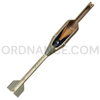
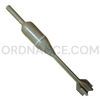
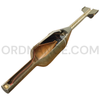
90mm HEAT Projectile Cutaway for the M67 Recoilless Rifle
Add a close look at Vietnam-era antiarmor ammunition design to your collection with this 90mm HEAT projectile cutaway for the M67 recoilless rifle. Its sectioned format makes it an appealing display piece for military collectors, museums, and educational exhibits.
Cutaway Features and Contents
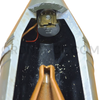
The cutaway provides a view of the projectile’s internal structure. For historical comparison, Army drawings of the M371A1 service round show an internal copper cone, a long nose spike, a fuze near the base, and stabilizing tail fins. These features help explain the arrangement of the M67’s HEAT ammunition without relying on an exterior view alone.
Original Function
HEAT stands for high explosive antitank. The original service projectile used a shaped charge to focus explosive energy into an armor-piercing metal jet. Its effect depended mainly on the warhead’s design rather than impact speed alone. Although intended chiefly for armored targets, the ammunition also had uses against fixed positions through blast and fragmentation.
Product History
The M67’s HEAT ammunition family developed during the early Cold War. The Army’s 1965 field manual described the M371E1 HEAT round, while ammunition data records give the M371A1 a standard classification date of 1966. Later manuals continued to document the M371A1, linking this projectile design to both the Vietnam era and the following decades of military service.
Documented Applications
The documented parent weapon for this ammunition type is the 90mm M67 recoilless rifle. Army manuals list the M371A1 HEAT cartridge alongside M371 practice ammunition and M590 antipersonnel canister ammunition. These rounds gave the M67 separate options for armor engagement, training, and defense against infantry.
Equipment History
The M67 was established in U.S. Army documentation by February 1962. Its portable design suited infantry units that needed a support weapon they could carry on foot. The Army published a detailed training manual in 1965 and an updated operator and maintenance manual in 1985, showing continued support for the equipment through the later Cold War.
Weapon-System Background
The M67 was a crew-served, single-shot weapon with a rifled 90mm barrel and an optical sight. It loaded through the breech and was designed mainly for ground firing using a bipod and monopod, although shoulder firing was also possible. Its recoilless system released some firing gases through the rear to reduce recoil, allowing a portable weapon to fire a substantial projectile.
History of Use
The M67 saw service during the Vietnam War. A March 1970 Australian War Memorial photograph documents soldiers of the combined Australian and New Zealand 6RAR/NZ ANZAC battalion using the weapon at Fire Support Base Peggy in South Vietnam. The M67 later remained with the U.S. Army’s 75th Ranger Regiment into the late 1980s. The replacement Carl Gustaf M3 was fielded to the Rangers in 1991.
Approx length 28", Approx width 3", Approx height 3", Approx weight 3.7lbs.
Pictures are stock images of our inventory. Unless otherwise noted, you will not be receiving the exact item shown in the pictures. The pictures are representative of the item’s general condition. The item you receive might be slightly better, or worse, condition than was shown in the pictures.
Please visit our page about order lead times here: Order Lead Times.