




Description
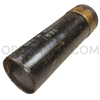
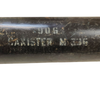
90mm M336 Antipersonnel Canister Projectile
Item Overview
The 90mm M336 canister projectile is an American military ammunition component associated with Cold War tanks and self-propelled guns. Its blunt, cylindrical shape reflects a specialized role in close-range infantry support. This collectible connects to the history of the M47 Patton, M48 Patton, and M56 Scorpion.
Identification and Features
The original service design used a thin steel canister body joined to a heavy, cup-shaped steel base. A rotating band made from a copper alloy surrounded the base and engaged the gun’s rifling. Four lengthwise slits helped the container open after firing, while a closing disk held its contents in place. These features distinguish the M336 from pointed tank projectiles.
Original Function
The service-loaded M336 carried approximately 1,281 cylindrical steel pellets for use against personnel at close range. After leaving the gun’s muzzle, the canister opened and released the pellets in a spreading pattern. Its action resembled a large shotgun shell and gave tank crews a specialized close-defense round.
Product History
American 76mm and 90mm tank canister ammunition developed during the early 1950s. The M336 became part of the U.S. 90mm ammunition inventory and gained a documented combat role during the Vietnam War. Army ammunition data sheets continued to describe it in later decades, preserving details of its construction and applications. Its history follows the continued use of canister ammunition as tanks took on infantry-support duties.
Documented Applications
Army technical references list the M336 cartridge for the M36, M41, and M54 90mm guns. These weapons armed the M47 Patton, the original 90mm-armed M48 Patton series, and the M56 Scorpion, respectively. Army historical accounts specifically document M336 ammunition in use with M48A3 tanks in Vietnam.
Equipment History
The M47 entered American service in 1952 after the Korean War created an urgent need for improved tanks. It combined a modified T42 turret with an M46 hull. The M48 began replacing it in 1953 and introduced a new hull, turret, and suspension. Later M48A3 tanks received diesel engines. The M56 took a lighter approach, carrying a 90mm gun on a small tracked chassis built for airborne troops.
Weapon-System Background
The M36 gun developed from the earlier M3A1 90mm tank gun and increased its power. The M41 became the main armament of the 90mm M48 series, while the M54 equipped the M56. These systems could use several ammunition types, including armor-piercing, high-explosive, and canister rounds. That range allowed their crews to address different targets, with the M336 filling the close-range antipersonnel role.
History of Use
Canister ammunition became an important part of American armored operations in Vietnam. M48A3 crews used it during infantry support, responses to ambushes, and defensive fighting. It also helped clear thick vegetation that blocked visibility. An Army account records 90mm canister use by the 1st Squadron, 11th Armored Cavalry near Suoi Cat on December 2, 1966. This documented service gives the M336 a strong connection to Vietnam-era tank history.
Condition
This M336 is an inert projectile component intended for collecting, display, and historical study.
Ideal For
A suitable addition to American tank ammunition collections, Vietnam War displays, and collections of canister ordnance. It also works well alongside period manuals and other 90mm projectile types when explaining the different ammunition roles within a tank’s main-gun system.
Approx length 11", Approx width 3", Approx height 3", Approx weight 8lbs.
Pictures are stock images of our inventory. Unless otherwise noted, you will not be receiving the exact item shown in the pictures. The pictures are representative of the item’s general condition. The item you receive might be slightly better, or worse, condition than was shown in the pictures.
Please visit our page about order lead times here: Order Lead Times.