






Description
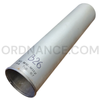
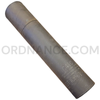
Fired 90mm M112 Cartridge Case with M572 Fiber Container for the M67 Recoilless Rifle
Item Overview
This fired 90mm M112 cartridge case comes with an M572 fiber ammunition container labeled for XM590E1 antipersonnel canister ammunition. The combination brings together a spent cartridge component and marked military packaging associated with the M67 recoilless rifle. Both are inert collectibles for historical study and display.
Identification and Features
The fiber tube bears the supplied marking: “C410 CARTRIDGE 90MM CANNISTER ANTIPERSONNEL XM590E1 FOR 90MM RIFLE M67.” This identifies the ammunition type intended for the container. Army references document the following component identifiers.
- Cartridge case: 90mm M112, fired.
- Case material: Aluminum.
- M112 case drawing number: 8595496.
- Fiber ammunition container: M572.
- Historical container NSN: 8140-00-089-8668.
- Container part/drawing number: 9213611.
Original Function
The M112 case held the propelling charge and primer and formed the rear portion of a complete cartridge. It joined the projectile so the ammunition could be loaded as one unit. The M572 fiber container protected an individual canister cartridge during storage and transport, while its printed markings helped supply personnel and weapon crews identify the contents.
Documented Applications
The M112 was the common cartridge case for the M67’s M371 practice, M371A1 HEAT, and M590 canister ammunition. The M572 container had a more specific application: XM590E1 canister ammunition, later listed as M590. The C410 marking is the ammunition identification code for this antipersonnel canister cartridge.
Product and Packaging History
These component designs belong to the M67’s Cold War ammunition program. A 1970 update to the Army’s FM 23-11 included XM590E1 canister ammunition among the rifle’s authorized rounds. Later ammunition data listed the cartridge as M590, with standard classification dated 1971. The supplied tube retains the earlier XM590E1 designation, while the M112 case design served across several ammunition loads.
Parent Equipment History
The M67 was already documented in an Army operator manual dated February 1962. Its portable design gave infantry a support weapon they could carry on foot, with antiarmor capability supplied by HEAT ammunition. Canister ammunition broadened its role to include close defense against infantry. An updated operator and maintenance manual appeared in 1985, reflecting continued support for the system.
Weapon-System Background
The M67 was a crew-served, breech-loaded, single-shot weapon with a rifled 90mm barrel and an optical sight. It was designed mainly for ground firing using a bipod and monopod, although shoulder firing was also possible. Controlled rearward gas release reduced recoil. Its canister round dispersed small steel darts called flechettes for antipersonnel use.
History of Use
The M67 saw service during the Vietnam War. Australian War Memorial records document March 1968 trials of flechette ammunition at Nui Dat by the 7th Battalion, Royal Australian Regiment. The weapon later remained in use with the U.S. Army’s 75th Ranger Regiment into the late 1980s. The replacement Carl Gustaf M3 was fielded to the Rangers in 1991.
Condition
The M112 cartridge case has been fired and is supplied with the labeled M572 fiber container. This is a used cartridge case offered with its accompanying packaging as inert collectible components.
Ideal For
Suitable for collections that show military ammunition cases alongside their marked transport packaging, with a specific connection to the M67 recoilless rifle.
- M67 recoilless rifle accessory displays.
- U.S. military ammunition packaging collections.
- Cold War and Vietnam-era ordnance exhibits.
- Reference collections of fired cartridge cases.
Approx length 20", Approx width 4", Approx height 4", Approx weight 7.6lbs.
Pictures are stock images of our inventory. Unless otherwise noted, you will not be receiving the exact item shown in the pictures. The pictures are representative of the item’s general condition. The item you receive might be slightly better, or worse, condition than was shown in the pictures.
Please visit our page about order lead times here: Order Lead Times.