








Description
German 88mm Sprgr. 43 High Explosive Round for Tiger II and Pak 43
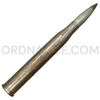
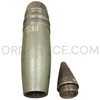
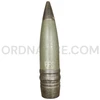
A 1944-dated steel case, A.Z.23/28 nose fuze, and C/22 St electric primer distinguish this German 88mm Sprgr. 43 high explosive round. It represents the ammunition family supplied for the Tiger II’s KwK 43 and the related Pak 43 antitank guns, offering collectors a substantial display example of Germany’s late-war tank and artillery ammunition. Extremely rare to find complete King Tiger tank rounds in the United States, and this is the only example of the high-explosive round that we have, so you will be receiving the exact round shown in the photos!
Projectile Design and Markings
The projectile’s elongated steel body, two driving bands, and extended rear section match the documented 8.8 cm Sprgr. 43 high explosive design. In service, this shell provided blast and fragmentation against troops, gun positions, and other ground targets. The white “FES” marking identifies sintered-iron driving bands, reflecting Germany’s wartime use of iron bands in place of copper-bearing designs. A black “95” is visible near the nose. In German ammunition marking practice, this number identified a cyclonite/TNT filling, also described as RDX/TNT.
A.Z.23/28 Fuze and C/22 St Primer
The conical nose fuze is marked “A.Z.23/28” and “43,” identifying its model and 1943 component date. This impact fuze provided instantaneous or short-delay action in service and belonged to the wider German A.Z.23 fuze family. At the case base, the marked C/22 St is the steel-bodied version of the C/22 electric primer. Its two broad head flats distinguish it from earlier brass-bodied examples with three keyways. Electric priming was used across the Pak 43/KwK 43 ammunition family, including its towed gun applications.
Steel Case and Production Markings
The long, necked 88×822mm case, also designated 88×822R, carries the preserved case number “6388 St,” manufacturer code “awt,” and date “44.” The “St” suffix identifies steel construction. British wartime documentation describes the 6388 St as a solid-drawn steel case protected with a brass coating. This construction reduced the amount of brass required for a large cartridge case. The 1944 case date and 1943 fuze date identify those components individually.
Documented Gun and Vehicle Applications
This ammunition family served the 8.8 cm KwK 43 L/71 in the Tiger II, also known as the Königstiger or King Tiger, and the towed Pak 43 and Pak 43/41. Vehicle-mounted applications included the Pak 43/1 in the Nashorn, originally called Hornisse, on a chassis combining Panzer III and IV components; the Pak 43/2 in the Ferdinand/Elefant, built on the Porsche Tiger chassis; and the Pak 43/3 or Pak 43/4 in the Panther-based Jagdpanther. High explosive ammunition gave these weapons a useful role against ground positions alongside their armor-piercing loadings.
Development and Wartime Service
The Pak 43/KwK 43 family formed part of Germany’s effort to field more powerful weapons against increasingly well-armored tanks. Its long L/71 barrel and larger cartridge supported greater armor-piercing performance than the earlier 88mm system. The Tiger I’s KwK 36 L/56 used the shorter 88×571mm round, while the Tiger II’s KwK 43 used this 88×822mm ammunition family. The towed Pak 43 used a cruciform mounting, and the Pak 43/41 placed the gun on a two-wheeled split-trail carriage. These installations brought the same ammunition family to both armored vehicles and antitank units. Tiger II development began in 1942, and the tank first entered combat during the Normandy campaign in 1944.
Condition
All ordnance is inert. Please check the pictures for the general condition of the item.
Ideal For
This round supports focused displays and research into German heavy armor and antitank artillery.
- Tiger II, Jagdpanther, Nashorn, and Ferdinand/Elefant collections.
- Pak 43 and KwK 43 museum or restoration displays.
- Study of German projectile markings, steel cases, and electric primers.
Approx length 46", Approx width 5.5", Approx height ", Approx weight 31 lbs.
Pictures are stock images of our inventory. Unless otherwise noted, you will not be receiving the exact item shown in the pictures. The pictures are representative of the item’s general condition. The item you receive might be slightly better, or worse, condition than was shown in the pictures.
Please visit our page about order lead times here: Order Lead Times.