




Description
German 88mm KwK 43 / PaK 43 Armor-Piercing Round
This inert German 88x822mm round combines a 1944-dated steel case with a capped armor-piercing projectile. It represents the long 88mm ammunition family used by the Tiger II heavy tank and several German tank destroyers. The visible case markings, white painted projectile tip, twin driving bands and retained base-fuze components give collectors useful details for a display centered on Germany’s late-war armored vehicles. Extremely rare to find complete King Tiger tank rounds in the United States, and this is the only example of the armor-piercing round that we have, so you will be receiving the exact round shown in the photos!
Steel Case and Wartime Markings
The case head carries the designation 6388 St, the date code 44 and an eagle acceptance mark. This long, rimmed, bottlenecked steel case served the KwK 43 and PaK 43 ammunition family. Service rounds used a C/22 or C/22 St electric primer.
Armor-Piercing Projectile and Base Fuze
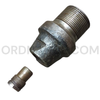
The projectile’s capped profile, dark body, white nose and two driving bands are consistent with the Pzgr. 39 series. This armor-piercing capped, ballistic-capped design, commonly called APCBC, combined a penetrating steel body with an armor-piercing cap and a streamlined outer nose cap. The base-fuze body and smaller threaded component shown are consistent with the Bd.Z. 5127 fuze and its tracer arrangement. In service, this fuze initiated a small bursting charge after penetration, while the tracer helped crews follow the projectile’s flight. The Pzgr. 39/43 version used wider driving bands than the earlier Pzgr. 39-1. U.S. ordnance references list the loaded and fuzed Pzgr. 39/43 projectile at approximately 22.8 pounds, with the long 88mm guns firing APCBC ammunition at about 1,000 meters per second.
Tiger II Tank Application
The principal tank application was the 8.8 cm KwK 43 L/71 fitted to the Tiger II, also known as Königstiger or King Tiger. Design work began in 1942 around the need to mount a longer, more powerful 88mm gun than the Tiger I’s KwK 36 L/56. The larger weapon required more turret space, and its longer ammunition was not interchangeable with Tiger I ammunition. Krupp developed the turret while Henschel and Porsche worked on competing hull designs; Henschel’s design entered production. The Tiger II reached combat in 1944, including the Normandy campaign. This round’s ammunition family is therefore directly associated with the Tiger II’s main armament.
Tank Destroyers and Towed PaK 43 Guns
The same ammunition family equipped several specialized antitank vehicles. The Nashorn, originally called Hornisse, carried the PaK 43/1 on a chassis combining Panzer III and Panzer IV components. The Ferdinand/Elefant mounted the PaK 43/2 on the Porsche Tiger chassis. The Jagdpanther used the PaK 43/3 or PaK 43/4 on the Panther chassis, replacing the rotating turret with a fixed armored superstructure that accommodated the larger gun. Towed applications included the PaK 43 on a low cruciform mounting and the PaK 43/41 on a two-wheeled split-trail carriage. These installations brought the long 88mm gun into heavy tank, tank-destroyer and ground-mounted antitank service.
Condition
The pictured example shows worn dark finish, surface corrosion and pitting on the case and projectile. The white nose paint is chipped, the driving bands show oxidation, and some stamped details are faint. Base-fuze components are present as pictured and show corrosion and surface wear. The case primer is absent, leaving its threaded pocket exposed. All ordnance is inert. Please check the pictures for the general condition of the item.
Ideal For
A useful reference and display piece for collections examining the ammunition and armament of German heavy tanks and tank destroyers.
- Tiger II and Jagdpanther vehicle-history displays.
- Comparative studies of KwK 43 and PaK 43 ammunition.
- Museum exhibits covering German antitank weapons of World War II.
Approx length 44", Approx width 5.75", Approx height 5.75", Approx weight 36lbs.
Pictures are stock images of our inventory. Unless otherwise noted, you will not be receiving the exact item shown in the pictures. The pictures are representative of the item’s general condition. The item you receive might be slightly better, or worse, condition than was shown in the pictures.
Please visit our page about order lead times here: Order Lead Times.