





Description
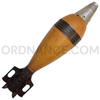
U.S. 81mm M43A1 High Explosive Fragmentation Mortar Round with M52 Superquick Point-Detonating Fuze and M3 Tail Fin
This inert U.S. 81mm M43A1 high-explosive fragmentation mortar round includes an M3 tail-fin assembly and an M52 point-detonating fuze. Associated with the 81mm M1 infantry mortar, the M43A1 provided American troops with portable, high-angle fire support during World War II. This round is an useful addition for collections and displays covering U.S. infantry weapons, mortar ammunition, and wartime fuze development.
Purpose and Historical Performance
The M43A1 was the light high-explosive round in the M1 mortar’s ammunition range. It was intended principally for personnel and light targets, delivering blast and fragments from its steel shell body. Its curved flight allowed infantry to reach positions screened by terrain or obstacles that blocked direct rifle and machine-gun fire.
Development from the M43
The M43A1 replaced the earlier M43 light high-explosive shell while retaining its basic body, explosive filling, nose adapter, and fuze-well arrangement. An important change was the revised tail assembly, which omitted the fin flanges previously needed to retain the older propellant increments. The revised arrangement accommodated newer increment packaging. Further manufacturing changes produced the M43A1B1, which eliminated the separate nose adapter by incorporating its function into the shell body. These developments show how the ammunition evolved through changes to components and production methods while retaining its infantry-support role.
M52 Fuze and M3 Tail Assembly
The M52 was a superquick point-detonating fuze used with both 60mm and 81mm mortar ammunition. In service, its rapid impact action helped the light shell burst near the surface before substantial burial, allowing its fragments to spread above ground. The M3 tail assembly stabilized the round in flight and housed the ignition system. Its fins also supported the external propellant increments used with service ammunition. The M3 ignition cartridge shown at the tail belongs to an earlier ignition arrangement; later M43A1 configurations used other ignition cartridges and separate percussion primers.
The 81mm M1 Mortar and Its Origins
The M1 mortar grew from the French Edgar Brandt company’s improvements to the British Stokes mortar of World War I. Brandt’s work refined both the weapon and its ammunition, particularly the stability of the shell in flight. The United States acquired Brandt mortars for trials in 1931 and purchased manufacturing rights in 1932. Improvements incorporated into the American system included better sighting and leveling equipment, a heavier barrel, and a revised baseplate. The resulting smoothbore, muzzle-loading M1 became a standard American infantry support weapon. Its ammunition combined a stable, fin-guided flight with a nose fuze suited to reliable impact functioning.
Wartime Use and Continued Applications
During World War II, Army infantry battalions fielded 81mm mortar platoons in their heavy weapons companies, giving commanders supporting fire close to their rifle units. Marine forces also used the M1 mortar in Pacific operations. The Navy’s contemporary report on the capture of Iwo Jima specifically lists M43A1 high-explosive ammunition with the M52 fuze, documenting this combination in the wartime supply system. Later ammunition references continued to list the M43A1 for the M1 and the succeeding M29 and M29A1 mortars. These applications establish the ammunition family’s wider service history without attributing a particular campaign or unit history to this specimen.
Ideal For
This round provides a reference for studying the ammunition and components that supported American infantry mortar crews.
- World War II U.S. mortar ammunition collections.
- Displays accompanying an 81mm M1 mortar restoration.
- Museum exhibits on infantry battalion support weapons.
- Comparative study of M43-series rounds, M52 fuzes, and mortar tail assemblies.
Approx length 13.5", Approx width 3.5", Approx height 3.5", Approx weight 5.6lbs.
Pictures are stock images of our inventory. Unless otherwise noted, you will not be receiving the exact item shown in the pictures. The pictures are representative of the item’s general condition. The item you receive might be slightly better, or worse, condition than was shown in the pictures.
Please visit our page about order lead times here: Order Lead Times.