




Description
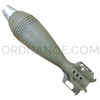
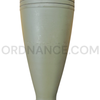
81mm M43 High-Explosive Mortar Round with M45 Practice Fuze – Inert Display
Item Overview
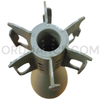
This inert 81mm M43 high-explosive mortar round is fitted with an M45 practice fuze and is intended for collection, education, and display. The original M43 was an early light high-explosive round developed for the U.S. M1 81mm mortar. Its streamlined body, nose-mounted fuze, and fin-stabilized tail represent the basic design used by American mortar ammunition during the World War II era. This offered example is inert and contains no live explosive or propelling material.
Identification and Features
The combination of an M43 shell and M45 practice fuze creates a distinctive display representing early U.S. 81mm mortar technology. Period records confirm the M43 designation as both a high-explosive service shell and a related practice-shell design.
- Caliber: 81mm
- Shell designation: M43
- Original service role: High explosive
- Installed component: M45 practice fuze
- Primary documented weapon: U.S. 81mm Mortar M1
- Additional documented application: 3-inch Trench Mortar Mk. IA2, subject to period charge restrictions
- Configuration: Inert display round
- Live explosive or propelling material: None
Inert Display Configuration
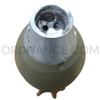
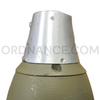
This item represents the outward form of a complete mortar round but is sold only as an inert historical display. The installed M45 practice fuze is an inert component and must not be confused with an operational service fuze. No claim is made that this combination represents the most common wartime loading of the M43 HE round. Period firing tables usually list the M43 with an M52 point-detonating fuze, while later references also identify other approved fuze arrangements.
M43 Mortar Round History
The M43 belonged to the light class of 81mm mortar ammunition developed for greater range than the heavy mortar shells of the period. A U.S. War Department firing table lists the M43 HE shell and related M43 and M44 practice shells for the M1 mortar. That table gives a service weight of 6.87 pounds for the M52-fuzed projectile and a maximum listed range of 3,290 yards. These are historical service specifications and should not be treated as the measurements or weight of this inert display example. The improved M43A1 later continued the same general role.
M45 Fuze History
World War II technical manuals identify the original live M45 as a point-detonating fuze for 3-inch and 81mm mortars. It could be set for superquick impact action or a short delay of about one-tenth of a second. By 1944, the M45 was listed as limited standard and had been replaced in current production by the single-action M52 and M53 fuzes. The term “practice fuze” in this listing describes the inert M45 component installed on the offered item; it is not the historical military classification of an operational M45 fuze.
M1 81mm Mortar System History
The U.S. M1 81mm mortar grew from the French Brandt improvement of the earlier Stokes trench mortar. The U.S. Army tested Stokes-Brandt mortars and M1930 mounts in 1931, found the design successful, and purchased manufacturing rights. The resulting M1 used a smoothbore, muzzle-loaded tube with a bipod, baseplate, and sighting system. Its high-angle fire allowed crews to reach targets behind hills, buildings, and field defenses. The weapon could be carried in separate loads by its crew, fired from a ground position, or installed in vehicles such as the M4 mortar carrier.
History of Use
The M1 became an important battalion-level support weapon during World War II. Mortar crews used it to place indirect fire on enemy troops, machine-gun positions, light fieldworks, and other targets that direct-fire weapons could not easily reach. The M43 family provided a lighter high-explosive option for longer-range missions. The M1 remained in American service during the early postwar period and the Korean War era before newer 81mm mortar systems replaced it. This history applies to the ammunition and weapon type; it does not establish where or when this individual display round served.
Condition
Please check the pictures for the general condition of the item.
Ideal For
This inert M43 mortar round offers a recognizable display of early American infantry-support ammunition and fits well with collections focused on World War II weapons, mortar development, or U.S. Army ordnance.
- Military museums and educational displays
- World War II and Korean War-era collections
- U.S. mortar and artillery ammunition collections
- Veterans’ organizations and historical exhibits
- Military-themed offices, stores, and display rooms
Approx length 13", Approx width 4", Approx height 4", Approx weight 7 lbs.
Pictures are stock images of our inventory. Unless otherwise noted, you will not be receiving the exact item shown in the pictures. The pictures are representative of the item’s general condition. The item you receive might be slightly better, or worse, condition than was shown in the pictures.
Please visit our page about order lead times here: Order Lead Times.