



Description
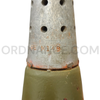
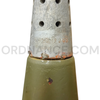
81mm M374 High-Explosive Mortar Round with M501A1 Fuze and M149 Fin – Inert Composite Display
Item Overview
This inert display combines an original-style 81mm M374 high-explosive mortar projectile body, an M501A1 mechanical time and superquick fuze, and an M149 fin assembly. The M149 is a documented early-production component for the M374 cartridge. However, the M501A1 was not a standard service fuze for the M374. This item should therefore be described as a composite display rather than an original service-issued M374 configuration. It is represented as completely inert and is intended only for collecting, education, and display.
Key Features
This substantial display brings together three identifiable pieces of American ordnance history. The assembled form shows the major external parts of a military mortar cartridge, including the nose fuze, steel projectile body, and finned tail assembly. Its mixed components also make it a useful example of how collectors may encounter ordnance assembled from parts that were not originally authorized for use together.
- 81mm M374 high-explosive mortar projectile body
- M501A1 mechanical time and superquick fuze
- M149 six-fin tail assembly
- Documented early M374 fin type
- Composite configuration assembled for inert display
- No claim of an original service-issued M374 and M501A1 combination
- Suitable for military collections, museums, and educational displays
Inert Composite Configuration
The offered round is represented as inert and contains no functional explosive, propellant, primer, or fuze system. The exact method used to deactivate each component is not specified. Although the M374 body and M149 fin are historically related, the M501A1 fuze belongs to a different group of ammunition. This distinction is important because the assembled display does not reproduce an authorized M374 service configuration. The M501A1 adds visual and historical interest, but it should not be represented as the original fuze supplied with this mortar cartridge.
Original M374 Service Configuration
The live M374 was a U.S. high-explosive cartridge intended to produce blast and fragmentation against personnel and materiel. A standard service round included a projectile body, an approved point-detonating or proximity fuze, a fin assembly, an ignition cartridge, a percussion primer, and removable propellant increments. Army references list approved fuze families such as the M524, M526, M567, M716, and M532, depending on the production period and authorized configuration. The M501A1 is not listed among the standard M374 fuzes.
- Historical service type: 81mm high-explosive mortar cartridge
- Documented weapons: M1, M29, and M29A1 81mm mortars
- Historical projectile material: forged steel or pearlitic malleable iron
- Original live filler: approximately 2.10 pounds of Composition B
- Historical complete-round weight: approximately 9.34 pounds
- Historical complete-round length: approximately 20.838 inches
- Standard service finish: olive drab with yellow identification markings
M149 Fin Assembly
The M149 fin assembly is the correct tail assembly for early-production M374 cartridges. It was normally paired with an M66A1 ignition cartridge. Its six canted fins stabilized the projectile during flight and produced a small amount of spin. Later M374-series ammunition used the M170 fin assembly with the M285 ignition cartridge. The M149 therefore represents an important early stage in the development of the M374 ammunition family.
M501A1 Fuze History
The M501A1 was a mechanical time and superquick nose fuze. In its original live form, it allowed a crew to select either timed functioning or impact functioning. It was designed for spin-stabilized projectiles fired from 105mm and 155mm howitzers and from the rifled 4.2-inch mortar. The smoothbore 81mm M374 was fin-stabilized and used other fuze families. The M501A1 fitted to this display should therefore be viewed as a separate artillery artifact that has been combined with the mortar body.
History of the 81mm Mortar System
The American 81mm mortar family developed from the French Brandt design and became an important source of infantry fire support. The M1 mortar served during World War II and the Korean War. The lighter M29 entered U.S. service during the early 1950s, while the improved M29A1 appeared during the 1960s. These smoothbore, muzzle-loaded weapons could be separated into a cannon, bipod, baseplate, and sight for transportation. Their high-angle fire allowed crews to engage targets behind hills, buildings, and other cover.
History of Use
The M374 family was part of the Cold War generation of American 81mm mortar ammunition. Army manuals document it for the older M1 as well as the M29 and M29A1 mortars. The M29 series provided battalion-level fire support and saw extensive service during the Vietnam era. Mortar crews used high-explosive ammunition to support infantry, attack exposed personnel, and engage light field positions. This display has no documented connection to a particular unit, battle, or theater, and period photographs of 81mm mortar crews do not always identify the exact cartridge model being handled.
Collector Appeal
This inert composite round offers a strong visual representation of American mortar and artillery development during the Cold War. The correct early M149 fin provides a direct connection to the M374 ammunition family, while the separate M501A1 fuze represents mechanical time-fuze technology used with larger artillery and rifled-mortar ammunition. It would make an impressive addition to a military museum, Vietnam-era collection, ordnance display, classroom exhibit, gun shop, or historical training collection.
- Cold War and Vietnam-era military displays
- U.S. mortar and artillery collections
- Military museums and historical exhibits
- Ordnance identification and educational displays
- Gun rooms, offices, and veteran organization displays
Condition
Please check the pictures for the general condition of the item.
Approx length 21", Approx width 4", Approx height 4", Approx weight 7lbs.
Pictures are stock images of our inventory. Unless otherwise noted, you will not be receiving the exact item shown in the pictures. The pictures are representative of the item’s general condition. The item you receive might be slightly better, or worse, condition than was shown in the pictures.
Please visit our page about order lead times here: Order Lead Times.