




Description
U.S. 81mm M141 Mortar Fin Assembly
Item Overview
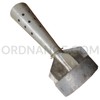
This inert U.S. 81mm M141 mortar fin assembly is the documented tail assembly used with the M362 and M362A1 high-explosive mortar cartridges. Often called a fin section, it attached to the rear of the projectile body and supported the round’s ignition, propelling, and flight-stabilizing systems. The M141 belongs to the post-World War II generation of American 81mm mortar ammunition used with the M1, M29, and M29A1 mortars. This listing is for the inert fin assembly only, not a complete M362 or M362A1 mortar cartridge.
Identification and Features
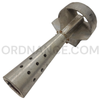
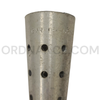
The standard M141 assembly consisted of an aluminum cartridge housing, a fin, and holders for the removable propellant increments. The housing was threaded at its forward end for the M66 ignition cartridge and at its rear for the fin. Openings in the housing carried the ignition flash to the M5 propelling charge fitted around the tail. The complete service configuration used eight removable propellant increments and an M71-series percussion primer. These components describe the original military configuration and should not be considered included with this inert fin section unless they are specifically shown or stated.
- Official designation: Fin Assembly M141
- Common description: 81mm mortar fin section
- Documented cartridges: M362 and M362A1 high-explosive rounds
- Component function: Projectile attachment, ignition support, propellant support, and flight stabilization
- Standard ignition cartridge: M66
- Standard propelling charge: M5 with eight removable increments
- Standard primer: M71-series percussion primer
- Documented mortars: M1, M29, and M29A1
- Status: Inert
Historical Background
The American 81mm mortar family began with the M1 mortar, which entered service before World War II and became an important infantry-support weapon during World War II and the Korean War. Its high-angle fire allowed crews to engage troops and light positions located behind terrain, walls, and other cover. The lighter postwar M29 mortar continued this role, while the improved M29A1 became closely associated with U.S. operations during the Vietnam era. The M362 and M362A1 cartridges were Cold War-era high-explosive rounds designed for use against personnel and light material through blast and fragmentation. The M362 used a forged-steel projectile body, while the M362A1 used a cast pearlitic-malleable-iron body; both used the M141 fin assembly. In the original service round, the mortar’s firing pin struck the primer, which ignited the M66 ignition cartridge. Its flash passed through openings in the M141 housing and started the selected M5 propellant increments. The resulting gas pressure launched the projectile, while the M141’s fixed fins kept it stable during flight. Later M374-series ammunition provided improved range, accuracy, and terminal performance with different fin assemblies, so the M141 should not be described as a general-purpose fin for every U.S. 81mm mortar round.
Condition
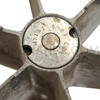
This item is confirmed inert and contains no live energetic or explosive material. It is an M141 fin assembly only and does not form a complete 81mm mortar cartridge. A projectile body and fuze are not included. Please check the pictures for the general condition of the item.
Ideal For
This M141 fin assembly is a useful display and study component for collections focused on Cold War and Vietnam-era U.S. mortar equipment. Its documented connection to the M362-series high-explosive cartridge also makes it suitable for exhibits explaining the development and construction of American 81mm mortar ammunition.
- U.S. 81mm mortar-ammunition collections
- M362 and M362A1 cartridge displays
- M1, M29, and M29A1 mortar exhibits
- Cold War and Vietnam-era military displays
- Museum, educational, and technical-reference collections
Approx length 7.6", Approx width 3", Approx height 3", Approx weight 0.7lbs.
Pictures are stock images of our inventory. Unless otherwise noted, you will not be receiving the exact item shown in the pictures. The pictures are representative of the item’s general condition. The item you receive might be slightly better, or worse, condition than was shown in the pictures.
Please visit our page about order lead times here: Order Lead Times.