




Description
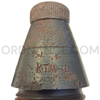
Soviet 76mm OF-350 HE-Frag Round with KTM-1 Fuze
This inert Soviet 76x385mm round features an OF-350 (ОФ-350) high-explosive fragmentation projectile and a KTM-1 impact fuze dated 1939. It represents the ammunition used by Soviet field guns, tanks, and self-propelled artillery to support infantry, offering collectors a direct connection to the weapons that equipped the Red Army.
OF-350 Projectile and Purpose
The OF-350 was a spin-stabilised high-explosive fragmentation projectile for Soviet rifled artillery. It combined explosive blast and fragmentation against personnel, exposed gun positions, and light field defenses, giving field and tank crews a general-purpose shell for infantry support. Soviet manuals list a historical loaded projectile weight of 6.20 kg.
KTM-1 Fuze
The KTM-1 was a standard nose-mounted impact fuze for the OF-350, designed to initiate the explosive burst when the shell struck its target. The fuze stamp 55-39г identifies lot 55, manufactured in 1939. Its ЗИД maker's mark is associated with the Dzerzhinsky factory in Perm, a documented producer of KTM-1 fuzes.
From Imperial Field Guns to the ZiS-3
Soviet 76mm divisional artillery grew from the Imperial Russian Model 1902 field gun, which served in the Russo-Japanese War and World War I. Modernized in 1930, that gun remained in use during World War II. Later Soviet designs retained the Model 1902/30 ammunition family. The best-known wartime example was the ZiS-3, developed under Vasily Grabin at Factory No. 92 and adopted on February 12, 1942. It combined the ballistic performance of the USV divisional gun with the lighter carriage of the 57mm ZiS-2. This produced a lighter, less expensive gun suited to mass production while retaining established ammunition.
T-34 and SU-76M Applications
The OF-350 also served in the ammunition supply for the T-34's 76mm tank guns. Early T-34s carried the L-11, which gave way to the F-34 during 1941. These guns used fixed rounds from the Model 1902/30 and USV divisional gun ammunition families. High-explosive fragmentation shells gave tank crews a means of attacking gun positions and field defenses while supporting advancing infantry. The ZiS-3 also armed the SU-76M self-propelled gun. Introduced in 1943, the SU-76M corrected powertrain problems in the early SU-76 and provided mobile artillery support using components derived from the T-70 light tank. Its battlefield work included suppressing artillery and firing positions and attacking field fortifications.
Service Beyond World War II
The ZiS-3 continued in service after 1945 and spread widely among Soviet allies during the Cold War. North Korean forces used it during the Korean War of 1950–1953. This extended service places the associated 76mm ammunition in both World War II and postwar artillery history.
Condition
All ordnance is inert. Please check the pictures for the general condition of the item.
Ideal For
Suited to displays and research projects connecting Soviet ammunition with the guns and vehicles that used it.
- OF-350 projectile and Soviet fuze study collections.
- ZiS-3, T-34, and SU-76M museum exhibits.
- Ammunition displays accompanying military vehicle restorations.
Approx length 26.5", Approx width 3.5", Approx height 3.5", Approx weight 15.2lbs.
Pictures are stock images of our inventory. Unless otherwise noted, you will not be receiving the exact item shown in the pictures. The pictures are representative of the item’s general condition. The item you receive might be slightly better, or worse, condition than was shown in the pictures.
Please visit our page about order lead times here: Order Lead Times.